At its heart, an information technology company is the technical backbone of a modern business. They're the ones who make sure all the digital pieces—from your laptop to your cloud servers—work together without a hitch. It’s far more than just fixing computers; a true IT partner handles everything from designing your office network and providing 24/7 support to bigger strategic moves like AI integration and hardware leasing. For example, they might implement a secure cloud backup system for a law firm or deploy 200 workstations for a new call center.
What an Information Technology Company Actually Does
Think of an IT company as a dedicated partner whose entire job is to make your business run better and more securely. Their main goal is to manage your complete technology setup, freeing you up to concentrate on what you do best. Instead of just showing up when things go wrong, a great IT partner is always working in the background, building and maintaining systems to stop problems before they ever start.
For any growing business here in the Philippines, this is a game-changer. It means you have a team of experts ready to tackle the tough stuff, whether that's wiring a brand-new office or getting hundreds of laptops ready for a remote team. Technology stops being a headache and starts becoming a real engine for growth.
Beyond Break-Fix Support
The days of the old "break-fix" model—where you only call an IT guy when something breaks—are long gone. Today's IT partners are woven into the fabric of your business strategy, offering services that make you more efficient and resilient.
- Strategic Planning: They'll sit down with you to figure out the right tech that fits your long-term goals. For instance, they might recommend a scalable cloud server solution for an e-commerce business expecting a surge in holiday traffic, ensuring you're not wasting money on equipment that will be obsolete next year.
- Proactive Maintenance: They don't wait for a server to go down. They're constantly monitoring your systems, applying security patches overnight, and performing tune-ups to prevent costly downtime. A practical example is detecting a failing hard drive in a server and replacing it before it can crash and take your entire system offline.
- Scalability as a Service: Need to grow your team fast? They offer flexible options like hardware leasing or rent-to-own plans, letting you scale up or down without a massive upfront investment. This means a BPO can add 50 new agent seats for a seasonal project without a huge capital expenditure.
A great information technology company doesn't just solve today's problems; it anticipates tomorrow's needs. It transforms technology from a necessary expense into a competitive advantage that fuels growth, security, and operational excellence.
A Practical Example of an IT Partnership
Let's picture a startup planning to open a 50-seat call centre. An IT partner like REDCHIP IT SOLUTIONS INC. does a lot more than just deliver 50 computers. They manage the entire project from start to finish. This would involve designing and installing all the network cabling, setting up a robust firewall to keep data safe, and rolling out all 50 workstations on a budget-friendly leasing plan.
Once the call centre is up and running, the IT partner provides round-the-clock helpdesk support, making sure agents stay productive. They also handle the data centre hosting and harden the security to protect sensitive customer data. It's also worth noting how these companies use technology themselves, often adopting tools like AI receptionist features tailored for IT companies to improve their own operations. This all-in-one approach means the startup can focus completely on training its people and serving clients, knowing their entire tech foundation is solid.
Essential Services That Fuel Your Business Engine
A top-tier information technology company does far more than just fix things when they break. It offers a whole suite of services designed to keep your business running smoothly, securely, and ahead of the curve. Think of these services as the building blocks for a rock-solid tech foundation, letting you focus on your customers and growth instead of wrestling with IT headaches.
This is all about making technology work for your business, not the other way around. The image below shows how it all fits together—how support, strategy, and hardware are all interconnected to help you hit your goals.
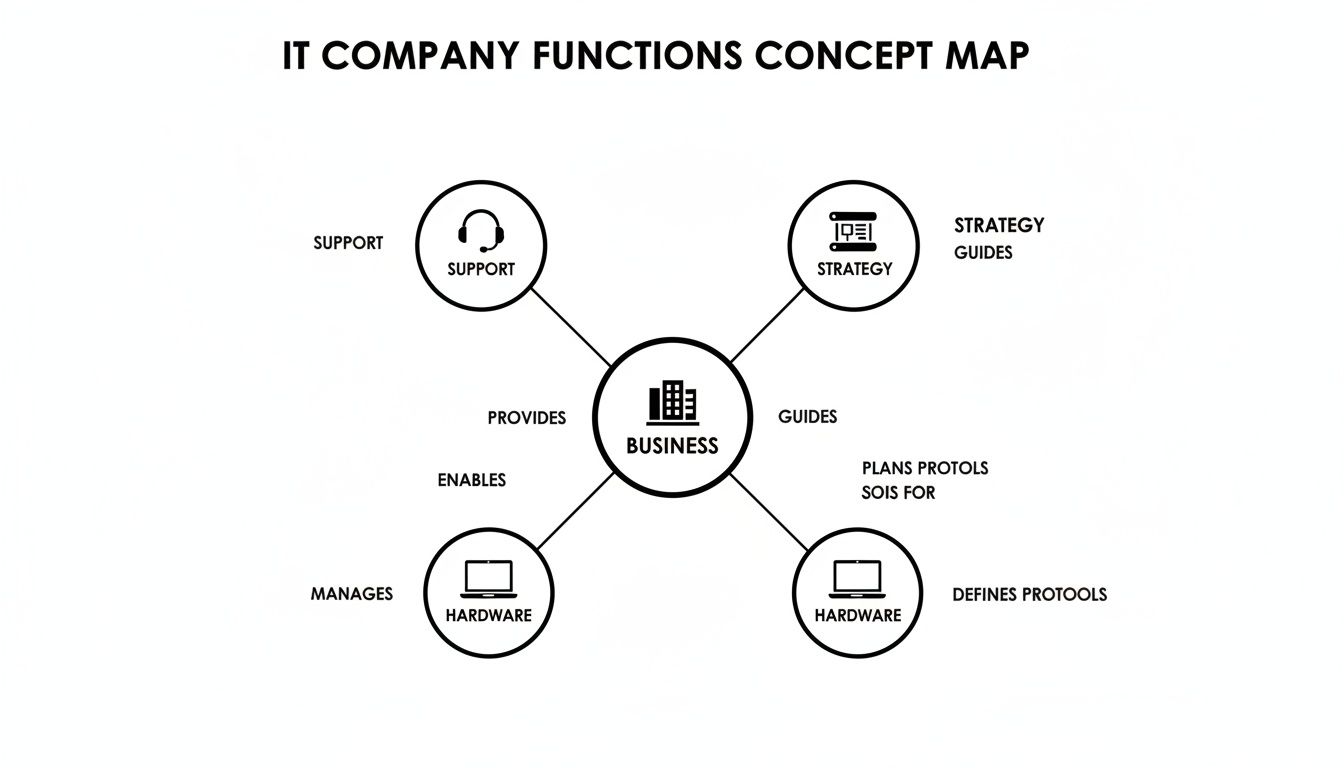
As you can see, a great IT partnership is a balanced ecosystem. It’s where day-to-day support, long-term planning, and the right equipment all work in harmony. Let's dig into the seven critical services that make this happen.
Key IT Services and Their Business Impact
To really understand what an IT partner brings to the table, it helps to see how each service directly translates into a tangible business benefit. This table breaks down the core offerings and shows you exactly what they do for your bottom line.
| Service | What It Is | Practical Business Benefit | Ideal For |
|---|---|---|---|
| Managed IT Services | Proactive, 24/7 monitoring and maintenance of your entire IT infrastructure to prevent problems. | Minimises downtime, improves security, and provides predictable monthly costs instead of surprise repair bills. | Businesses that can't afford any operational disruptions, like BPOs or manufacturers. |
| Hardware Leasing | Providing computers, servers, and other gear on a rental or rent-to-own basis. | Avoids huge upfront costs, preserves cash for growth, and ensures your team always has up-to-date equipment. | Startups, scaling companies, and businesses with large teams. |
| Network Design & Cabling | The physical and logical setup of your office network, from wiring to Wi-Fi and security configurations. | Ensures fast, stable, and secure connectivity for all employees, which is the backbone of modern productivity. | Any business setting up a new office or upgrading an existing one. |
| 24/7 Helpdesk Support | On-demand technical assistance for your employees, available any time of day or night. | Quickly resolves employee tech issues, preventing small glitches from turning into major productivity killers. | Companies with remote teams, multiple shifts, or customer-facing operations. |
| Security Hardening | A multi-layered approach to identify and close security gaps in your systems, networks, and applications. | Protects your critical business data and customer information from cyber threats like ransomware and data breaches. | Every business. Data security is no longer optional. |
| Data Centre & Hosting | Managing the physical or cloud-based servers and storage where your company's data and applications live. | Guarantees your applications are running on a reliable, secure, and high-performance foundation. | Businesses running critical software like ERPs, CRMs, or e-commerce platforms. |
| AI Implementation | Integrating artificial intelligence tools to automate tasks, analyse data, and improve processes. | Boosts efficiency, uncovers business insights, and enhances customer service without adding headcount. | Forward-thinking companies looking for a competitive edge. |
These services aren't just line items on a contract; they are strategic investments that directly impact your company's ability to operate and grow effectively.
Managed IT Services
Imagine having an entire IT department on call, but without the hefty payroll. That's managed IT. Instead of frantically calling for help after a server crashes, a managed service provider (MSP) watches your systems 24/7, spotting and fixing potential issues before they can ever disrupt your work. It's a fundamental shift from being reactive to being proactive.
A BPO in Cebu, for example, simply can't afford for its network to go down during peak hours. A managed IT service ensures that never happens by constantly monitoring performance, applying security updates overnight, and keeping everything optimised so agents stay connected. It’s the difference between fire-fighting and fire prevention, a concept we explore in our guide on preventive and corrective maintenance.
Hardware Leasing and Rent-to-Own
For any startup or growing business, dropping a huge amount of cash on equipment can stop you in your tracks. Hardware leasing and rent-to-own programs completely sidestep this problem. They turn a massive capital expense into a predictable, manageable monthly operational cost, freeing up your money for hiring, marketing, or other crucial growth activities.
Picture a new tech startup in Manila that needs to outfit 50 developers with powerful laptops. Instead of burning through millions of pesos at once, they can lease the exact machines they need. This gets them enterprise-grade tools from day one while keeping their budget flexible and lean.
Network Design and Cabling
A well-planned network is the central nervous system of your business. It's so much more than just plugging computers into the internet. It's about building a fast, reliable, and secure infrastructure that underpins everything you do, from structured cabling and Wi-Fi optimisation to firewall setup.
If you want to understand the basics, guides on essential internet and phone systems for small businesses offer great context on these foundational pieces. In a real-world scenario, this means strategically placing Wi-Fi access points across a multi-floor office and running clean, structured data cables to every desk to guarantee a stable connection for everyone.
24/7 Helpdesk Support
When tech problems pop up—and they always do—your team needs expert help right away. A 24/7 helpdesk provides that instant technical support, ensuring that a minor glitch doesn’t snowball into a major productivity roadblock. This is absolutely critical for any company that operates across time zones or outside of the typical 9-to-5.
A responsive helpdesk acts as an insurance policy for your productivity. Every minute an employee spends troubleshooting is a minute they aren't serving a customer or advancing a project. Instant support minimises that loss.
Take a hotel in Boracay. Its booking system has to work perfectly, day and night. If that system fails at 2 AM, a 24/7 helpdesk can log in remotely, diagnose the issue, and get it back online, preventing lost bookings and unhappy guests.
Security Hardening and Data Protection
With the constant threat of cyberattacks, strong security isn't just a nice-to-have; it's non-negotiable. Security hardening is the process of proactively finding and sealing up vulnerabilities in your network, servers, and software. It’s about building layers of defence to shield your sensitive business and customer data from hackers.
A practical example would be implementing multi-factor authentication (MFA) across all company accounts and running regular phishing simulation tests with employees. This involves everything from configuring firewalls and setting up strict access controls to encrypting your data. It’s a proactive defence that protects your digital assets before an attack can ever do damage.
Data Centre and Hosting Services
All of your company’s data needs a safe, reliable place to live. Data centre and hosting services provide just that—the physical or cloud infrastructure of servers, storage, and networking needed to run your most important applications. Whether you have a server in your own office or use a cloud solution, your IT partner takes care of the maintenance, security, and performance.
This need is fuelling incredible growth right here in the Philippines. In fact, the local ICT market is expected to hit $118.8 billion by 2033, thanks to massive demand from BPOs, e-commerce, and the big shift to the cloud.
AI Implementation
Artificial intelligence isn't just for mega-corporations anymore. A good IT partner can help you integrate practical AI solutions to automate tedious tasks, make sense of your data, and dramatically improve customer service. This could be as simple as deploying an AI-powered chatbot to answer common customer questions on your website or using machine learning to analyse sales data and predict which products will be popular next quarter. AI implementation is all about making your operations smarter and more efficient.
Why Different Industries Need a Custom IT Strategy
Trying to apply a single, generic IT solution to every business is like a doctor prescribing the same medicine to every patient. It just doesn't work. An experienced information technology company knows that the systems perfect for a massive call centre would completely overwhelm a small, agile startup. Every industry has its own unique mix of operational hurdles, regulatory requirements, and growth plans, and each one needs a technology strategy built just for them.
This customised approach is non-negotiable in the fast-moving Philippine business environment. A one-size-fits-all plan simply can't keep up with the specific pressures and opportunities different sectors face. Here, customisation isn't a luxury—it's a fundamental part of building a business that can last and compete.

Small And Medium Businesses Leveraging Enterprise Power
Small and medium businesses (SMBs) are the lifeblood of the Philippine economy, but they almost always run on tight budgets. Their biggest struggle is getting access to the same calibre of IT security and support that big corporations enjoy, but without the crippling cost of a full-time, in-house IT department. A smart partnership with an IT company closes that gap.
For an SMB, a custom strategy is all about boosting efficiency and locking down security. This usually means bringing in managed IT services to proactively stop problems before they cause downtime and putting strong security hardening measures in place to shield sensitive company and client data. It's about getting corporate-level protection on an SMB-friendly budget.
Practical Example: A local accounting firm with 25 employees can't justify the salary of a full-time IT manager. By partnering with an IT provider, they get 24/7 monitoring, automated security updates, and an on-demand helpdesk for one predictable monthly fee. This frees them up to focus on their clients, knowing their critical financial data is safe.
Business Process Outsourcing And Mission-Critical Uptime
The Business Process Outsourcing (BPO) industry is a giant in the Philippines, and it runs on a simple, brutal rule: uptime is everything. Every second of downtime means real, significant revenue loss. Their IT needs are all about unbreakable reliability and massive scale. The entire focus is on building a mission-critical infrastructure that can support thousands of agents working at the same time, without a single hiccup.
This requires incredibly detailed planning and flawless execution in a few key areas:
- Structured Cabling: For a 1,000-seat facility, this isn't just running wires. It's designing and installing a perfect nervous system of data cables to guarantee every single workstation has a fast, stable connection.
- 24/7 Helpdesk Support: When an agent’s computer fails at 3 AM, "we'll get to it in the morning" isn't an option. Immediate support is essential to meet strict service level agreements (SLAs).
- Data Centre Resilience: BPOs need constant, uninterrupted access to their data and applications. That demands robust data centre and hosting solutions with multiple layers of redundancy built-in.
The Philippine IT-BPM sector is a massive engine for the national economy, projected to soar past $40 billion in revenue. This incredible growth puts a spotlight on the need for specialised IT support, from leasing hardware for rapidly expanding teams to fine-tuning networks for today's hybrid work models.
Hospitality And The Guest Experience
In the world of hotels, resorts, and condominiums, technology isn't just a back-office tool; it directly shapes the guest experience. The main IT challenge is a balancing act: delivering seamless, high-speed Wi-Fi to hundreds (or thousands) of guests while simultaneously securing the network and protecting private guest data.
A custom IT strategy for hospitality has to master both performance and security. It starts with a detailed site survey to figure out the perfect placement for wireless access points, ensuring strong coverage everywhere from the lobby to the poolside bar. It also means building a segmented network that keeps guest traffic completely separate from the hotel's internal systems, like booking and payments.
Practical Example: A beachfront resort in Palawan needs to offer solid internet across its sprawling property. An IT partner would design a mesh Wi-Fi network that can handle hundreds of people streaming and browsing at once, while a managed firewall stands guard over the resort’s sensitive financial systems.
Startups And Scaling With Agility
Startups live and die by their ability to move fast and be smart with their cash. They need to scale their teams and operations in a flash without getting tied down by huge, upfront costs for technology. Their IT strategy has to be three things: flexible, scalable, and cost-effective.
This is where hardware leasing and rent-to-own models are a game-changer. Instead of draining precious capital to buy a fleet of laptops and servers, a startup can get its entire team equipped through a flexible leasing plan. This keeps cash free for what really matters: developing the product, marketing, and hiring top talent.
For a startup, technology must be an enabler, not an anchor. Flexible IT solutions provide the tools to compete with established players from day one, allowing them to pivot and grow without the dead weight of outdated, owned hardware.
This modern way of thinking about tech acquisition is a core idea we dive into in our article on technology in the Philippines. By finding the right information technology company to partner with, a startup can get the gear it needs right now and easily add more as soon as it lands its next round of funding.
How to Choose the Right Information Technology Partner
Let's be blunt: choosing an IT company is one of the biggest decisions you'll make for your business. This isn't just about hiring a vendor. You're entrusting a partner with the keys to your entire digital operation—your security, your team's productivity, and your ability to grow.
Get it wrong, and you're looking at crippling downtime, glaring security holes, and constant headaches. Get it right, and your IT partner becomes a genuine asset, a silent engine powering your success.
The trick is to look past the sales pitch and flashy websites. It’s not about finding the cheapest hourly rate, but about finding a team whose technical chops, operational discipline, and business sense truly click with yours. To do that, you need to ask the right questions—the sharp, specific ones that reveal what a company is really made of.
The Essential Questions to Ask Any Potential Provider
Before you even think about a contract, you need to put potential partners through their paces. Vague answers are a massive red flag. You want concrete proof they understand the real-world pressures of your business.
Start with these questions to quickly weed out the pretenders:
Do you get our world? Ask them directly: "Can you show me case studies or give me references for companies our size, like a 100-seat BPO, or in our industry, like hospitality?" A team that primarily serves small retail shops probably won't grasp the mission-critical uptime needed for a 24/7 call centre. This question cuts right to the heart of their relevant experience.
Who is actually doing the work? Follow up with: "What kind of certifications do your network engineers and security specialists hold?" This tells you about the skill level of the people who will have their hands on your systems, not just the sales team.
Are you a firefighter or a fire marshal? Try this: "Walk me through your process for proactive maintenance. How do you spot and fix problems before they take us down?" Their answer immediately separates a modern, forward-thinking managed services provider from an old-school "break-fix" shop that only shows up when things are already broken.
What happens when things go wrong? This one is non-negotiable: "What's your step-by-step plan if we have a security breach or lose data?" You're looking for a calm, detailed, and confident response. This is also a great time to ask about their own internal security. A good partner practices what they preach. A truly comprehensive security system supplier will have this down to a science.
Don't Just Skim the Service Level Agreement (SLA)
The SLA is the most important part of your contract, but it's often dense with jargon. You have to learn to read between the lines. Two metrics in particular are crucial for understanding what you're actually paying for.
Think of the Service Level Agreement as more than just a legal doc—it's a promise. It’s the provider’s written commitment to keeping your business running and tells you exactly what to expect when a crisis hits.
Response Time vs. Resolution Time: The Critical Difference
These two sound almost the same, but they mean worlds of difference for your business.
Response Time: This is simply how fast they promise to acknowledge your support ticket. A 15-minute response time sounds amazing, but it could just be an automated email saying, "We got your message." It doesn't mean anyone is actually working on your problem.
Resolution Time: This is the one that really counts. It's the commitment to actually fix the issue. A four-hour resolution time for a critical server outage is a much more powerful guarantee than a lightning-fast but ultimately empty response.
Making Sense of Pricing and Timelines
IT pricing models can be confusing, so it’s vital to find one that fits your budget and how you plan to grow. Most providers use one of two main structures.
| Pricing Model | How It Works | Best For | Potential Pitfalls |
|---|---|---|---|
| Per-User Plan | You pay a flat monthly fee for each employee. Simple. | Businesses with a stable headcount or predictable growth. | Watch out for hidden onboarding fees or extra project costs. |
| Tiered Plan | You choose a pre-set package (e.g., Basic, Pro, Enterprise). | Companies who want a specific set of services. | You might get hit with extra charges for anything that falls outside your chosen tier. |
Finally, always pin them down on deployment timelines. A good provider will give you a realistic schedule, not just what you want to hear. For example, cabling and setting up a small 15-person office might take a week. But rolling out the entire network, security, and workstation setup for a new 300-seat BPO site is a bigger project that could easily take four to six weeks. Clear timelines set proper expectations and help you plan everything else around them.
Seeing IT Solutions in Action: From Startup to Enterprise
Talking about IT services in the abstract is one thing, but seeing how they solve real problems is what makes it all click. The real magic of a great IT partner is their ability to scale—to match their expertise to the specific size, budget, and goals of any business, whether it's a two-person startup or a sprawling enterprise.
To show you what this looks like on the ground, let's walk through two very different scenarios. These examples highlight how a flexible IT provider like REDCHIP IT SOLUTIONS INC. can tackle vastly different challenges, proving that the solution must always fit the scale of the operation.
The Agile Startup Scenario
Picture a 30-person creative agency in Metro Manila, buzzing with energy after landing a new office space. They’re growing like crazy, but they’re also watching every single peso. Their immediate goals? Get the lights on, keep cash flow healthy, and make sure their team has rock-solid tech to hit demanding client deadlines.
A generic, one-size-fits-all IT package would be a disaster. What they need is a smart, nimble plan.
- Hardware Leasing: Instead of draining their bank account on new equipment, the agency leases 30 high-performance laptops perfect for graphic design and video work. This transforms a huge upfront capital cost into a predictable, manageable monthly expense.
- Complete Network Setup: The IT partner comes in and handles everything from the ground up. They design and run structured cabling to every desk, install and configure Wi-Fi for total office coverage, and set up a tough-as-nails firewall to guard sensitive client files.
- Managed IT Support: With a lean team, there's no room for a full-time IT guy. A managed services plan is the perfect answer, giving them access to a 24/7 helpdesk and proactive system monitoring. Tech problems get squashed instantly, before they can derail a project.
For a startup, the right IT solution is an accelerator, not a cost centre. It provides enterprise-grade tools and support on a startup-friendly budget, enabling the team to focus entirely on innovation and growth.
This approach gets the agency up and running in record time with a professional-grade tech foundation that’s ready to grow right alongside them.
The Large-Scale Enterprise Scenario
Now, let's zoom out to a completely different world: a 1,500-seat BPO company launching a massive new facility in Clark. The scale here is enormous, and the stakes couldn't be higher. We're talking complex logistics, zero tolerance for downtime, and the need for perfect execution on a tight timeline.
In this case, the information technology company becomes a high-level project manager and infrastructure architect.
- Massive Hardware Deployment: The BPO needs 1,500 PCs, a huge investment. A custom rent-to-own programme is created to equip the entire site without tying up millions in capital, neatly aligning costs with the revenue the new facility will generate. The IT partner handles sourcing, imaging, and deploying every single machine.
- Structured Data Cabling: Wiring a building for 1,500 workstations is a mammoth task. The IT team designs and installs a complex web of structured data cabling, guaranteeing that every agent has a stable, lightning-fast connection.
- Dedicated Data Centre Support: The BPO's entire operation lives and dies by its data. The IT partner provides dedicated support for their data centre, managing the servers, storage, and network backbone to ensure the mission-critical uptime their global clients demand.
This shift towards service-based models is a major trend. In fact, the Philippines IT services market is projected to reach $9.83 billion by 2033, largely because businesses are choosing reliable managed support over one-off purchases. If you're curious, you can learn more about how IT services in the Philippines will spur development.
These two stories—from a 30-person agency to a 1,500-seat call centre—perfectly illustrate how a skilled IT partner adapts its playbook to solve wildly different business puzzles.
So, How Does This All Tie Back to REDCHIP?
We’ve covered a lot of ground in this guide, from the nitty-gritty of network cabling to the big-picture strategy of deploying technology for hundreds of employees. The running theme through it all is that picking an IT company isn’t just about buying computers; it’s a critical business decision that can make or break your growth.
This is exactly where we, REDCHIP IT SOLUTIONS INC., come in. We don't see ourselves as just another vendor on your list. We're here to be your partner, the team in your corner dedicated to making technology work for you, not against you.
Our services are built to solve the real-world problems Philippine businesses run into every day. Need to equip a new team but don't want to burn through your cash reserves? Our flexible hardware leasing and rent-to-own plans get the right tools in your team's hands without the massive upfront cost. This is a game-changer for startups that need to stay nimble and for BPOs managing huge rollouts.
Your Guide in the Tech Maze
What really makes us different is how we think. We’re not just here to sell you a box. We’re here to give you practical, business-first advice. We know the laptop an admin needs is completely different from the high-performance workstation a graphic designer or a BPO agent requires.
Our whole approach is consultative. We take the time to understand what you're trying to achieve so your investment actually pays off. And our relationship doesn’t end once the hardware is delivered; our after-sales support is incredibly responsive because we know that downtime is lost money.
Think of REDCHIP as your outsourced tech leadership. We help you standardise your systems securely, operate with confidence, and scale up without the usual headaches. You focus on running your business; we'll handle the tech.
We act as the bridge between your business goals and the technology you need to get there. For a hotel, that might mean designing a rock-solid Wi-Fi network that guests can depend on. For a growing BPO, it could be managing the entire logistical puzzle of deploying 500 new workstations for a new office.
Ready to Build a Smarter Operation?
Whether you’re just trying to get your office IT in order, lock down your network security, or you’re planning a major expansion, our team has been there and done that. We handle everything from the foundational structured cabling and proactive IT support to helping you figure out where AI can give you a real competitive edge.
Let's have a real conversation about what you want to build. Schedule a no-obligation consultation with REDCHIP today and see what it feels like to have an IT partner who’s truly invested in your success.
Frequently Asked Questions About IT Services
Stepping into a partnership with an IT company can feel like exploring new territory. It's only natural to have questions. We’ve answered some of the most common ones we hear from businesses just like yours.
Is Hardware Leasing Really Better Than Buying?
For most businesses, especially those in a growth phase, leasing is a much smarter financial play. Think of it this way: instead of a massive, one-time cash outlay for new equipment, you get a predictable monthly operational expense. This frees up your capital for what really matters—hiring talent, marketing, and growing the business.
A startup, for example, can get its entire team kitted out with brand-new laptops without emptying its coffers. Plus, leasing takes the headache out of tech refreshes. You’re no longer stuck with slow, ageing hardware; at the end of your term, you can simply upgrade to the latest and greatest. It keeps your team productive and your technology current.
What Should I Expect During a Network Deployment?
A professional network deployment isn't just about plugging in a few cables. It’s a carefully planned process designed to get you up and running without a hitch. It always starts with a deep dive—a consultation and a physical site survey where the IT team gets to know your office space and, more importantly, your business requirements.
After that initial discovery, the process typically unfolds like this:
- Design: A customised network blueprint is drawn up. For example, mapping out Wi-Fi access point locations for a multi-floor office to eliminate dead zones.
- Installation: All the structured cabling and physical hardware (like routers and switches) are put in place.
- Configuration: The team sets up your entire network, including Wi-Fi access and crucial security firewalls.
- Go-Live Support: On the day you switch over, technicians are on-site to tackle any immediate teething problems and ensure a smooth transition for your team.
I'm a Small Business. Do I Really Need Managed IT Services?
Yes, without a doubt. Thinking that managed IT is only for big corporations is a common but costly mistake. A server crash, a data breach, or even just persistent network issues can bring a small business to a screeching halt, wrecking productivity and damaging your reputation.
A managed service isn't just about fixing things when they break; it's about preventing them from breaking in the first place. It's proactive care that stops problems before they start, which is always cheaper and far less chaotic than reactive repairs.
For instance, an IT provider might detect that your backup system has been failing silently for a week and fix it, preventing catastrophic data loss you wouldn't have known about until it was too late. This kind of proactive support also scales right alongside you. It ensures the tech foundation you build today is strong enough to support your growth tomorrow.
Ready to build a smarter, more resilient operation? REDCHIP IT SOLUTIONS INC. delivers the expert guidance and end-to-end services you need to succeed. Schedule a consultation today.


