For businesses in the Philippines, the daily grind often involves battling a trio of technological hurdles: unreliable internet, a persistent tech talent gap, and the ever-present threat of cyberattacks. These aren't just minor frustrations; they're serious operational risks that quietly chip away at productivity and profit, creating hidden costs that can bring growth to a screeching halt.
The Hidden Costs of Technology Gaps in the Philippines
Many Filipino businesses find themselves in a tough spot. On the surface, everyone is "digital," but the reality is a daily struggle against technical issues. Just having an internet connection doesn't mean it's stable enough to run a modern business—far from it.
Think of it like trying to drive a sports car on a road riddled with potholes. You have the engine for speed and performance, but the environment itself holds you back, creating constant risks. Every bump in the road—a dropped video call with a client, a system crash during a crucial payment, or a security alert—slows you down and causes real damage.
The Real-World Business Impact
These tech gaps are more than just annoying. They translate directly into tangible losses. They create a tough operational environment where just keeping things running is a challenge, let alone trying to scale or expand.
For owners and managers, this means wrestling with problems that hit the bottom line hard.
- Lost Productivity: Imagine your sales team is supposed to be making calls, but for two hours every morning, they're troubleshooting a slow CRM system that won't load customer data. That's two hours of lost sales opportunities, every single day.
- Damaged Reputation: When your customer-facing app or website fails during a 12.12 sale, it doesn't just frustrate users; it breaks their trust. They'll simply buy from your competitor, and many won't come back.
- Increased Expenses: An unexpected server failure or a successful ransomware attack can lead to eye-watering bills for repairs, recovery, and downtime. For example, a small logistics company might face a P100,000 ransom demand, plus the cost of days of inactivity.
These recurring issues drain time, money, and focus. Instead of innovating and out-thinking the competition, companies get stuck putting out fires, which severely limits their ability to grow.
Understanding the Core Challenges
When you dig deeper, most of these problems stem from a few core issues. Unreliable internet and an unstable power grid create a shaky foundation for any digital operation. You can have the best equipment in the world, but it's useless without consistent connectivity and power.
On top of that, a widespread skills gap means many companies simply don't have the in-house expertise to manage and secure their IT infrastructure properly. This vulnerability is magnified by the rise in sophisticated cybersecurity threats that now target businesses of all sizes, not just the big players. For a broader look, you can explore more about the state of technology in the Philippines and see how these factors intersect.
In this guide, we'll break down each of these challenges and offer practical, service-based solutions to help your business finally build a resilient technology foundation.
Building on Shaky Ground: Unreliable Connectivity and Power
For any business today, your digital infrastructure is the ground you build everything on. But here in the Philippines, many companies are trying to build on shaky ground, wrestling daily with unreliable internet and unstable power. It's like trying to put up a skyscraper on a weak foundation—no matter how impressive the structure, you're always worried it might crumble.
These core technological issues in the Philippines are far more than minor annoyances. They're constant, nagging threats that grind operations to a halt, kill productivity, and hit your bottom line hard. Let's dig into the two wobbly pillars holding up this unsteady base.
The Connectivity Crisis
Everyone knows the feeling. Unstable internet is probably the most common and infuriating tech problem we face. It’s not just about slow downloads; it’s the high latency, the connection dropping out of nowhere, and the wildly unpredictable performance that paralyses how a business runs. The consequences of this ripple through the entire company.
Take a BPO centre in Cebu, for example. Their entire business model depends on clear, stable Voice-over-IP (VoIP) calls to clients overseas. When that connection drops mid-sentence, it’s not just a frustrated customer on the line. It's a direct hit to the BPO's reputation and can trigger real financial penalties for not meeting their service-level agreements.
And this isn't just a BPO problem; it affects everyone.
- Hospitality: A boutique hotel in Palawan has its online booking system crash during the peak season. The result? Double bookings, angry tourists, and lost income.
- Retail: A popular coffee shop chain can't process payments because its cloud-based point-of-sale (POS) system is offline. You can just imagine the long queues and frustrated customers.
- Logistics: A courier service loses real-time tracking of its fleet due to spotty mobile data, causing dispatch nightmares and late deliveries.
These aren’t hypotheticals; they are daily realities that show how a bad connection directly sabotages your efficiency and your relationship with customers. The problem isn't always the internet provider, either. Often, the culprit is hiding inside your own walls—in poorly planned office cabling or weak Wi-Fi coverage that creates frustrating dead zones.
Power Instability and Its Hidden Dangers
The second wobbly pillar is our notoriously unstable power grid. Brownouts and voltage spikes are just part of life here, but for a business, they are ticking time bombs. Every flicker of the lights or sudden outage is a direct assault on your most expensive hardware.
A single, powerful voltage spike can be catastrophic. It can fry the sensitive components in servers, workstations, and networking equipment, leading to immediate hardware failure and potentially irreversible data loss.
Picture a small accounting firm in Metro Manila getting hit by a sudden power outage. They have no protection in place. Their main server, holding all their clients' financial records, crashes abruptly. When the power comes back on, the server's hard drives are corrupted. Years of critical data, not properly backed up, are just gone.
This happens all the time. A small retailer could lose its entire sales history from a fried POS terminal. A design agency could lose a full day's work when a power surge corrupts a massive project file. The cost to replace the hardware is bad enough, but the cost of lost data and the downtime can be crippling.
To help illustrate just how interconnected these issues are, let's look at a summary of their direct impact.
Core Infrastructure Challenges and Business Impact
This table breaks down the primary infrastructure issues plaguing Philippine businesses and their direct operational consequences.
| Technological Issue | Primary Cause | Direct Business Impact | Example Scenario |
|---|---|---|---|
| Unstable Internet | ISP limitations, poor internal network design, geographical "dead zones" | Interrupted communications, failed transactions, poor customer experience, productivity loss | A remote team member can't join a critical video conference, delaying a project deadline. |
| Power Fluctuations | Unreliable national grid, local transformer issues, building-level electrical problems | Hardware damage, data corruption, complete operational shutdowns, security system failures | A power surge destroys a company's primary server, halting all business operations for hours or days. |
| Poor Wi-Fi Coverage | Incorrect access point placement, physical obstructions (walls, metal), signal interference | "Dead zones" in the office, slow performance for mobile staff, dropped connections for warehouse scanners | Employees in a back office constantly lose connection, forcing them to relocate to get work done. |
| Outdated Cabling | Use of old (Cat5) standards, improper installation, physical wear and tear | Network bottlenecks, intermittent connection drops, inability to support high-speed devices | A company's new fibre internet plan feels slow because the old office wiring can't handle the speed. |
As you can see, these foundational problems create a domino effect, turning small glitches into major business disruptions.
These weaknesses—bad connectivity and shaky power—force businesses into a constant state of reaction and stress. If you want to build a resilient operation, you have to start by fixing this foundation. That means tackling the physical layer first with solutions like professional structured cabling for your network, strategic Wi‑Fi optimisation to kill dead zones, and the non-negotiable implementation of uninterruptible power supplies (UPS) to shield your gear from electrical chaos. Without these fundamentals in place, any money you spend on fancier tech is always at risk.
The Great Divide: Access vs. Real Digital Adoption
There’s a world of difference between simply having technology and actually using it to make your business grow. Far too many companies here in the Philippines are caught on the wrong side of this divide. They've got the computers, they've got the internet connection, but the productivity boosts and competitive edge they were promised just aren't materialising.
Think of it like this: you've bought a top-of-the-line, professional-grade toolkit. It's filled with every power tool imaginable. But if you don't know how to build anything, those tools just sit in the box, their potential completely wasted. This is the heart of the technological issues Philippines businesses are wrestling with—the chasm between ownership and meaningful adoption.
This isn't just a hunch; the numbers tell a pretty stark story. While most businesses have computers, the use of more advanced, strategic tools is lagging far behind. This gap between having the basic gear and putting it to work is what holds so many businesses back.
The Problem of Low Strategic Awareness
On one side of the divide, you have a straightforward lack of awareness. Many business owners still view technology as a cost centre, like office furniture or electricity—just another bill to pay. They haven't made the connection that tools like e-commerce platforms, customer relationship management (CRM) software, or even Artificial Intelligence (AI) are strategic assets that can sharpen operations, slash costs, and open up entirely new ways to make money.
Take a local manufacturing firm, for instance. They might be tracking all their inventory by hand on spreadsheets. It’s a slow process, riddled with human error, and gives them absolutely no real-time view of what’s on the shelves. An inventory management system could automate the whole thing, but if the leadership team doesn't see the clear business case for it, that investment will never happen.
The real challenge is shifting the mindset from "Do we have computers?" to "What are our computers doing for us?" Without a clear strategy, technology just becomes an expensive paperweight.
This absence of a strategic plan means golden opportunities are missed every single day, leaving companies stuck with inefficient, old-school ways of doing things.
The Critical Shortage of IT Talent
The other, and arguably bigger, piece of the puzzle is the severe shortage of skilled IT professionals. Let's say a business owner does see the light and decides to invest in new software. Great. Now, who's going to set it up? Who's going to manage it, keep it secure, and get the staff trained on how to use it properly?
This is exactly where so many well-intentioned projects fall flat. A logistics company might spend a small fortune on a powerful route optimisation software. The licenses are bought, but the software is complex and needs to be carefully integrated with their existing systems. With no dedicated IT person on the payroll, the project grinds to a halt. That expensive software ends up gathering digital dust on a server while the drivers keep using the same old, inefficient routes.
This kind of story is painfully common for small and medium-sized enterprises (SMEs). They often can't justify the cost of hiring a full-time, experienced IT manager. This leaves them trapped—unable to implement the very tools that could unlock their growth.
The data backs this up perfectly. While an impressive 90.8% of Philippine establishments own computers and 81% have internet access, the adoption of game-changing tech like AI is stuck at a shockingly low 14.9%. This massive difference highlights the core problem: a lack of strategic awareness and a major skills gap are preventing businesses from getting real value from the tools they already own. You can learn more about these barriers from the Philippine Institute for Development Studies.
This digital adoption gap is a massive hurdle. It stops businesses from becoming more efficient, reaching new customers, and defending themselves from modern threats. Just having the hardware is clearly not enough. The only way forward is to bridge this gap by making specialised expertise accessible and affordable. For many, that means turning to external support is no longer a luxury—it’s a necessity for survival.
Solving Your Top Tech Challenges with Practical Strategies
Knowing the common tech issues that businesses in the Philippines face is one thing, but fixing them is another. Let's move past the problems and get straight to the practical, real-world solutions that will strengthen your operations, protect your finances, and pave the way for real growth.
Every challenge, whether it’s a spotty internet connection or the looming risk of a cyberattack, has a direct countermeasure. These aren't just fixes for big corporations; they're concrete steps any business can take to build a much stronger technological foundation.
Fortifying Your Digital Foundation
A weak internet connection isn't something you just have to accept. While you can’t control your provider's infrastructure, you absolutely can perfect the network inside your own office. The fix often begins with professional structured cabling. This simply means swapping out that old, tangled mess of wires for a planned, organised system that guarantees data flows smoothly to every single computer, killing those internal slowdowns for good.
Think of it like the plumbing in your building. You might have great water pressure coming from the main line, but if your pipes are ancient and clogged, all you'll get is a frustrating trickle. Proper cabling is what lets you use the full internet speed you’re paying for. Combine that with managed Wi-Fi services that strategically place access points to get rid of dead zones, and you've built a rock-solid network backbone for your entire team.
For companies wrestling with internal tech hurdles, understanding the various IT management challenges is key to building a complete and effective strategy.
The gap between simply having computers and actually using them effectively is a major hurdle. This diagram shows how getting from basic access to meaningful application isn't a straight line—it highlights the critical skills gap right in the middle.
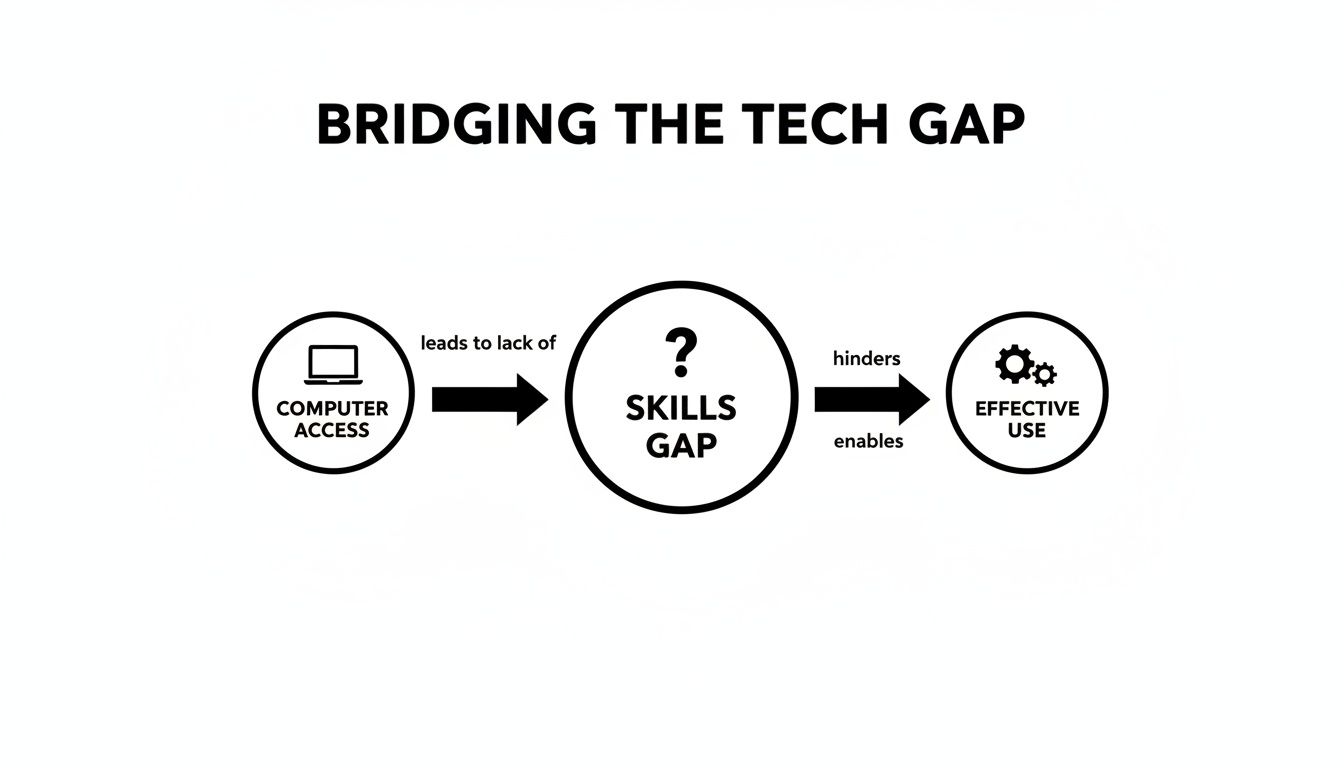
As you can see, the journey from owning a computer to mastering it requires a focused effort to close that skills gap.
Overcoming High Hardware Costs
For startups and growing companies, one of the biggest walls you can hit is the huge upfront cost of new hardware. Outfitting a new team of 50 people with quality laptops can drain cash that’s desperately needed for marketing or product development. This is where rethinking how you acquire your equipment can be a game-changer.
Instead of a massive capital expense (CAPEX), look into computer leasing or rent-to-own programs. This approach cleverly turns a huge one-time cost into a predictable monthly operational expense (OPEX).
- Financial Flexibility: You get every piece of equipment you need right away without emptying your bank account, keeping your business agile.
- Always-Current Tech: Leasing cycles mean your team is always working on modern, reliable machines, which is a huge boost for both productivity and morale.
- Reduced Maintenance Burden: Most agreements bundle in maintenance and support, so you're not left scrambling (and paying) when something breaks.
This strategy allows a new company to equip a full team of 50 professionals with top-tier hardware from day one, all without putting its financial health or growth plans at risk.
Bridging the IT Talent Gap
So, what do you do when you need enterprise-grade IT know-how but can't afford an enterprise-level salary? For most small and medium-sized businesses, the answer is simple: you outsource. A 24/7 managed IT helpdesk becomes your dedicated, on-demand team of experts.
Imagine your e-commerce site goes down at 2 AM. Without an IT service, you might not even know until you wake up, having lost hours of sales. With a managed helpdesk, their monitoring systems would detect the outage instantly and a technician would be working to fix it while you sleep. This immediately gives you access to a deep pool of specialists for a fraction of what it would cost to hire even one full-time IT person.
Implementing Non-Negotiable Security
Finally, with cyber threats on the rise, strong security isn't just a "nice-to-have"—it's a must. The good news is that powerful, foundational protection doesn't have to be impossibly complex. It all starts with two core elements: a professionally configured firewall and endpoint security hardening.
A firewall is like the security guard for your entire network. It inspects all the data coming in and out, immediately blocking anything that looks suspicious. Endpoint hardening then secures every single device—laptops, desktops, and servers—by locking them down, closing unused access points, and fine-tuning their security settings.
Take a small medical clinic, for example. They handle incredibly sensitive patient records, and a ransomware attack could be catastrophic. By setting up a proper firewall and hardening their computer systems, they create a defensive shield that can stop an attack before it ever starts. This protects their patients' privacy and ensures they can continue to operate without interruption. If your business needs to reinforce its defences, partnering with a specialised cyber security firm can provide the expert setup and monitoring you need.
How to Build a Resilient and Future-Ready Tech Strategy
Getting ahead of the common technological issues in the Philippines isn't about slapping on a bandage every time something breaks. The real goal is to build a forward-thinking strategy that turns your technology from a constant headache into your sharpest competitive edge.
A resilient tech foundation is the best asset you can have for long-term, sustainable growth. This proactive approach rests on four pillars, each one designed to tackle a major operational risk and turn it into a source of strength for your business.
The Four Pillars of a Proactive Tech Strategy
Building an operation that's ready for whatever comes next means getting out of the reactive repair cycle. It's about establishing a solid, dependable framework from the ground up.
-
Start with a Stable Infrastructure: This is the absolute, non-negotiable starting point. It all begins with professional network design and reliable power protection, creating a stable environment where your digital tools can actually do their job properly.
-
Bring in Strategic Expertise: You have to bridge the internal skills gap, and the smartest way is often by partnering with outside experts. This gives you immediate access to enterprise-level knowledge for security, maintenance, and support without the massive overhead of a large in-house IT team.
-
Implement Airtight Security Protocols: Professionally configured firewalls and endpoint security are not optional. Think of these measures as your frontline defence, actively protecting your valuable data and daily operations from a constant barrage of threats.
-
Rethink Hardware Acquisition: Adopting flexible models like computer leasing or rent-to-own programs is a game-changer for preserving capital. It ensures your team always has modern, efficient equipment without the crippling upfront costs that can stall growth.
A managed IT service provider isn't just another vendor; they're a strategic partner in building this foundation. They design and execute a long-term plan that aligns your technology directly with your business goals, making sure every peso you invest delivers real, tangible value.
Turning Challenges into Opportunities
This kind of strategic approach does a lot more than just solve today's problems—it sets your company up for the future. For any organisation navigating the complex environment here in the Philippines, adopting this mindset means seriously considering tools for future-proofing workplace communication and other forward-looking solutions.
Once you have a solid tech foundation, you can finally shift your focus from putting out fires to actively seeking out new opportunities. For example, with a stable network and secure systems in place, a retail business can confidently launch a new e-commerce platform, knowing it won't crash during a flash sale. This is how you transform a defensive necessity into an offensive weapon for growth.
A trusted technology partner can empower your business to turn what are often seen as national challenges into your own unique advantages. They take on the complexities of your IT—from day-to-day support to a long-term plan for preventive and corrective maintenance—freeing you up to do what you do best: innovate. This is how you scale with confidence, compete effectively, and truly thrive.
Got Questions About Your Office Tech? We've Got Answers.
Running a business in the Philippines means you've probably asked yourself some of these questions. Here are some straightforward answers to help you cut through the noise and make the right call for your company's technology.
"My Business is Small. Do I Really Need to Hire an IT Team?"
Yes, and here's why. Many small business owners think they can fly under the radar, but that's exactly what makes them a prime target for cyberattacks. Attackers know you likely don't have robust security, making you low-hanging fruit. On top of that, even a few hours of downtime from a busted laptop or a spotty internet connection can hit a small team's bottom line hard.
Think of professional IT support as having an enterprise-level tech department on speed dial, but for a tiny fraction of the cost. It's not just about fixing things when they break; it's a smart investment that keeps your business secure, stable, and ready to grow.
"Should We Buy All Our Computers or Just Lease Them?"
For most businesses here, especially those just starting out or scaling up, leasing is the way to go. It completely changes the financial game. Instead of a massive upfront cash outlay for equipment (a capital expense), you get a predictable, manageable monthly bill (an operational expense). This frees up your cash for what really matters—like marketing your product or hiring your next superstar employee.
Plus, leasing takes the long-term headaches of ownership off your plate. You no longer have to worry about maintenance, repairs, or what to do with a pile of outdated machines in three years. Your team always has reliable, up-to-date tools to do their best work.
"How Do I Protect My Business from Both Power Cuts and Hackers?"
You need a solid plan for both, as they attack your business from different angles. For the all-too-common power interruptions, an Uninterruptible Power Supply (UPS) is non-negotiable. It's your first line of defence, giving your critical hardware—like servers and key workstations—a battery backup to prevent sudden shutdowns and data loss.
On the digital front, you need a multi-layered defence. This starts with a professionally managed firewall to guard your network's perimeter, combined with strong endpoint security on every single company device. Just as important is training your staff to spot phishing emails. A good IT partner can manage both your physical (UPS) and digital (security) safeguards, giving you a complete shield.
"We Pay for Fast Internet, So Why is Our Office Wi-Fi Still So Slow?"
The speed you get from your internet provider is just the starting line. The real race is won or lost inside your office walls. More often than not, slow Wi-Fi is a symptom of a poorly designed network. Things like concrete walls, interference from other electronics, or simply having the wrong kind of hardware can create massive bottlenecks.
A professional Wi-Fi optimisation isn't just about plugging in a new router. It involves a proper site survey to map out signal dead zones and strategically placing access points to ensure strong, even coverage. It’s about designing a network that can handle how your team actually works, so you get every bit of the speed you're paying for.
Ready to stop fighting with your technology and start using it as a secret weapon? REDCHIP IT SOLUTIONS INC. delivers complete managed IT services—from hardware leasing and network design to 24/7 helpdesk support—built for the unique challenges Philippine businesses face. Build your resilient tech strategy with us today.


