Think of IT consulting as the architectural plan for your company's technology. It’s a shift away from just fixing things when they break. Instead, it’s about creating a smart, forward-thinking strategy that makes sure your technology actively helps your business grow, stay secure, and outpace the competition. A practical example is a retail business that wants to expand. Instead of just buying new cash registers, an IT consultant would design a unified system that connects inventory, sales, and customer data across all stores, turning a simple expansion into a data-driven growth strategy.
What Are Consulting IT Services Really

Let's use an analogy. You wouldn't build a high-rise office tower without a detailed architectural blueprint, would you? You could have the finest steel and the most skilled crew, but without that master plan, you’d end up with a structure that’s unstable and can't handle your company's needs down the road. IT consulting provides that exact same blueprint for your technology infrastructure.
This isn't just about outsourced IT support; it's a strategic partnership. The entire point is to get your tech and your business goals perfectly in sync. We move beyond simply reacting to problems and start building a technology foundation that becomes a real engine for your success. To see how this works in practice, it's worth looking at the specialised work done by IT Service Providers and MSPs.
Beyond the Break-Fix Mentality
For years, the standard IT model was "break-fix." Something breaks—a server goes down, a laptop dies, the internet cuts out—and you call for help. It’s a purely reactive cycle that almost always results in frustrating downtime and unexpected, often hefty, repair bills. For instance, a small accounting firm's server fails during tax season. Under a break-fix model, they lose an entire day of billable hours waiting for a technician to arrive and diagnose the problem, costing them thousands.
IT consulting turns that old model completely on its head. Instead of waiting for a fire, a consultant works alongside you to spot the risks and build solutions before they can disrupt your business.
A proactive IT strategy is not an expense; it's an investment in operational stability and future growth. It shifts the focus from "what is broken?" to "what is possible?"
For example, a consultant might analyse your network traffic and discover a weak spot in your security before a hacker ever finds it. Or, they might suggest a hardware leasing plan to keep your team working on fast, reliable equipment, preventing the slow-down that comes with ageing tech.
Addressing Core Business Challenges
Good consulting it services get to the heart of what’s holding your business back. Especially for companies in the Philippines that have their own unique operational hurdles, the goal is to create a clear, actionable technology roadmap that delivers tangible results.
Here are a few common challenges we help solve:
- Scaling Operations: A BPO needs to onboard 100 new agents in a month. An IT consultant maps out the entire process—from leasing workstations and deploying software to ensuring the network can handle the new load without a hiccup.
- Cybersecurity Threats: A hotel chain is concerned about protecting sensitive guest data. A consultant would step in to deploy robust network security, set up modern firewalls, and train staff on how to spot and avoid phishing scams.
- Unpredictable Costs: A startup is tired of surprise IT bills that wreck their budget. The consultant can introduce a managed services plan with a predictable, fixed monthly fee, turning chaotic expenses into a manageable operational cost.
What an IT Consulting Partnership Really Does for Your Business
Working with an IT consultant is about more than just having someone on call to fix a broken computer. It's about fundamentally changing how you view technology—turning it from a necessary, often frustrating, expense into a genuine tool that helps you grow. This shift brings real, measurable benefits that hit your bottom line, streamline your operations, and prepare you for the future.
The magic happens when expert advice turns into smarter financial and operational decisions. A good partner helps you cut through the noise of the tech world, making sure every peso you spend on IT is directly tied to a business goal.
Stop Buying, Start Operating: How to Manage Your Tech Budget
One of the first and most powerful changes is how you handle your technology budget. In the old days, growing your business meant dropping a huge amount of cash upfront for servers, laptops, and networking gear. That’s a massive capital expense (CAPEX) that ties up money you could be using for marketing, hiring new people, or developing new products.
An IT consulting partner flips this model on its head.
By using strategies like hardware leasing or rent-to-own programs, you can swap a huge, one-time capital expense for a predictable, manageable monthly operational expense (OPEX). This keeps your cash flow healthy and gives you the flexibility to invest in what really matters—growing your business.
Here’s how it works in the real world: A BPO in Manila lands a new client and needs to bring on 100 new agents, fast. Instead of buying 100 new workstations and servers outright, their IT consultant sets up a leasing deal. The BPO gets all the hardware deployed quickly for a simple monthly fee, saving its capital for recruiting and training the new team.
Keeping Your Team Online and Productive
Downtime is a quiet but deadly drain on your revenue. Every hour your team can't access their tools or data is an hour of lost work and, very often, lost sales. A huge part of what an IT consultant does is provide 24/7 managed support that’s designed to stop problems before they even start.
This proactive approach means your network, servers, and computers are constantly monitored to keep them running smoothly. It’s the difference between panicking when a system crashes and having an expert team that spots and fixes a potential issue before you even knew it was there. For example, monitoring software might detect that a server's hard drive is showing early signs of failure. The IT partner can then schedule a replacement overnight, resulting in zero downtime for the business.
The results of this constant watchfulness are immediate and clear:
- More Uptime, More Work Done: Your systems are always available when your team needs them, which means productivity stays high.
- Less Frustration for Your Staff: Employees can actually focus on their jobs instead of fighting with slow computers or network glitches. For many companies, solving these common technological issues in the Philippines is a massive win for efficiency.
- Quicker Fixes: When something does go wrong, you have experts ready to jump in and solve it immediately, keeping business interruptions to a minimum.
Growing Your Business Without the Headaches
For businesses with multiple locations, like hotel chains or retail stores, keeping everything consistent is a massive operational challenge. This is where a consulting partner truly shines. They design a standardised IT blueprint—a master plan—that can be easily and efficiently rolled out across every single one of your locations.
This is especially critical in the Philippines today. The IT services market here is expected to hit USD 5.30 billion in 2024 and is on track to reach USD 9.83 billion by 2033. This boom is fueled by businesses needing help with cloud technology, security, and digital projects—all areas where you need an expert guide.
Let’s look at a practical example: A hotel group wants to give guests a seamless, secure, high-speed Wi-Fi experience at all their properties across Luzon and Visayas. An IT consultant designs one robust network plan, chooses the best hardware for the job, and manages the installation at each hotel. The outcome? A consistent guest experience, easy central management for the head office, and much stronger network security for the entire brand.
What Does an IT Consulting Service Actually Do?
The world of IT consulting services can seem like a confusing menu of technical jargon. But in reality, a good IT consultant’s toolkit is filled with practical, powerful solutions designed to solve real-world business problems. These services aren't just standalone fixes; they work together to build a strong, secure, and efficient technology foundation for your company.
Think of it like building a high-performance race car. You need a powerful engine (managed support), a tough roll cage (security), a flawless fuel system (cabling), and a smart way to pay for it all (leasing). Each part is crucial, and they all need to work in perfect harmony to get you across the finish line.
This diagram shows how major IT services like support, security, and cabling are all connected parts of a complete strategy.
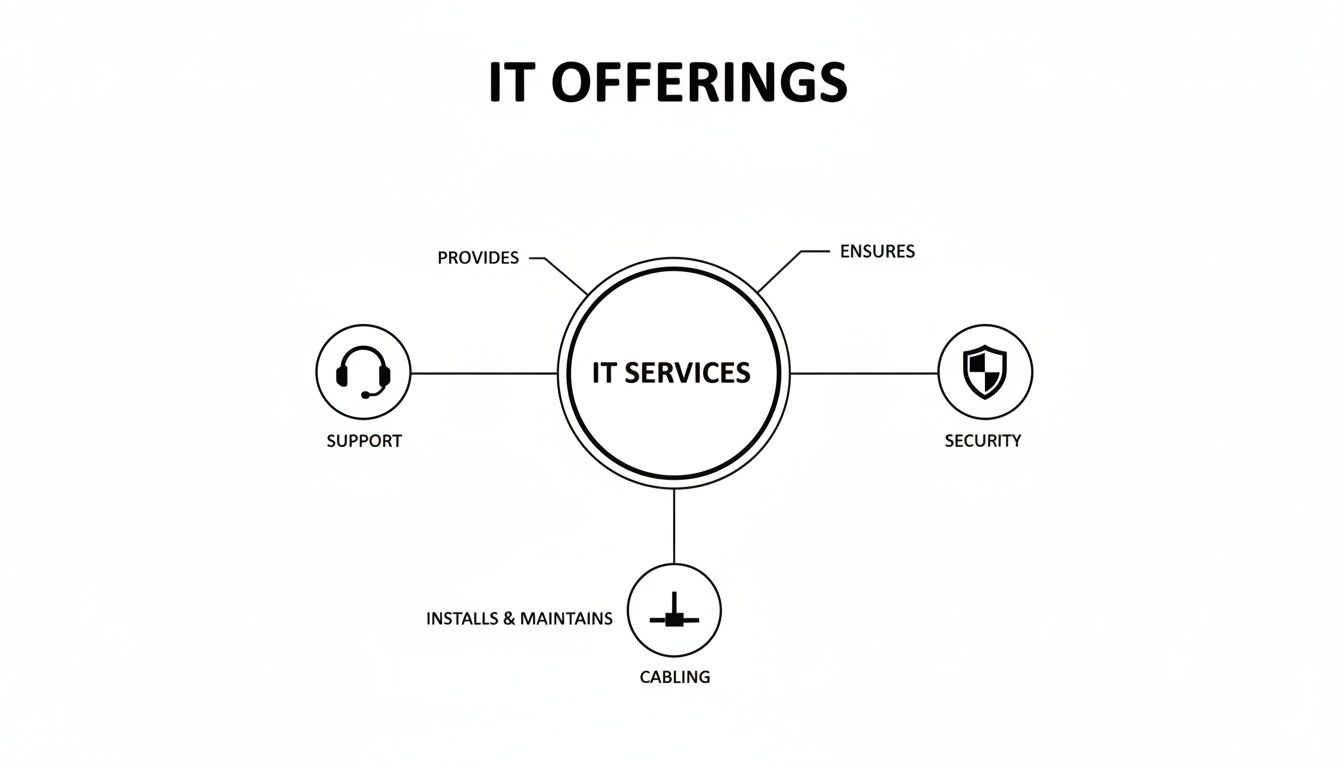
The takeaway here is that you can't just focus on one area. A strong IT strategy weaves all these elements together to help you hit your business goals. For example, fast structured cabling is useless if your network isn't secure, and even the best hardware is a liability without proactive support.
To help you understand the different approaches, let's compare the most common ways businesses handle their IT.
Comparing IT Service Models for Your Business
| Feature | In-House IT Team | Break-Fix Support | Managed IT Consulting (e.g., REDCHIP) |
|---|---|---|---|
| Cost Structure | High fixed costs (salaries, benefits, training) | Unpredictable, hourly rates when things break | Predictable, fixed monthly fee |
| Approach to Problems | Mix of proactive and reactive | 100% Reactive (waits for failure) | 90% Proactive (prevents issues) |
| Expertise | Limited to the skills of your hired staff | Varies; may not know your specific setup | Access to a deep bench of specialised experts |
| Downtime | Can be significant if the team is overwhelmed | High risk; you call after the system is down | Minimal; issues are often fixed before you notice |
| Budgeting | Difficult to predict project or emergency costs | Impossible to budget for | Simple, predictable operational expense (OPEX) |
As you can see, a managed consulting model offers a fundamentally different, more strategic approach compared to the old ways of doing things.
Managed IT Support: Your Proactive Defence
Managed IT support is the polar opposite of the old "break-fix" model. Instead of calling for help after a server has already crashed, this service involves constant, proactive monitoring of your entire IT environment. It’s like having a dedicated crew of engineers watching over your systems 24/7, catching and fixing problems before they can ever disrupt your workday.
The goal is to maintain operational health, not just react to emergencies. Small issues get spotted and quietly resolved in the background, often before your team even knows there was a problem. To get a better sense of this approach, you can learn more about how preventive and corrective maintenance keeps a business humming along.
A managed support model shifts IT from being a source of unpredictable fires to a stable, reliable business asset. It’s all about guaranteeing business continuity, not just fixing broken computers.
Network Security Services: Your Digital Fortress
In any modern business, your data is one of your most valuable assets. Network security services act as the digital fortress protecting that data from a relentless list of threats—from common viruses and malware to sophisticated phishing scams that target your employees.
This is much more than just installing antivirus software. A truly comprehensive security strategy involves multiple layers of defence all working together.
- Firewall Configuration: This is your first line of defence. It acts as a gatekeeper, inspecting all incoming and outgoing network traffic to block anything malicious from getting in or out. For example, a properly configured firewall can block access to known malicious websites, preventing an employee from accidentally downloading ransomware.
- Wi-Fi Security Hardening: Crucial for hotels, cafes, or offices with guest networks. This ensures that public Wi-Fi is completely isolated from your critical internal business systems.
- Employee Training: A surprising number of security breaches start with a simple human error. A good consultant will train your staff to spot and avoid common scams and cyber threats.
Structured Cabling: The Central Nervous System
If your servers and computers are the brain of your operation, then structured cabling is the central nervous system. It’s the organised, high-performance network of cables that carries all your data, voice, and video between devices. When done right, it's invisible and just works. When done poorly, it’s the source of constant slowdowns, dropped connections, and endless frustration.
A high-speed internet connection is useless if your internal wiring is a mess—it’s like owning a Ferrari but only having potholed dirt roads to drive on. A properly designed structured cabling system ensures information flows at top speed without a hitch, which is absolutely vital for BPOs, hotels, and any business that depends on fast, stable connectivity. For instance, in a busy call center, quality cabling prevents dropped calls and ensures clear voice quality, directly impacting customer satisfaction.
This foundation is especially critical here in the Philippines. The BPO industry is a powerhouse of the national economy, expected to hit a record-breaking $38 billion in revenue for 2024. With IT now the top outsourced service at 54%, companies are increasingly turning to specialists like REDCHIP IT SOLUTIONS INC. to handle everything from network administration to structured cabling for large-scale deployments.
Hardware Leasing and Rent-to-Own: A Smarter Financial Strategy
Finally, let’s talk about money. Hardware leasing and rent-to-own models offer incredible financial flexibility, particularly for growing businesses. Instead of draining your capital to buy equipment outright, you can outfit your entire office with the latest tech for a predictable monthly fee.
This simple shift turns a huge capital expenditure (CAPEX) into a manageable operational expense (OPEX). That frees up your cash to invest in other critical areas, like marketing or hiring.
Here’s a practical example:
A new BPO needs to equip 50 agent stations with desktops, monitors, and headsets. Buying everything upfront would be a massive cash outlay. Instead, they partner with an IT provider for a leasing arrangement. They get all 50 stations delivered, set up, and ready to go for a fixed monthly cost, preserving their capital while still giving their team the tools they need to succeed from day one.
Choosing the Right IT Consulting Partner in the Philippines
Picking an IT consulting partner is a big deal. This isn't like ordering office supplies; you're choosing a long-term partner who will have a direct hand in your company's productivity, security, and growth. Get it right, and they become a seamless extension of your team. Get it wrong, and you're in for a world of frustrating downtime and unresolved issues.
Finding that perfect fit, especially here in the Philippines, takes more than just a quick Google search. You have to look past the slick website and really dig into what a provider can do, who they've worked with, and where they can physically be when you need them. You’re not just hiring a vendor—you’re finding a strategic ally who gets your business.
The Non-Negotiable Checklist for Evaluation
Before you even think about sending an email or making a call, you need a solid checklist. This simple framework is your best tool for comparing providers apples-to-apples, ensuring you don’t miss something critical in the sales pitch. Think of these as the absolute must-haves.
A great evaluation always starts with a clear understanding of your own needs. Are you a BPO about to hire and deploy a hundred new agents? Or maybe a hotel chain that needs standardised Wi-Fi and security across several properties? Pinpointing your main goal helps you zero in on the partners who have the specific skills that matter to you.
Here are the essentials to build your list around:
- Proven Local Presence: This is huge. Can they get a technician to your office—fast? If your business is in Cebu or Davao, a provider stuck in Manila traffic won't be much help when a server goes down. A strong, responsive local team isn’t just a nice-to-have; it's essential for any hands-on problem.
- Deep Industry Experience: Do they actually speak your language? An IT partner who’s worked with dozens of BPOs will already understand the intense security and uptime demands you face. Likewise, a consultant with a history in hospitality knows the ins and outs of guest Wi-Fi, booking systems, and POS integration.
- Demonstrated Scalability: You need a partner who can grow with you, not hold you back. Ask them to show you how they've helped other clients scale. A provider should be able to take you from a 50-person team to a 500-person operation without their service quality even flinching.
Key Questions to Ask Potential IT Partners
Once you have a shortlist of providers who tick the basic boxes, it’s time to dig deeper. The goal here is to get past the sales talk and understand how they really work. Asking sharp, specific questions is the best way to uncover their actual expertise.
These questions are designed to test their real-world experience and see if their processes line up with what you need. Vague, generic answers are a major red flag. You're looking for confident, detailed responses that can only come from experience.
The quality of a provider's answers to tough questions is a direct reflection of their experience. A true partner will have clear, confident responses based on a history of successful deployments and problem-solving.
Make sure you come to your meetings armed with these questions:
- "Can you share a detailed case study of a multi-site deployment you managed from start to finish for a client in our industry?" This forces them to show, not just tell. It proves whether they can actually handle the logistical complexity of working across multiple locations.
- "What are your guaranteed response and resolution times in the Service Level Agreement (SLA) for a critical system failure, like a server outage?" This is non-negotiable. It defines their commitment to getting your business back online when everything is on the line. Look for specifics, like a 15-minute response time and a 4-hour resolution guarantee.
- "How do you handle hardware procurement and deployment for a large-scale project, such as outfitting 100 new employees?" This peels back the curtain on their logistics. A real pro will have a well-oiled machine for sourcing, configuring, and deploying equipment without causing chaos.
- "Describe your onboarding process for a new client. What are the first 30 days like?" A great partner won’t just flip a switch. They’ll have a structured plan to learn your environment, install their tools, and make sure everyone knows who to call for what.
Finding the right provider means looking for a team that has both the technical chops and a genuine understanding of the Philippine business landscape. To learn more about what separates a great local provider from the rest, explore the key qualities of a top information technology company in the Philippines. This framework will give you the confidence to choose a partner who will be a true asset to your business for years to come.
Making Sense of Contracts, Timelines, and SLAs
When you bring on an IT consultant, your relationship moves beyond handshake agreements into a professional partnership. This relationship is built on clear contracts, realistic timelines, and solid guarantees, which are all captured in the paperwork. Don’t think of this as just a formality; it’s the blueprint for a successful collaboration. It ensures everyone knows exactly what to expect in terms of costs, duties, and what happens if something doesn’t go as planned.
Getting a handle on these documents takes the mystery out of the process and, more importantly, protects your business. A well-written contract prevents future headaches by setting expectations from the get-go, creating a partnership grounded in trust. It's the written promise that turns a service provider into a genuine strategic ally.
Decoding Common Pricing Models
One of the first things you'll talk about is how you'll be billed. IT partners typically offer a few different pricing structures, and the trick is finding the one that fits your budget and how your company operates.
- Monthly Retainer: This is the standard for ongoing managed services. You pay a consistent, fixed fee every month for proactive support, system monitoring, and regular maintenance. It's a great fit for businesses that need predictable IT costs and want to prevent problems before they start. For example, a 50-person company might pay a set monthly fee that covers all their IT support, from forgotten passwords to server maintenance, making budgeting simple.
- Project-Based Fee: Got a specific, one-off goal in mind? This model is for you. Things like wiring a new office floor with structured cabling or moving your servers to a new location would fall under this. You get a single, upfront quote for the entire job, from start to finish.
- Hourly Rate (Ad-Hoc): If you don’t need round-the-clock support, you can opt for an on-demand hourly rate. You simply pay for the time a technician spends fixing a specific problem. This works well for businesses that only need occasional help with isolated issues.
What Is a Service Level Agreement (SLA)?
The Service Level Agreement, or SLA, is arguably the most important piece of your contract. It's more than just a list of what your provider will do; it’s a set of measurable commitments about their performance. You can think of it as the warranty card for your IT support.
An SLA turns vague promises like "fast service" into tangible, measurable targets. It spells out the exact level of service you're paying for and makes your provider accountable for hitting those marks.
For example, an SLA will define guaranteed response and resolution times. A critical issue, like your main server going down, might have a 15-minute response time (meaning they have to acknowledge the problem and start working on it within 15 minutes) and a 4-hour resolution time (the guaranteed maximum time to get it fixed).
A Practical Deployment Timeline Example
Let’s put this into a real-world context. Imagine you're a BPO setting up a new office for a 100-person team. Here’s what a typical deployment timeline looks like, broken down into phases to keep business disruption to an absolute minimum.
- Week 1: Site Survey and Planning: The consultant gets on-site to walk the new space. They’ll map out where every network point needs to go, confirm the hardware requirements for all 100 workstations, and draw up a detailed project plan for you to approve.
- Week 2: Hardware Procurement: With the plan signed off, it's time to order the gear—desktops, monitors, switches, and all the peripherals. A good provider uses their network of suppliers to get everything delivered on schedule.
- Weeks 3-4: Cabling and Network Setup: Now the real work begins. Technicians pull and install all the structured cabling. At the same time, the core network equipment—routers, firewalls, and switches—is configured and brought online, ready for the computers to be connected.
- Week 5: Workstation Deployment: The pallets of new computers arrive. Each of the 100 workstations is unboxed, assembled, set up at its designated desk, plugged into the network, and loaded with your company's standard software package.
- Week 6: Testing and Go-Live: Everything gets a final, thorough check. The IT team then works side-by-side with your staff on the official 'go-live' day, providing on-the-ground support to tackle any teething issues as the new team gets to work.
Real-World Examples of IT Consulting in Action

It’s easy to talk about what IT consulting can do, but what does it actually look like on the ground? The real proof is in the results. A great IT partner doesn't just fix problems; they help businesses overcome real-world challenges and turn them into growth opportunities.
Let's walk through a few common scenarios we've seen where a smart IT strategy made all the difference.
Scenario 1: The Expanding Hotel Chain
Picture a growing hotel group with locations all over the Philippines. They had a big problem: consistency. Each hotel had its own separate Wi-Fi setup, creating a clunky and unreliable experience for guests moving between properties. Worse, without a unified security standard, they were vulnerable to data breaches.
An IT consultant was brought in to overhaul their entire network infrastructure.
- The Action: They rolled out a single, high-speed Wi-Fi network across every hotel. Now, guests could enjoy a seamless login experience, whether they checked in at a branch in Manila or Cebu.
- The Result: Guest satisfaction scores for internet access shot up. On the back end, managing the network became far simpler, and security was beefed up across the entire chain, protecting valuable guest information.
Scenario 2: The High-Growth BPO
A BPO firm just landed a massive contract, but there was a catch—they needed to hire and equip 300 new agents in just six weeks. Buying 300 workstations outright was a financial nightmare that would have drained their cash reserves, and the logistics of setting them all up in time were daunting.
This is where a flexible IT partnership became a lifesaver.
A core benefit of modern IT consulting is transforming huge capital expenditures into predictable operational costs. This allows businesses to scale rapidly without tying up essential growth capital in depreciating hardware assets.
The consultant immediately set up a hardware leasing agreement for all 300 workstations. They took care of everything—sourcing the equipment, configuring it, and deploying it on-site. Every agent had a fully functional PC on day one. The BPO hit its tight deadline without the huge upfront cost and successfully onboarded its new client.
Scenario 3: The Remote-First Startup
A tech startup decided to go fully remote to attract the best talent, no matter where they lived. This brilliant move came with its own set of headaches: How do you get company laptops to people’s homes? How do you provide tech support to a team scattered across the country? And how do you keep company data safe on personal networks?
An IT consultant built a complete work-from-home solution from scratch. They managed the logistics of shipping pre-configured laptops directly to new hires. They also set up a central helpdesk so every employee had one number to call for any tech issue. To handle requests efficiently, consultants often help businesses adopt new tools like AI-powered support solutions for their distributed teams. The result was a startup that could operate securely and productively with a fully supported remote workforce.
Got Questions About IT Consulting? We've Got Answers.
Jumping into an IT partnership can feel like a big step, and it's natural to have questions. We hear a lot of the same ones from business owners trying to make the right call. Here are some straightforward answers to the most common queries we get.
Are IT Consulting Services Just for Big Companies?
Not at all. While big corporations certainly rely on them, IT consulting is a game-changer for small to medium-sized businesses and startups. In fact, that's where some of the biggest benefits are. Modern providers have figured out how to make top-tier tech accessible, offering things like hardware leasing and flexible support plans. This means you get the same powerful tools and expertise as the big guys, without the massive upfront investment.
It really levels the playing field. You can stop worrying about managing complex IT and pour all that energy and capital back into what you do best: growing your business.
What’s the Real Difference Between Managed Services and IT Consulting?
It’s helpful to think of it like building a custom home.
IT consulting is your architect. They sit down with you, understand your vision and your goals, and then draw up the strategic blueprint for your entire technology setup. They make sure every piece is designed to support how you want to work and grow.
Managed IT services are the builders and the maintenance crew. They take that blueprint and bring it to life, then stick around to make sure everything runs smoothly, securely, and efficiently, day in and day out.
A truly effective IT partner does both. They start with a solid, strategic plan built just for you, and then they provide the hands-on, proactive support to make sure that plan actually works for you, month after month.
The best partnerships seamlessly connect the "why" with the "how."
How Much Should I Expect to Budget for This?
There's no one-size-fits-all answer, as costs depend entirely on what you need. However, most pricing falls into a few common models. For ongoing support and maintenance, a fixed monthly fee for managed services is typical, which is great for predictable budgeting. For specific, one-off jobs like setting up a new office network, a project-based fee makes more sense.
Some providers also offer an hourly rate for quick, on-demand help. Any reputable partner will start by properly assessing your needs before giving you a clear, itemised quote. Don't forget, options like hardware rent-to-own can also be a smart way to get the equipment you need without wrecking your cash flow.
How Can an IT Consultant Help My Business Grow to New Locations?
This is where an experienced IT consultant really shines. Managing a multi-site expansion is one of their core skills. They take charge of standardising everything, ensuring every single one of your locations has the same secure, reliable, and consistent IT experience. This covers everything from designing the unified network and security rules to sourcing, setting up, and deploying all the hardware.
Having this unified approach means your team and your customers get the same great performance whether they’re at your main office or a brand-new branch—all managed efficiently through one trusted partner.
Ready to build a technology strategy that actually fuels your growth? The team at REDCHIP IT SOLUTIONS INC. specialises in creating practical IT blueprints for Philippine businesses, from scalable hardware leasing to robust multi-site network deployments. Let's start the conversation and map out your path to success.


