Something big is happening in Philippine business. A digital wave, powered by things like artificial intelligence, sophisticated cloud computing, and new approaches to cybersecurity, is changing how companies work. This isn't just about upgrading your IT; it's a fundamental shift. For example, a local hotel can now use AI to predict booking patterns and adjust room prices automatically, maximising revenue during peak seasons. To grow, you need to embrace these tools to gain a real competitive edge.
The Digital Shift Transforming Philippine Business

The business landscape here is evolving fast. With a booming Business Process Outsourcing (BPO) sector and a national push for better connectivity, technology adoption is hitting an incredible pace. Keeping up with the latest Information and Communications Technology (ICT) trends is no longer just a nice-to-have; it's a matter of survival and growth.
This change is fuelled by huge investments in digital infrastructure from both the government and private companies. In fact, the Philippines' ICT market is set to hit a massive USD 122.9 billion by 2034, expanding at a steady clip of 11.81% each year. A big driver is the BPO industry, which now employs over 1.5 million Filipinos and depends on world-class connectivity and cloud solutions to serve its global clients. You can learn more about the rapid expansion of the Philippine ICT market.
Why This Matters for Your Business
For small to medium-sized businesses (SMBs), BPOs, and hotels, this digital shift brings a mix of challenges and incredible opportunities. Getting on board with modern ICT means you can:
- Boost Operational Efficiency: Automate those repetitive tasks, smooth out your workflows, and achieve more with the resources you already have. For instance, a small business can use accounting software to automatically send invoice reminders, saving hours of manual follow-up each week.
- Enhance Customer Experience: Provide faster, more personalised service that keeps customers coming back and builds real loyalty. A practical example is a hotel using a customer relationship management (CRM) system to remember a guest's preference for a corner room, making their next stay feel special.
- Improve Security and Resilience: Safeguard your critical data and keep your business running, even as cyber threats get more sophisticated. This could be as simple as implementing multi-factor authentication for email access, making it much harder for unauthorised users to gain entry.
- Enable Flexible Work Models: Give your remote and hybrid teams the secure, reliable access they need to be productive from anywhere. A BPO, for example, can set up a secure Virtual Private Network (VPN) so agents can access sensitive client data safely from their homes.
The bottom line is simple: technology has become a core driver of business value. The companies that figure out how to weave these new ICT trends into their daily operations will pull ahead of the competition.
Making Advanced Technology Accessible
It all starts with understanding what these technologies actually are. This guide is here to demystify complex topics like AI, cloud computing, and advanced cybersecurity, turning them into practical tools you can actually use.
We’ll explore how these powerful trends can be implemented through manageable solutions, like managed IT services, allowing you to modernise without a massive upfront investment. Adopting modern technology in the Philippines isn't just a trend; it's a core strategy for building a business that lasts. By connecting these concepts to practical applications, you can start building a clear roadmap for your company's digital future.
How AI and Automation Can Work for You
Think about hiring a "digital employee." This team member works 24/7, never gets tired, and handles your most repetitive, mind-numbing tasks without a single mistake. That’s the real-world promise of Artificial Intelligence (AI) and automation. Forget the complex jargon; it's about adding a smart assistant to your team to make everything run smoother.
This isn’t just a passing fad—it's a massive economic shift. Projections show AI could add USD 92 billion to the Philippine economy by 2030, a 12% boost to our GDP. Even more immediate, it has the potential to automate nearly 50% of routine tasks across our key industries. This is a huge reason why the local ICT market is booming as businesses hunt for smarter ways to operate.
And this technology isn't just for the big players in Makati. Imagine a BPO in Cebu using an AI chatbot to instantly answer common customer questions, letting human agents focus on the really tough problems. Or picture a hotel in Palawan with a system that automatically manages bookings, sends personalised welcome emails, and even coordinates room service orders.
Practical Applications Across Key Sectors
The true magic of automation is in its everyday, practical use. It takes over the boring stuff, freeing up your team to do what people do best: think creatively, solve complex problems, and build relationships. To see how this works in detail, it's worth understanding what is AI automation and its direct applications.
The table below breaks down how these tools can be put to work in different sectors right here in the Philippines, turning abstract concepts into concrete business results.
Practical AI and Automation Use Cases for Philippine Businesses
| Business Sector | Practical Application Example | Key Benefit | How Managed Services Help |
|---|---|---|---|
| BPO / Contact Centre | AI analyses call transcripts in real-time to give agents live feedback and suggestions. | Improves first-call resolution rates and boosts agent performance. | Provides the backend infrastructure and AI expertise to deploy and manage the system. |
| Hospitality (Hotels/Resorts) | An automated system manages restaurant inventory, reordering supplies when stock is low. | Reduces food waste, prevents stock-outs, and cuts down on manual admin hours. | Sets up and maintains the automation software and integrates it with existing POS systems. |
| Small & Medium Businesses (SMBs) | Robotic Process Automation (RPA) handles invoicing, data entry, and weekly report generation. | Drastically cuts administrative workload, reduces human error, and speeds up cash flow. | Leases the necessary high-spec workstations and offers expert support to configure and run RPA bots. |
| Retail & E-commerce | AI-powered chatbots on a website handle customer queries about orders, returns, and product info 24/7. | Enhances customer satisfaction with instant support and frees up staff for sales. | Offers security hardening to protect customer data handled by the AI and ensures system uptime. |
These examples show how automation isn't about replacing people, but empowering them to work on what truly matters for growing the business.
By delegating repetitive work to digital systems, you not only increase speed and accuracy but also boost employee morale. Your team gets to focus on more engaging, high-value activities that drive business growth.
Ultimately, this all leads to very real benefits: better efficiency, lower operating costs, and happier customers who get faster, more reliable service every time.
How to Implement AI and Automation Affordably
Bringing these powerful tools into your business doesn't have to mean breaking the bank on new servers and hiring a team of data scientists. This is where managed IT services become a game-changer for Philippine businesses.
Instead of a huge upfront investment, a managed services provider can lease you the high-specification servers and workstations needed to run AI applications. For example, a small design firm wanting to use AI for image generation can rent a powerful graphics workstation instead of buying one for hundreds of thousands of pesos. This simple move shifts the cost from a painful capital expense (CAPEX) to a predictable monthly operational expense (OPEX).
More importantly, a good partner brings the technical expertise to the table. They handle the complex setup, configuration, and ongoing maintenance, making sure your AI and automation tools just work. This support structure makes sophisticated technology genuinely accessible, allowing a business of any size to innovate and compete.
Using the Cloud for Greater Business Flexibility
Think about running a business out of a small stockroom. As you get more successful, you’re constantly tripping over inventory, running out of shelf space, and struggling to fit new equipment. You worry about security, power cuts, and what would happen in a flood.
Now, imagine renting a spot in a massive, professionally managed warehouse instead. It's incredibly secure, has backup power, and you can add or remove shelf space instantly, paying only for what you actually use. That’s the big idea behind cloud computing.
It's one of the most important shifts in business technology right now because it changes your IT from a physical thing you own and maintain (your stockroom) to a flexible service you rent (the warehouse). For businesses here in the Philippines, this is a massive opportunity for growth and agility.
This move away from buying and managing your own hardware is completely changing the game locally. The IT services market is booming, and it's all being driven by cloud adoption. It's such a big deal that the Philippine data centre market is projected to more than double, jumping from USD 1,043.5 million in 2025 to USD 2,226.9 million by 2034, all because companies need that flexibility. You can explore more about how the local data centre market is expanding to keep up with this incredible demand.
From Big Upfront Costs to Smart Monthly Expenses
Not too long ago, starting or expanding a business meant shelling out a huge amount of cash for servers, networking equipment, and software. This is what accountants call Capital Expenditure, or CAPEX. The cloud completely flips that on its head, turning those big, lumpy technology costs into a predictable monthly bill—an Operational Expenditure, or OPEX.
Instead of buying a powerful server that might be too big or too small in a year, you just rent the exact amount of computing power you need, right now. This has huge, practical benefits:
- Startups and SMBs: An aspiring e-commerce entrepreneur can get their website and inventory system online without buying a single piece of physical hardware, which dramatically lowers the barrier to entry.
- BPOs: A growing contact centre can instantly provision virtual desktops for hundreds of new agents for a specific project, then just as easily scale back down when the contract ends. No more paying for expensive equipment that’s just sitting there gathering dust.
This shift from CAPEX to OPEX isn’t just about accounting—it’s a real strategic weapon. It frees up your cash to be invested in what really matters, like marketing, product development, or hiring great people. It makes your entire business more nimble and resilient.
Powering Operations from Anywhere
The cloud is the engine that truly makes remote and hybrid work models possible. When your company's critical applications and data live in the cloud, your team can get to them securely from anywhere they can find an internet connection. This is a game-changer for keeping the business running and for finding the best talent.
Just look at these real-world examples:
- A hotel chain's reservations team can securely log into their system from home during a transport strike or lockdown, ensuring that bookings never stop.
- A BPO is no longer limited to hiring agents who live within commuting distance of their office. They can now recruit the best talent from anywhere in the Philippines because their entire work environment is securely accessible in the cloud.
This kind of operational flexibility is absolutely essential for navigating disruptions and building a modern, distributed workforce.
Making the Move to the Cloud Seamless
Of course, moving your entire business operation to the cloud can sound intimidating. It’s a big project with a lot of moving parts. But the good news is, you don’t have to figure it all out on your own. This is exactly where managed services from a trusted partner come in, turning a potential headache into a smooth, well-executed plan.
Experts can handle the entire migration from start to finish. This includes services like managed server migration, where specialists carefully transfer your data and applications to the new cloud environment with almost zero downtime. For example, a retail business could migrate its point-of-sale and inventory system overnight, ensuring no disruption to store operations the next day. They also provide ongoing data centre support, making sure your cloud setup is always secure, optimised, and running perfectly. This leaves you free to do what you do best: run your business.
Strengthening Your Cybersecurity Defences

As your business relies more on digital tools, cybersecurity has to be more than just installing an antivirus programme—it needs to become a core part of your business strategy. The old way of protecting your network was like putting a strong lock on the front door but leaving all the internal office doors wide open. Once a threat got inside, it had free rein.
That traditional "castle-and-moat" approach is no longer enough, especially with teams working from everywhere—the office, home, and even on the road. Today's cyber threats are smarter and more persistent, so your security has to be as well. This is why one of the most significant new trends in ict is a fundamental shift in how we think about protecting our data.
Embracing the Zero Trust Model
Imagine a highly secure facility. Instead of just checking your ID at the main gate, a guard is posted at every single door—every office, server room, and storage closet—demanding to see your credentials before letting you in. That's the core idea behind a Zero Trust security model.
This modern framework is built on a simple yet powerful principle: never trust, always verify. It starts with the assumption that threats could be anywhere, even inside your own network. It makes no difference if an employee is logged in from your Makati head office or a coffee shop in Cebu; they must prove who they are every single time they try to access a company resource.
Zero Trust is a strategic shift away from a location-centric model ("you're safe because you're inside our walls") to an identity-centric one ("you're safe because we've verified who you are and what you're allowed to touch"). For today's hybrid work setups, this isn't just a good idea—it's absolutely essential.
Putting this into practice means every single request gets scrutinised. A BPO agent working from their home in Quezon City, for example, wouldn't just log in once. They would need to pass multi-factor authentication to get into the network, and then again to open a specific client application or download a sensitive report.
Unifying Security and Networking with SASE
Building on the Zero Trust concept is another critical trend: Secure Access Service Edge (SASE), often pronounced "sassy." Think of SASE as the ultimate all-in-one package for your network and security needs, delivered straight from the cloud.
Instead of buying and managing a dozen different security tools—a firewall here, a VPN there, a web gateway somewhere else—SASE bundles them all together. This drastically simplifies management, cuts down on complexity, and most importantly, ensures your security rules are applied consistently to every user, no matter where they are.
Here’s how SASE works in the real world:
- For a BPO: An agent connects remotely through the SASE cloud service. The system automatically routes their connection through the nearest secure access point, giving them fast, reliable access to client data while enforcing strict security policies, like preventing them from copying information to a personal device.
- For a Hotel: A resort in Boracay can use SASE to create totally separate networks. The guest Wi-Fi network is kept completely isolated from the hotel’s critical operational network that handles bookings and payments. A security issue on the guest network can never spill over and affect the business.
By merging security and network access into a single cloud-native service, SASE provides the agility and robust protection that modern businesses demand.
Why Managed Security is the Smartest Move
Let's be realistic. Implementing advanced frameworks like Zero Trust and SASE can feel overwhelming, especially if you don't have a dedicated cybersecurity team. Defending against modern threats requires constant vigilance and specialised expertise—resources most SMBs, hotels, and even many BPOs simply don't have in-house. This is where managed security services become a game-changer.
Partnering with an expert gives you access to a team of professionals who live and breathe this stuff every day. They can design, deploy, and manage these sophisticated security architectures for you. For example, instead of trying to configure a complex firewall yourself, a managed service provider's team monitors it 24/7, actively blocking threats before they reach your network. This approach not only delivers far better protection but is often more cost-effective than trying to build the same capabilities yourself. To see the full range of possibilities, you can explore comprehensive cyber security solutions designed for businesses like yours.
Ultimately, outsourcing your security lets you focus on what you do best—running your business—with the peace of mind that your digital assets are being guarded by specialists using the very latest tools and strategies.
Building a Foundation with Advanced Connectivity
Every piece of modern tech we talk about, from AI to cloud apps, relies on one thing: a fast, stable network. The best way to think about your business's connectivity is as the highway system for your data. If those roads are narrow, riddled with potholes, and always jammed, even the fastest sports car—your shiny new AI tool—is going to get stuck in traffic.
Upgrading to faster internet with 5G and Wi-Fi 6/7 isn't just about getting quicker downloads. It's about building a wider, smoother, and far more reliable highway for your business operations. These technologies are crucial because they form the foundation that everything else is built on. Without solid connectivity, any big digital plans you have will grind to a halt before they even get started.
This upgraded "highway" lets a massive amount of data flow at once without bottlenecks. For a bustling BPO, that means crystal-clear VoIP calls and zero lag when accessing client systems in the cloud, even with hundreds of agents working. For a hotel, it means guests can stream 4K movies without a hiccup while your own booking and management systems run flawlessly in the background.
The Rise of Smart, Connected Devices
Once you have that powerful network in place, you can start tapping into one of the most practical innovations available today: the Internet of Things (IoT). The idea is simple. You connect everyday objects—from your office air conditioners to security cameras—to the internet, allowing them to send you data and handle tasks automatically.
IoT isn't some far-off, futuristic concept anymore; it's delivering real, bottom-line results for businesses right now. It's all about making your physical space smarter and more efficient, which ultimately saves you money and helps you catch problems before they become disasters.
Here’s how IoT is already working for businesses across the Philippines:
- For a Hotel in a Tourist Hub: Think about putting smart sensors in your guest rooms. When a guest leaves, the sensor detects the room is empty and automatically turns the aircon down to an energy-saving level, slashing your electricity costs. If a pipe under the sink starts a tiny leak, a moisture sensor can alert your maintenance crew immediately, preventing a flooded room and expensive water damage.
- For a BPO in Metro Manila: An IoT system can keep a constant watch on the temperature and humidity in your server room. If conditions drift outside the safe range for your expensive hardware, it instantly sends an alert to your IT team. They can fix the cooling before your critical servers overheat and cause a massive, costly outage.
The Internet of Things changes your workplace from a passive building into an active, intelligent asset. It gives you the power to monitor, manage, and automate your physical operations with a precision you never had before, leading directly to lower costs and a more resilient business.
The Critical First Step: Structured Cabling
Here’s the thing, though. None of these advanced tools—not your Wi-Fi 6 network, not your IoT sensors, and definitely not your cloud services—will work reliably without a proper physical backbone. This is where professional structured cabling is absolutely essential. We're talking about the organised, high-quality network cables running neatly through your walls and ceilings. It’s the stuff you don’t see, but it’s what makes everything else work.
Trying to run modern technology on old, messy, or cheap wiring is like trying to build a skyscraper on a foundation of sand. It’s a recipe for disaster. For example, a contact centre experiencing choppy voice calls might blame their internet provider, when the real culprit is poor quality cabling inside their own office. You’ll be stuck with slow network speeds, dropped connections, and endless troubleshooting headaches. A professionally designed and installed cabling system guarantees every device gets a stable, high-speed connection. It's the bedrock for your entire digital operation. As you upgrade your network, it’s also wise to get ahead of protocol changes; you can learn more about IPv6 and why it matters for future-proofing your connectivity.
Investing in a solid network foundation isn't just a good idea; it's the non-negotiable first step. It ensures that as you bring more of these exciting new technologies into your business, your infrastructure is more than ready to handle the demand.
Your Practical Roadmap to ICT Adoption
Knowing about the latest ICT trends is great, but figuring out how to actually use them to grow your business is what really counts. For businesses here in the Philippines, jumping into a full digital overhaul doesn't have to mean a massive, one-time cash outlay. A smarter way is to tackle it in phases, building a strong digital framework one step at a time. This ensures every piece of new technology you add brings real, immediate value.
Think of this journey as a timeline: you start with a solid foundation, then expand access, and finally, you can really start to innovate.
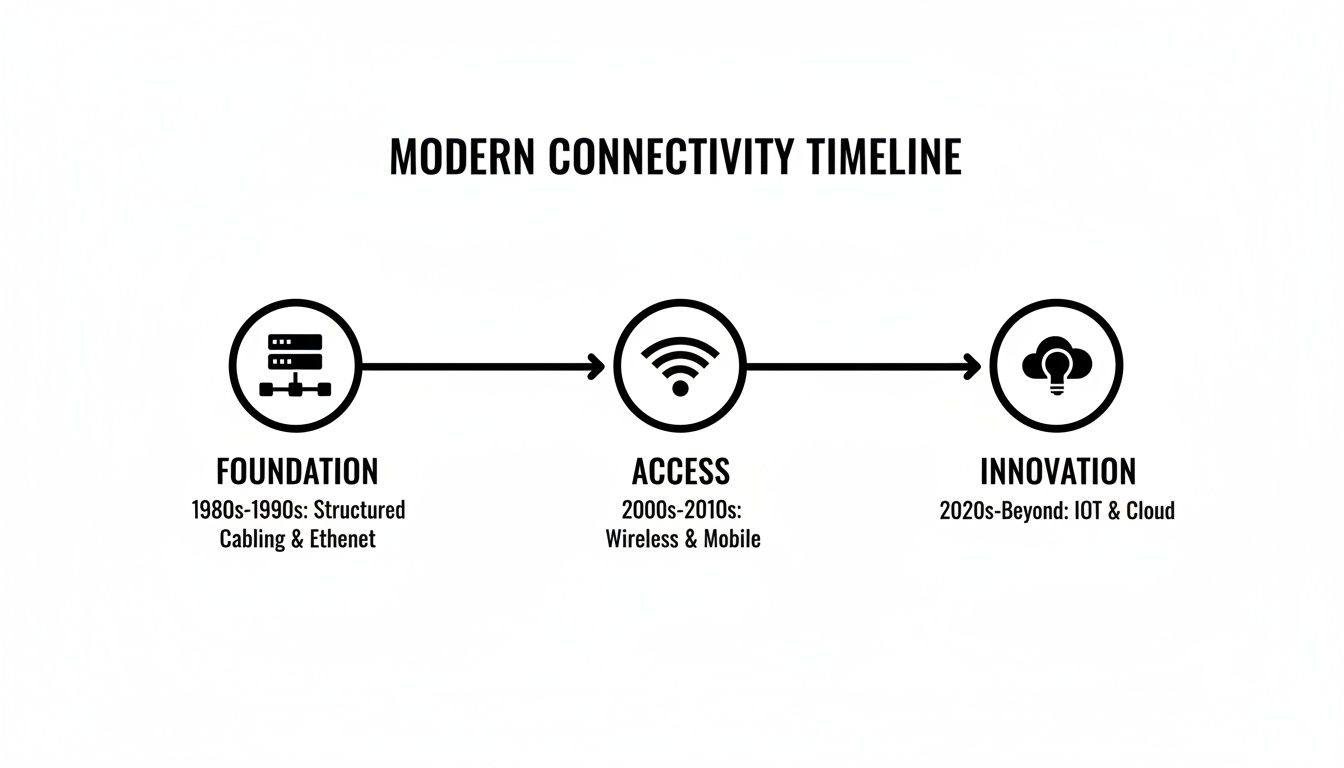
As you can see, you can’t get to the exciting stuff like cloud services and IoT without first putting in the groundwork—that means professional cabling and reliable network access.
A Phased Strategy for Success
The most practical way to bring these technologies on board is to focus on what your business needs most right now, then build on that with more advanced tools. This sequence makes sure your systems are stable and ready for whatever comes next.
1. Phase 1: Build the Foundation
Start with the absolute must-haves. This means professional structured cabling to create a dependable network backbone. It also means putting fundamental cybersecurity measures in place, like firewalls and adopting a Zero Trust mindset from day one. This isn't just for big corporations; it's the non-negotiable first step for everyone, from a small BPO startup to an established hotel chain.
2. Phase 2: Improve Efficiency
With a solid base, you can now look at making your daily operations run smoother. This is where managed IT services come in, taking care of your day-to-day tech headaches. Consider hardware leasing or rent-to-own programmes, too. This simple move can shift your IT spending from unpredictable, large capital expenses to a predictable monthly operational cost, freeing up cash for other business priorities.
3. Phase 3: Innovate and Scale
Now that your foundation is secure and your operations are efficient, you’re finally ready to innovate. This is the perfect time to explore more advanced tools like AI and automation to take over repetitive tasks, or to adopt cloud services for more operational flexibility.
Following this phased roadmap helps you avoid a common mistake: investing in fancy, sophisticated tools before your infrastructure can even handle them. It’s a much smarter and more sustainable path to building a truly digital-ready business.
Getting started on this journey is far more achievable than you might think. When you partner with a managed service provider, you get a single point of contact for your entire digital transformation—from the person pulling the first network cable to the team deploying your first AI-powered chatbot.
With flexible payment options and expert support, these powerful new trends in ict are well within reach for businesses of any size. This strategic approach will help your organisation scale smarter, run more efficiently, and build a competitive edge that will last for years to come.
Answering Your Questions on Today's ICT Trends
Stepping into the world of modern technology can feel like learning a new language. Let's clear up some of the most common questions business owners like you are asking about these new ICT developments.
How Can My Small Business Possibly Afford All This New Tech?
It's a common misconception that adopting new technology requires a massive, upfront investment. The truth is, modern ICT has shifted away from huge capital expenses (CAPEX) towards a much more manageable operational expense (OPEX) model.
Think of it this way: instead of buying a whole fleet of delivery trucks outright, you can lease them as needed. The same principle applies here. Rather than purchasing expensive servers to run a new AI tool, you can lease the hardware from a managed IT provider. This gives you access to powerful technology for a predictable monthly fee, putting even the most advanced tools within reach for small and medium-sized businesses.
Isn't Moving Everything to the Cloud a Huge Headache?
The thought of shifting your entire business operation to the cloud can definitely sound intimidating. But it's not a disruptive, all-or-nothing leap into the unknown when handled correctly. With a good partner and a solid plan, the migration can be surprisingly smooth.
A managed services provider takes care of the heavy lifting—from mapping out the move to securely transferring your data and applications. For example, a hotel could move its entire booking system to the cloud over a quiet weekend. With the right team on the job, they'd be back online Monday morning without any downtime affecting guest reservations.
A well-planned migration isn't a disruption; it's a carefully managed upgrade. The goal is a seamless transition that unlocks greater flexibility and security for your business operations, without you having to handle the technical complexities.
There Are So Many Trends—Where Do I Even Start?
It's easy to get distracted by the flashiest new technology, but for most businesses, the smartest approach is to build a strong foundation first. Before you even think about AI or sophisticated automation, make sure your core infrastructure is rock-solid.
That means focusing on two critical areas to begin with:
- Top-Notch Connectivity: It all starts here. Professional structured cabling and modern Wi-Fi are the bedrock of your digital operations. Without a fast, reliable network, none of the other fancy tech will work properly.
- Solid Cybersecurity: From day one, implement essential security like robust firewalls and start building a Zero Trust mindset. Protecting your data and systems isn't an afterthought; it's a prerequisite for growth.
Once that foundation is set, you can confidently move on to cloud services for efficiency and then start exploring game-changers like AI.
Is It Better to Hire an In-House IT Person or Use a Managed Service?
Building an in-house IT team is a major commitment. The costs go far beyond a salary—you have to account for training, benefits, and the constant challenge of finding people with highly specialised skills. Managed IT services present a much more flexible and often more cost-effective alternative.
When you partner with a managed provider, you're not just getting one or two IT generalists. You're gaining access to a whole team of experts in cybersecurity, cloud platforms, and network engineering, all for a single, predictable monthly fee. For a BPO that needs round-the-clock support, this means having 24/7 expert help for a fraction of what it would cost to build an internal team with the same deep expertise.
Ready to modernise your business with the right ICT strategy? REDCHIP IT SOLUTIONS INC. provides the expert guidance, managed services, and flexible hardware solutions you need to scale smarter. Start your digital journey with us today.



