At its core, a colocation data centre is a purpose-built facility where businesses can rent space for their servers and other IT hardware. Think of it less like a storage unit and more like a high-security, high-tech apartment building for your company's most important digital assets. You own the servers, but the facility provides the industrial-strength power, cooling, connectivity, and physical security—the kind of infrastructure that would be incredibly expensive and complex to build and maintain on your own.
Understanding the Core Concept of Colocation
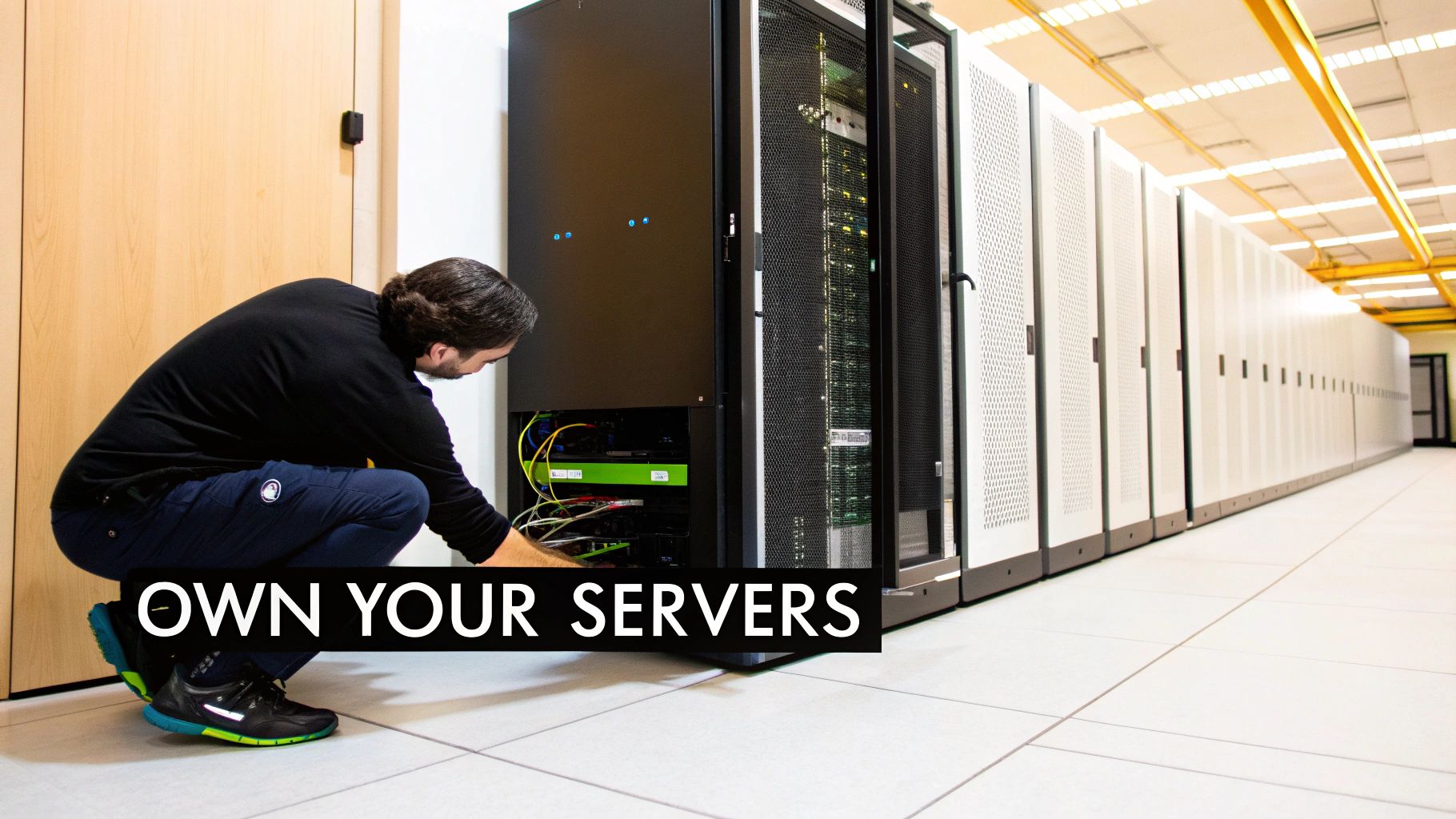
Let's use an analogy. Imagine you run a popular online bakery in Metro Manila. Your website, which handles all your orders, is your "server". Instead of trying to build a commercial-grade kitchen in your small apartment with industrial ovens, blast chillers, and 24/7 security (an on-premise data center), you rent a fully-equipped station in a shared, state-of-the-art culinary facility.
That’s the essence of a colocation data centre. You keep full ownership and control over your recipes and ingredients (your hardware and software), but you house them in an environment purpose-built for peak performance, reliability, and security. It’s a smart move that immediately gets rid of the massive capital investment and operational headaches that come with running your own server room.
Why Is Colocation Gaining Momentum in the Philippines?
The demand for solid, reliable IT infrastructure is growing faster than ever. Things like widespread digitalisation, the big shift to hybrid work, and the ever-increasing need for dependable online services are pushing businesses to find a better solution than that dusty server closet in the corner of the office.
This trend is fuelling explosive market growth. Here in the Philippines, the colocation data centre market is projected to skyrocket from USD 381.46 million in 2025 to a massive USD 1,804.84 million by 2035. This is largely driven by the country's rapid digital transformation and the fact that 85% of Philippine enterprises are aiming for a full cloud migration by 2026—often using colocation as a key stepping stone.
Colocation hits that sweet spot, offering enterprise-grade facilities without the eye-watering, enterprise-level price tag.
A colocation facility allows a business to convert a large, unpredictable Capital Expenditure (CapEx) for building a server room into a predictable, manageable Operating Expenditure (OpEx) through a monthly or yearly lease.
What Does a Colocation Provider Handle?
When you partner with a colocation provider, they take care of the entire physical environment. This frees up your IT team to focus on what actually drives your business forward—your applications and your data.
Here’s a quick breakdown of what they typically cover:
- Physical Space: You can rent anything from a single server rack to a private, caged-off suite. For example, a startup might begin with a quarter-rack, while a larger enterprise might lease a secure cage with multiple racks. This gives you the flexibility to start small and scale up as your business grows.
- Power and Cooling: Providers deliver redundant power from multiple sources, backed up by generators and uninterruptible power supply (UPS) systems to guarantee uptime. They also manage sophisticated, industrial-grade cooling to keep your hardware from overheating and ensure it runs efficiently.
- Network Connectivity: Most top-tier facilities are "carrier-neutral," meaning they have multiple internet service providers on-site. For instance, you could have a primary connection with PLDT and a backup with Globe, all within the same facility, ensuring constant connectivity. This creates a competitive ecosystem that gives you better performance, reliability, and pricing.
- Security: This is non-negotiable. Expect multi-layered security protocols, including 24/7 on-site staff, biometric scanners, and constant video surveillance to keep your valuable equipment safe.
This model is a powerful enabler for growth, especially for businesses that need to scale efficiently without breaking the bank. For a deeper dive into the local scene, you can read our guide on how technology is shaping the business landscape in the Philippines.
How Colocation Works in the Real World
Let's move beyond the textbook definitions. To really get a feel for how a colocation data centre works, let’s walk through a real-world scenario.
Picture a fast-growing BPO company right in the heart of Makati. They’ve just landed a huge new client. That's great news, but it also means they need to double their server capacity, and they need to do it yesterday. The problem? Their current office is already bursting at the seams—there's simply no more space, power, or cooling to support that kind of hardware.
This is the exact moment when colocation becomes a game-changer. Instead of a messy, expensive, and slow office renovation, the BPO decides to lease space in a purpose-built facility. The entire process is surprisingly logical, breaking down what seems like a massive technical project into a series of clear, manageable steps.
First things first, they have to figure out how much "real estate" they need for their gear. This isn't just about what they need today; it's about making sure they have room to grow tomorrow.
Securing Your Space and Power
The BPO's IT team gets to work. After a quick audit, they know they need to house ten new servers, two network switches, and a firewall. A standard 42U rack is the perfect fit. It gives them plenty of vertical space to install everything neatly, with some slots left over for when the next big client comes along.
Next up is power. They add up the power draw of every single piece of equipment and land on a requirement for a 5kW power circuit. The colocation provider doesn't just give them a single outlet; they provision A/B power feeds. Think of this as two completely independent electrical circuits, each connected to different power sources. If one feed somehow fails, the other one kicks in instantly, keeping the lights on and the business running.
The Migration and Connection Process
With the rack and power sorted, it’s time for the physical move. This is a meticulously planned operation where minimising downtime is the top priority.
- Preparation: Before anything leaves their office, the BPO's IT team sets up and configures all the new servers and networking gear. This "pre-staging" is a massive time-saver, ensuring that once the hardware is in the rack, it’s practically ready to go.
- Physical Move: The equipment is professionally packed and securely transported to the data centre. When they arrive, the facility’s security team verifies their identities and escorts them directly to their private, pre-assigned rack.
- Racking and Cabling: The team gets hands-on, physically mounting the servers, switches, and firewall into the rack. They plug everything into the A/B power strips and then run the network cables to a central patch panel in their rack.
- Connecting to the World: This patch panel is their gateway to the outside world. It connects their rack directly to the data centre's "meet-me room" (MMR), which is essentially a major hub where dozens of internet service providers have a presence. The BPO can now pick and choose the best ISP for their needs, giving them access to high-speed, low-latency connectivity that no standard office internet line could ever hope to match.
This carrier-neutral environment is a huge part of colocation's appeal. It’s a competitive marketplace for internet connectivity right inside the building. You can easily switch providers or even use multiple carriers for extra redundancy, all without the hassle of digging up streets to lay new fibre.
Managing Your Hardware from Afar
Once the servers are humming along, the BPO's IT staff doesn't need to drive to the data centre every time something needs attention. This is where a service called remote hands comes into play, and frankly, it's one of the most valuable parts of any colocation agreement.
Remote hands is exactly what it sounds like: a pair of skilled hands on-site, ready to help. For example, if a server becomes unresponsive and needs a hard reboot at 2 AM, the BPO's IT manager can simply submit a ticket. A qualified data centre technician will go to their rack, physically press the reset button, and report back, saving the manager a late-night drive through EDSA. This service is a lifesaver for managing off-site infrastructure.
For a growing company that can't afford a massive, 24/7 IT department, this service is an absolute lifesaver. It makes managing off-site infrastructure practical, efficient, and secure.
Choosing Your Path: Colocation vs Cloud vs On-Premise
Deciding where your company’s digital heart should live is one of the biggest calls you'll make. The choice between a colocation data centre, the public cloud, and a traditional on-premise server room isn't just about tech—it’s a strategic decision that balances cost, control, security, and your ability to grow. Each path offers a completely different set of trade-offs, and what's right for one business could be a disaster for another.
Think about a fast-growing e-commerce startup in Cebu. For them, the public cloud is a lifesaver. They can spin up resources instantly for a huge 11.11 sale and then dial it all back down the next day. They only pay for what they use, which is perfect for their unpredictable demand and avoids a massive upfront cost for hardware they might not need next month.
Now, picture a financial technology firm in Bonifacio Global City. They're handling incredibly sensitive transaction data and have strict regulatory hoops to jump through. For them, total control over their hardware isn't just a preference; it's a requirement. This is where a colocation data centre shines. It’s the perfect middle ground—they get complete authority over their own servers, but they're housed within a fortress-like facility that’s already compliant and secure.
A Head-to-Head Comparison
To really get to the heart of it, let's break down the core differences. The best choice almost always comes down to your specific business goals, the technical skills of your team, and how your budget is structured. Getting these distinctions right is the first step toward building an IT foundation that's both resilient and cost-effective.
This simple decision tree is a great way to visualise the very first question you should ask: should you build your own facility or go with colocation?
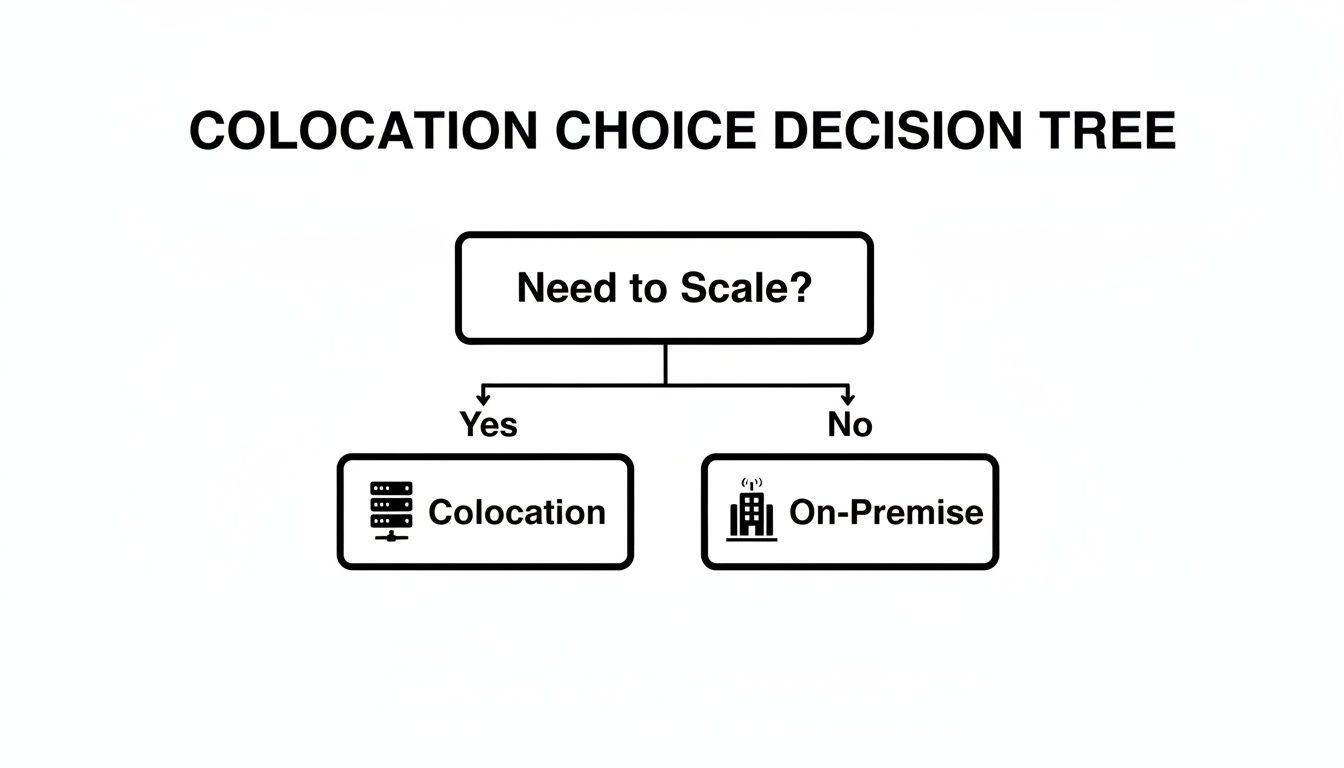
As you can see, the need for future growth is a huge driver. For any business with ambitions to scale, colocation offers a much more flexible and pragmatic path forward.
Infrastructure Showdown: Colocation vs Public Cloud vs On-Premise
The best way to see which model truly fits is to put them side-by-side and compare them on the factors that actually matter to your day-to-day operations. Each approach impacts your finances, security, and agility in its own unique way.
| Factor | Colocation Data Center | Public Cloud | On-Premise Server Room |
|---|---|---|---|
| Cost Model | Hybrid (CapEx for servers, OpEx for space/power) | Pure OpEx (Pay-as-you-go subscription) | Heavy CapEx (Building, power, cooling, hardware) |
| Control | Full control over your own hardware and software. | Limited to software and virtual machine configurations. | Complete control over every aspect of the environment. |
| Security | Shared responsibility. Provider secures the facility; you secure your servers. | Shared responsibility. Provider secures the platform; you secure your apps/data. | Sole responsibility for both physical and digital security. |
| Scalability | Good. Scale by adding more servers to your rack or leasing more space. | Excellent. Scale resources up or down almost instantly on demand. | Poor. Scaling requires significant new investment and physical build-out. |
| Maintenance | You maintain your servers. Provider maintains the facility. | Provider manages all underlying hardware and infrastructure. | You are responsible for all maintenance and repairs. |
Ultimately, the choice often boils down to this: On-premise gives you absolute control, but at the highest cost and with the least flexibility. The cloud offers incredible flexibility but forces you to give up control over the underlying hardware. Colocation strikes that powerful balance, giving you dedicated hardware control without the massive headache and expense of managing a data centre yourself.
For businesses looking to modernise, the hybrid nature of colocation is a huge draw. It lets you keep ownership of your most critical assets while offloading the incredibly complex and expensive job of running a world-class facility.
Many companies are now using colocation as a strategic home base for a hybrid cloud model. In this setup, they keep their most sensitive workloads on their own servers inside the colocation facility, while establishing a direct, secure connection to public cloud services for less critical tasks. This approach is especially powerful for managing complex database workloads, a topic we dive into in our guide to managed relational database services. It's a true "best of both worlds" solution, blending security, control, and flexibility into one smart strategy.
The Strategic Business Benefits of Colocation
Moving your servers into a colocation data centre is more than just a technical decision; it's a strategic move that can seriously impact your bottom line. For businesses in the Philippines, especially those looking to grow, this shift turns abstract concepts like "redundant power" into real-world advantages that boost efficiency, slash risk, and set the stage for expansion.
The first thing you’ll notice is the financial relief. Instead of shelling out a massive sum for capital expenditure (CapEx) to build or upgrade an in-house server room, you switch to a predictable monthly operating expenditure (OpEx).
For example, a mid-sized logistics company might budget PHP 5 million for a new server room. With colocation, they can invest that capital into new delivery trucks instead, while paying a predictable monthly fee of PHP 100,000 for rack space and power. This simple change frees up a huge amount of cash. Money that would have been tied up in concrete, wiring, and cooling systems can now be funnelled back into what actually grows your business.
Fortified Security and Unmatched Uptime
Let's be honest: for most small to medium-sized businesses, matching the security of a top-tier data centre is simply out of reach financially. Colocation gives you instant access to multiple layers of security designed to protect your most critical digital assets.
We're not just talking about a good lock on the door. This is a comprehensive security posture that includes:
- 24/7 On-Site Security Personnel: Real people monitoring the facility around the clock.
- Biometric and Keycard Access: Multiple authentication steps ensure only authorised staff can get anywhere near the servers.
- Continuous Video Surveillance: Every angle of the facility is covered and recorded.
Beyond physical threats, colocation delivers rock-solid reliability. These facilities are purpose-built with redundant power grids, backup generators, and uninterruptible power supply (UPS) systems. This setup is so robust that providers can confidently offer strict Service Level Agreements (SLAs), often guaranteeing 99.99% uptime or even higher. When every minute of downtime costs you money, that kind of guarantee is invaluable.
By housing your servers in a colocation facility, you're essentially outsourcing the risk of power outages, hardware failure due to overheating, and physical security breaches to an expert who handles it at scale.
This is particularly relevant in the Philippines, where the colocation market is booming to meet this exact need. The country is set for a massive expansion, with 13 upcoming facilities expected to add over 700 MW of capacity by 2028. This growth, fuelled by over USD 3 billion in planned investments, will more than double the country's capacity, showing just how much businesses value these resilient environments. You can learn more from these findings on the Philippine data centre expansion.
Superior Connectivity and Scalability
One of the biggest, yet often overlooked, perks of colocation is plugging into a rich network ecosystem. Most top facilities are "carrier-neutral," which is just a fancy way of saying they have multiple internet service providers (ISPs) operating within the same building. This creates a competitive marketplace right at your fingertips, letting you choose the best connection for your needs, often at a much better price.
This direct access to so many networks means lower latency and higher bandwidth for you, which translates to faster, more responsive applications and services for your customers.
Practical Example: A Retail Chain's Success
Think about a Philippine retail chain with 50 branches across Luzon and Visayas. Their entire operation—from inventory and sales to logistics—runs on a central system. If that system is hosted in a server closet at their head office, a simple power cut could bring the whole company to a standstill.
By moving their core servers to a colocation data centre, the chain completely changes the game:
- Centralised Reliability: All 50 branches now connect to a system with near-perfect uptime. No more worrying that a brownout in Manila will halt sales in Cebu.
- Improved Performance: With better network connectivity, inventory updates sync instantly across all stores. This means fewer stockouts and happier customers.
- Future-Proof Scalability: When they decide to open 20 more branches, IT isn't a bottleneck. They simply add another server to their rack in the data centre and scale up without a hitch.
This real-world scenario shows how colocation is more than just a technical solution. It’s a foundational business strategy that delivers operational stability and paves the way for ambitious growth.
Your Checklist for Choosing a Philippine Colocation Partner
Picking a colocation partner is a massive decision. It’s a choice that will echo through your company’s growth and resilience for years. And when you're doing it in the Philippines, you have to factor in unique local challenges, from the climate to the specific digital infrastructure landscape. You can’t afford to get this wrong.
This isn’t just about ticking boxes. It’s about digging deep and asking the tough questions that go beyond the glossy marketing brochures. Think of this as your practical guide to making sure your critical IT hardware rests on a truly solid foundation.
Location and Physical Accessibility
You know the old saying in real estate: location, location, location. Well, it's doubly true for data centres. In the Philippines, this means finding a facility that’s geographically smart. For example, is it located in an area like Clark, which is known to be less prone to earthquakes and flooding compared to other regions? These aren't edge cases; they're essential planning points.
Just as critical is simple access. You need to know that your authorised people can physically get to your servers anytime, 24/7, no exceptions. Look at the facility’s proximity to major roads and think about how your team would reach it in a real emergency.
Power Redundancy and Reliability
Clean, uninterrupted power is the absolute lifeblood of your operation. Given that the local power grid can sometimes be unpredictable, a provider's power redundancy plan is non-negotiable. Don’t just accept their claims—ask for a detailed tour and explanation of their power setup.
Get specific with your questions:
- Grid Feeds: Are they connected to multiple, independent power grids? A good example is a facility that draws power from both the Meralco A and B grids.
- UPS Systems: What’s the capacity and configuration of their Uninterruptible Power Supply (UPS) systems?
- Backup Generators: How many are on-site? What’s their fuel capacity, and how often do they run full-load tests?
A solid provider will have at least N+1 redundancy, which means they have an independent backup for every single component in their power delivery chain.
Network and Carrier Neutrality
A colocation facility should be a bustling intersection of connectivity, not a dead-end street. The best facilities are carrier-neutral, giving you access to a wide range of telcos and internet service providers (ISPs). This is crucial because it puts you in control, letting you pick the best carrier for your performance needs and budget.
Carrier neutrality creates a competitive marketplace right inside the data centre. It saves you from vendor lock-in and lets you build a resilient, multi-carrier network that guarantees the best possible uptime.
The demand for this level of connectivity is exploding locally. Manila remains the heart of the Philippine colocation market, home to most of the country's 28 facilities. The city is currently bracing for an incredible 124,000 new rack spaces by late 2025, driven by the massive growth in e-commerce and cloud services.
Security and Compliance Certifications
Your evaluation of a potential partner has to include a deep dive into their data center security. This isn't just about firewalls; it starts at the physical perimeter. Look for layers of security: 24/7 on-site guards, biometric access controls, mantraps, and comprehensive CCTV coverage.
Just as important are their certifications. These aren't just badges; they are proof that the provider has undergone rigorous third-party audits. Keep an eye out for key standards like:
- ISO 27001: The international gold standard for information security management.
- PCI DSS: Essential if your business processes any credit card transactions. For example, any e-commerce platform using the facility must ensure this compliance.
- SOC 2: Verifies their controls around security, availability, and confidentiality.
Scalability and Managed Services
Your business isn't static, and your infrastructure partner needs to be ready to grow with you. Ask them exactly what the process is for scaling up. For instance, if your website traffic doubles, can you get an additional 2kW of power and a new rack provisioned within 48 hours? A truly flexible partner will have a clear, predictable path for expansion.
Finally, see what managed services they offer. Can they provide "remote hands" for quick tasks, or do they have more in-depth support available? Having access to on-site expertise can be a lifesaver. If you're considering offloading even more IT work, understanding their capabilities in managed IT services and consulting is a critical part of the conversation.
Making the Move: From Migration to Ongoing Management
Knowing a colocation data centre is the right choice is one thing, but actually getting there is a completely different challenge. A successful move from your in-house server room to a professional facility isn't just a technical project; it's a major business upgrade that demands careful planning and expert execution. It’s about more than just moving boxes—it's about building a stronger, more resilient foundation for your entire operation.
The journey doesn't start with a moving truck. It starts with a conversation. At REDCHIP, our first step is a deep-dive IT consultation to understand your current setup, your daily workloads, and where you see your business heading. This assessment ensures the colocation space and services you choose are the right fit from day one, helping you avoid expensive mistakes later on.
From Physical Move to Peak Performance
With a solid strategy in place, the physical migration can begin. Our server migration services are built from the ground up to cause as little disruption to your business as possible. We manage the entire process: the careful decommissioning of your old setup, the secure transport of your valuable equipment, and the professional re-installation at the new facility. The goal is simple: get you back online quickly and safely.
Next, our experts handle the data cabling. This is a critical step that ensures your servers can talk to each other at top speed without creating frustrating bottlenecks. It’s not just about plugging in wires; it's about engineering an organised, efficient, and scalable network inside your new rack space.
The real value of a partner like REDCHIP becomes clear long after the physical move is done. We transition from migration support to ongoing management, freeing up your team to focus on what they do best—driving your business forward.
Our managed IT support acts as your expert team on the ground, right inside the colocation facility. We become your ‘remote hands’ for everything from routine health checks to emergency troubleshooting. This partnership also extends to the full hardware lifecycle. When equipment eventually needs to be retired, understanding the official data center decommissioning process ensures it's handled responsibly.
Ready to build a more resilient and scalable IT foundation for your business? Schedule a consultation with REDCHIP today to see how our migration and management services can support your growth.
Still Have Questions About Colocation?
Diving into IT infrastructure always brings up a few questions. It's a big decision, after all. Let's tackle some of the most common things business leaders in the Philippines ask when they're thinking about moving to a colocation data centre.
Is Colocation Only for Big Companies?
Not at all. In fact, many smaller businesses find it's a perfect fit. You don't have to rent a massive space; providers are flexible. You can start with just a small slice of a rack—a quarter or even half—and scale up as you grow.
Think about it: a growing e-commerce shop in Quezon City can’t afford to go offline during a brownout. By placing their web server in a colocation facility, they get the same uptime and security that major corporations rely on, all without the massive cost of building their own data room. It's about getting enterprise-level benefits on an SME budget.
How Is This Different from Just Using the Cloud?
The biggest difference comes down to ownership. With colocation, you own your servers. They're your machines, running your software, configured exactly how you want. You're just renting the secure, powered, and cooled space they live in. In the cloud, you're renting a virtual slice of someone else's hardware, like AWS or Azure.
Here’s a simple analogy: Colocation is like owning a classic car and keeping it in a professional, high-security garage. You have total control over the car, but the garage handles the security and keeps the lights on. The cloud is more like using a ride-hailing service—you don't own the car, you just pay for the ride when you need it.
So, Who’s in Charge of My Servers?
In a colocation setup, you are always responsible for your own hardware. That means you handle everything from buying and setting up your servers and switches to maintaining and eventually replacing them. The provider’s job is to take care of the facility itself: the power, cooling, physical security, and the network connections.
This clear line in the sand is a core principle of colocation. It gives you complete control over your tech stack while letting you offload the massive headache of managing a physical building.
But what if a server needs a reboot at 3 AM? You don’t have to drive to the data centre. Nearly every provider offers a "remote hands" service. For an extra fee, their on-site technicians become your hands, ready to plug in a cable, swap a drive, or just push a button for you. It’s an incredibly practical service that makes managing your gear from afar a breeze.
Ready to see if colocation can give your business the stability and security it needs to grow? The experts at REDCHIP IT SOLUTIONS INC. are here to help you plan, migrate, and manage the right IT infrastructure for you. Schedule your free consultation with us today.



