So, what exactly is a cyber security consultation? At its core, it’s a professional service where experts take a deep dive into your business's digital security. They identify weak spots and then create a solid, strategic plan to protect your data and keep your operations running smoothly.
Think of it as a proactive partnership, one designed to build a strong defence against cyberattacks before they ever have a chance to happen. A practical example is a consultant identifying that your customer database is not encrypted. Before a hacker can steal that data and sell it, the consultant helps you implement encryption, turning a potential disaster into a secured asset.
What a Cyber Security Consultation Really Means

Don't mistake a cyber security consultation for a simple tech audit. It’s more like hiring a master architect to design your digital fortress.
Imagine you're constructing a high-rise building. You wouldn't just build it and hope for the best; you'd bring in a structural engineer to check for hidden weaknesses long before an earthquake could ever hit. That engineer doesn't just point out a few cracks in the concrete. They give you a detailed blueprint to reinforce the entire foundation, ensuring the building can stand firm against future tremors. A security consultant does the exact same thing for your digital infrastructure.
This is a partnership that goes way beyond just spotting problems. It’s all about creating a proactive, long-term security plan that fits your business like a glove. The real goal is to shift your entire organisation away from a reactive, "fix-it-when-it-breaks" mentality and into a state of confident, resilient growth.
A Blueprint for Your Digital Defences
A good consultation delivers a clear, actionable roadmap, turning abstract threats into concrete steps you can take right away. This isn't about one-size-fits-all advice; it's about deeply understanding the unique way your business operates.
For instance, a fast-growing BPO in Manila that handles sensitive international client data has entirely different security needs than a hotel chain managing guest Wi-Fi across several islands in Palawan.
- For the BPO: The consultation would zero in on data privacy compliance (like GDPR), secure data transfer methods, and protecting client information from potential insider threats. A practical step might be implementing Data Loss Prevention (DLP) software that automatically blocks an email if it contains a client's credit card number.
- For the Hotel Chain: Here, the focus would likely be on locking down point-of-sale (POS) systems, securing the guest network from troublemakers, and making sure the guest booking database is absolutely impenetrable. A specific recommendation could be creating a separate, isolated network for guest Wi-Fi, so a guest's compromised laptop can't infect the hotel's administrative systems.
A proper cyber security consultation transforms security from a necessary expense into a competitive advantage. It builds trust with your clients and partners by demonstrating a serious commitment to protecting their data, which is often your most valuable asset.
Moving Beyond Simple Fixes
Ultimately, the consultation process is about embedding a sustainable security culture into your team's DNA. It's making sure everyone understands the risks and knows exactly what to do.
Instead of just installing a firewall and calling it a day, a consultant helps you develop clear policies and incident response plans. For example, they might help you create a "Phishing Reporting" policy where employees are trained to forward suspicious emails to an IT address and are rewarded for doing so. To see how a full-circle strategy can protect your business, you can explore our cyber security solutions.
This proactive approach means that when a threat inevitably appears, your team has a well-rehearsed plan, just like a fire drill. That preparation minimises panic and damage, letting you get back to business quickly and securely.
Why Expert Consultation Is a Game Changer for Your Business
Think of a professional cyber security consultation as shifting your business from a defensive crouch to a confident stride forward. It’s about bringing in specialised expertise to get real results that support your growth, build unshakable client trust, and protect your bottom line.
For most businesses, hiring a full-time, in-house security team just isn't feasible. A consultation completely levels the playing field. It gives you access to the kind of expertise a Fortune 500 company has, but without the massive overhead. It’s a smart, strategic move that pays for itself many times over.
This is more important than ever as cyber attacks become a daily headline. To see just how vital this guidance is, a real-world guide from a SharePoint migration consultant shows how expert advice can prevent disaster across all sorts of business operations.
From a Necessary Cost to a Driver of Growth
Here’s a simple truth: preventing a single data breach is thousands of times cheaper than cleaning up the mess afterwards. The cost of a breach goes far beyond just money. You're looking at regulatory fines, crippling operational downtime, and sometimes irreversible damage to your brand's reputation.
A consultation flips the script. It turns security from a reactive expense into a proactive investment that actually helps you grow. When you can confidently prove to clients and partners that their data is safe with you, you unlock bigger opportunities and build much stronger relationships. This shift is vital for businesses all across the Philippines, where different industries face their own unique set of risks.
How It Looks in the Real World
The true value of a cyber security consultation really clicks when you see how it applies to specific types of businesses. Each one has its own weak spots that need a tailored defence.
- For Business Process Outsourcing (BPOs): Landing those big international contracts often comes down to one thing: proving your security is top-notch. A consultation gets you ready to meet strict standards like GDPR or HIPAA, giving you the solid proof you need to assure clients their sensitive data is in safe hands. For example, a consultant can help you generate the exact compliance reports required by a European client to prove you meet GDPR standards.
- For Hotels and Multi-Site Properties: Your operation is a complicated network of payment systems, booking engines, and guest Wi-Fi. An expert can map out and secure every single potential entry point, protecting guest data and payment details across your entire chain. A practical step would be implementing network segmentation to ensure a breach in the guest Wi-Fi network cannot spread to the corporate network that processes payments.
- For Small and Medium Businesses (SMBs): You probably don't have a dedicated IT department, which, unfortunately, makes you a prime target for cybercriminals. A consultant becomes your on-demand security officer, setting up strong defences so you can get back to running your business without the constant worry. This could be as simple as configuring your cloud services (like Microsoft 365) with proper security settings, a task often overlooked by busy owners.
The main takeaway is this: a professional consultation gives you the clarity and game plan to turn your security into a powerful business advantage, building the trust you need to succeed for years to come.
Keeping Up with a Rising Tide of Threats
The need for this proactive approach is growing fast. Small and medium enterprises (SMEs) are the backbone of the Philippine economy—from startups and hotels to growing BPOs. They're now scrambling to adopt better cybersecurity measures, even with tight budgets. In fact, this market is expected to grow at a 10.05% compound annual growth rate through 2031.
Ransomware, in particular, has become a major problem, causing huge financial and reputational harm. This has pushed even budget-conscious call centres to invest in solutions like identity access management (IAM) and endpoint protection. Waiting for an attack to happen is simply not a strategy anymore. Proactive, expert-guided security planning is the only way to stay ahead of the curve and ensure your business can thrive safely.
A Look Inside the Cyber Security Consultation Process
Jumping into a cyber security consultation might feel intimidating, but it’s not an ambush. Think of it less like a surprise inspection and more like a guided tour of your digital operations. It's a structured partnership designed to give you clarity and, ultimately, control. The whole thing is a step-by-step journey, turning what seems like a complex technical mess into a straightforward, actionable business plan.
The goal here isn't to find fault; it's to build resilience. Each stage is carefully planned to paint a clear picture of where you stand today and then map out the smartest way forward. We make sure you understand every single recommendation before we move on.
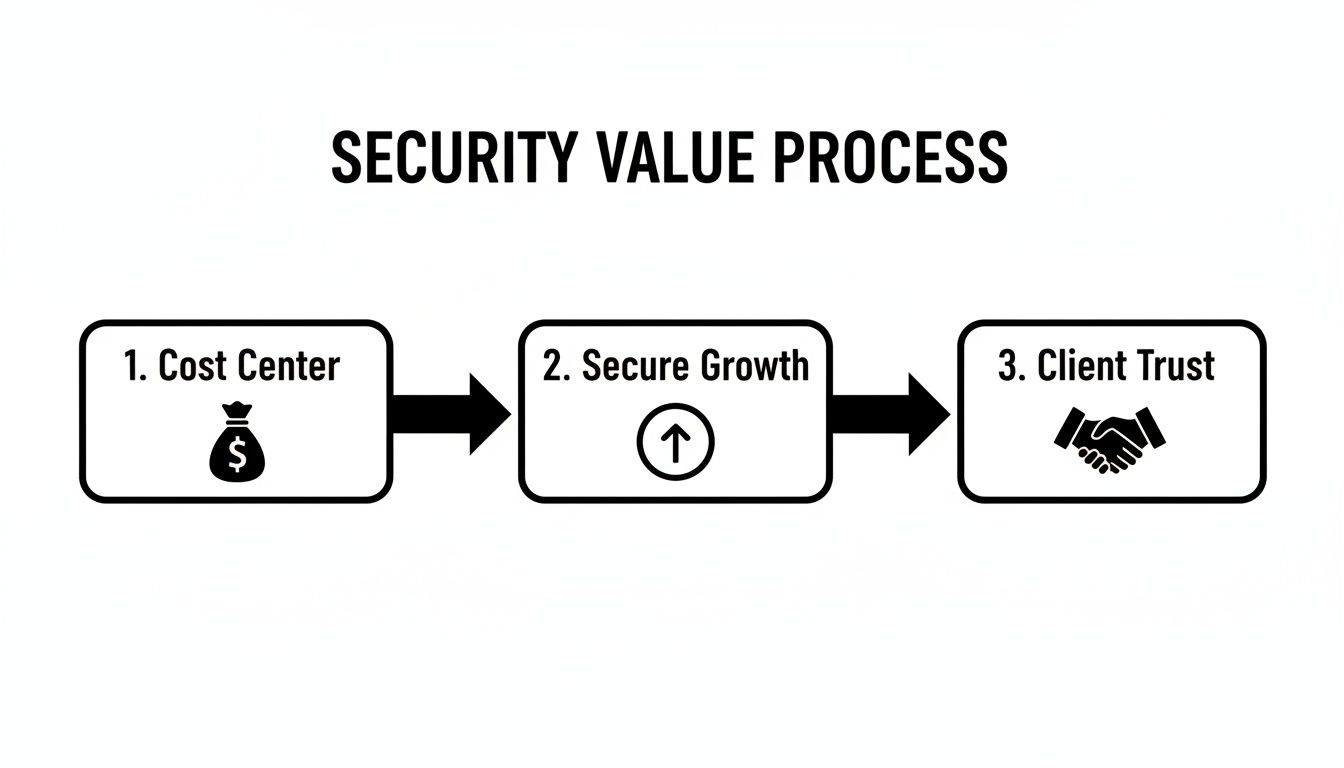
This process helps shift your mindset. Instead of seeing security as just another cost, you start to see it as a driver for secure growth and stronger client trust. The real insight here is that investing in good security isn't just an expense—it's a direct route to building a more reliable and reputable business.
Phase 1: Strategic Discovery
Every good consultation kicks off with a conversation, not a technical scan. This initial Strategic Discovery phase is all about understanding your business from the inside out. We need to know your goals, what drives your revenue, and which operational workflows are absolutely critical. We're not just looking at your tech; we're learning what makes your business tick.
For a logistics company in Cebu, this might mean mapping out how their booking, dispatch, and tracking systems all talk to each other. For a BPO startup, it's about figuring out where sensitive client data lives, how it moves between agents, and which compliance standards are non-negotiable. Context is everything.
Phase 2: Thorough Risk Assessment
Once we know what's most valuable to your business, we start looking for weaknesses. This is the Risk Assessment phase. It’s a lot like a building inspector checking for unlocked digital doors, weak windows, or faulty wiring in your network. We systematically review your systems, policies, and procedures to see where the cracks are.
This involves a few key steps:
- Asset Identification: We map out all your critical digital assets—from servers and employee laptops to cloud apps and databases. For example, identifying the specific server that hosts your e-commerce website's customer data.
- Threat Modelling: We figure out the most likely threats for your specific industry. A retail business faces different risks (like point-of-sale malware) than a healthcare provider (like patient data breaches).
- Vulnerability Analysis: We pinpoint specific weaknesses, like unpatched software, flimsy password rules, or a lack of employee security training. For instance, we might discover that new employees are not required to change their default passwords upon first login.
Phase 3: Controlled Technical Testing
With a clear map of potential risks, the next step is to test them. During Controlled Technical Testing, we ethically "rattle the doorknobs" to see which ones open. This isn't some brute-force attack; it's a careful, controlled process to confirm the vulnerabilities we identified earlier.
A common method is a vulnerability scan, an automated tool that checks your computers and networks for known security holes. For example, a scan might reveal that a public-facing server is running outdated software with a well-known exploit, making it a sitting duck for attackers.
Phase 4: The Actionable Strategy Blueprint
This is where all the technical findings get translated into a plain-English roadmap. A worthwhile cyber security consultation doesn't just dump a dense, jargon-filled report on your desk. Instead, it delivers an Actionable Strategy Blueprint—a prioritised list of recommendations based on risk level and business impact.
The blueprint separates the "must-do-now" items from the "should-do-soon" and "good-to-do-later." It gives you a clear, budget-friendly path to improving your security posture over time.
For instance, the top priority might be patching that critical server vulnerability we found in Phase 3. A medium priority could be rolling out multi-factor authentication for all employees, while a longer-term goal might be developing a full-blown security awareness training programme.
Phase 5: Clear Reporting and Supported Implementation
The final phases are all about clarity and partnership. You’ll receive a straightforward report that summarises our findings, the risks we identified, and the steps we recommend. But a true security partner doesn't just hand you a plan and walk away.
This is where Supported Implementation comes in. The consulting team helps you actually build the new defences, whether that means configuring firewalls, deploying new security software, or training your team. A practical example is the consultant not just telling you to use multi-factor authentication, but actively helping your IT team deploy it across your Microsoft 365 accounts and providing a short training guide for employees.
Understanding the Core Services in Your Consultation
A cyber security consultation isn't just about running software and handing you a technical report. Think of it as a strategic partnership. Each service is designed to solve a real-world business problem, shoring up your digital weak spots before they can cause a serious disruption. Understanding what these services actually do helps you see the immense value hidden behind all the technical jargon.
It’s a bit like building a house. You need a solid foundation (risk assessment), strong walls with good locks (vulnerability management), a clear emergency plan (incident response), and some house rules for everyone living inside (policy development). Every piece works together to keep your most important assets safe.
Risk Assessment and Vulnerability Scanning
The first, most critical step is figuring out what you’re trying to protect and what you're up against. A risk assessment does exactly that. We identify your most critical digital assets—things like your customer database, financial records, or the software that runs your operations—and then map out the threats that could realistically harm them.
Right after that comes vulnerability scanning, which is like having a security expert methodically check every single door, window, and potential entry point in your digital "house." It automatically probes your networks, servers, and applications for known weaknesses that a hacker could exploit.
Here’s how this plays out for a growing e-commerce business in the Philippines:
- The Problem: The business stores thousands of customer credit card numbers and personal details. A data breach wouldn’t just mean fines under the Data Privacy Act; it would shatter customer trust and could easily put them out of business.
- The Solution: A consultant runs a vulnerability scan and finds the web server is using outdated software with a well-known security flaw. This is the digital equivalent of a rusty, leaking pipe just waiting to burst. The scan flags this immediately, allowing the business to apply a patch long before a cybercriminal stumbles upon the easy entry point.
Security Policy Development
Once you know where your vulnerabilities are, the next move is to build a human firewall. Security Policy Development is all about creating a clear, simple rulebook for your team. It answers crucial questions like who can access what data, how they can access it, and why those rules are in place.
This isn't about micromanaging your staff; it's about empowering them. Clear guidelines protect both the employee and the business by removing guesswork. These policies cover everything from creating strong passwords and using company devices securely to spotting and reporting suspicious phishing emails.
A well-defined security policy turns abstract security goals into concrete, daily actions for your entire team. It's the difference between hoping everyone does the right thing and ensuring they know what the right thing is.
For a BPO with a hybrid work setup, a solid policy is non-negotiable. A practical example would be a "Work-From-Home Security Policy" that specifies that all employees must connect to the company network via a company-approved VPN and must lock their computers when not in use. You can learn more about streamlining these types of operations through our managed services consulting.
Incident Response Planning
Even with the best defences in the world, the hard truth is that a security breach can still happen. Incident Response Planning is your company’s fire drill for a cyberattack. It's a calm, well-rehearsed, step-by-step guide that tells everyone exactly what to do the moment something goes wrong.
The entire goal is to minimise the damage, get your business back online as fast as possible, and bring order to a chaotic situation. A good plan answers the tough questions before you're in a crisis: Who makes the first call? How do we isolate the affected systems to stop the bleeding? When and how do we notify our customers or regulators?
- Real-World Scenario: Imagine a multi-site hotel chain in the Philippines gets hit with ransomware, and its booking and payment systems are completely locked.
- Without a Plan: It's pure chaos. The front desk can't check guests in, management is scrambling to figure out who to call, and precious time is wasted. The financial and reputational damage snowballs with every passing minute.
- With a Plan: The team immediately kicks the Incident Response Plan into gear. The IT staff isolates the infected network to prevent the ransomware from spreading, management contacts their cybersecurity consultant, and the PR team readies a pre-approved statement for guests. The response is swift, controlled, and effective.
The demand for these protective services is exploding as the country digitises. By 2035, the Philippines' cyber security market is projected to hit USD 782.68 million, a massive jump from USD 234.69 million in 2025, reflecting a powerful 12.80% compound annual growth rate. This surge is driven by SMEs diving into e-commerce, mobile technology, and cloud services, which unfortunately also expands their exposure to breaches and ransomware, fueling the need for expert security help.
Getting Ready for Your First Consultation

Walking into your first cyber security consultation shouldn't be intimidating. The key to a truly productive meeting is to do a little homework beforehand. This prep work shifts the dynamic, turning you into an active collaborator rather than just a listener.
When you come prepared, the consultant can skip the basic fact-finding and dive straight into what matters for your business. It saves everyone time and ensures the advice you get is sharp, relevant, and grounded in your company's reality right from the start.
Your Pre-Consultation Checklist
Before the meeting, try to pull together a few key pieces of information. You don't need to be a tech wizard; this is about having a clear, high-level picture of your digital footprint. Think of it as sketching a quick map of your digital assets.
- List Your Core Software & Cloud Services: What applications does your team rely on every day? Jot down things like your accounting software (Xero, QuickBooks), your CRM, and any major cloud platforms like Google Workspace, Microsoft 365, or AWS.
- Pinpoint Where Critical Data Resides: Where is your most valuable information stored? This could be customer lists in your CRM, financial reports on a local server, or intellectual property in a specific cloud folder. Knowing this helps the consultant prioritise what to protect first.
- Gather Any Existing Security Policies: Do you have any documents that outline your current security rules, even informal ones? Grab your password policy, remote work guidelines, or employee IT onboarding checklist. Whatever you have is a great starting point.
- Recall Past Security Incidents: Has your business ever dealt with a security scare? Make a few notes about any previous virus infections, close calls with phishing emails, or data breaches. For example: "In March, our accountant's email was hacked after clicking a fake invoice link, and we had to reset all finance passwords." This history provides invaluable context.
Having a solid inventory of these assets is a crucial first step. For a more structured approach, you can explore our guide on Information Technology Asset Management.
Questions That Reveal the Right Partner
Remember, the consultation is a two-way conversation. The consultant will have plenty of questions for you, but the ones you ask are just as important—if not more so. Your questions help you vet their experience, their approach, and whether they're the right long-term partner for your business.
Don’t just hire a technician; find a strategic ally. The right questions will reveal a consultant's ability to connect their technical expertise to your business goals, ensuring their recommendations are both practical and impactful for your growth.
Come to the table ready to ask direct and insightful questions. These three are a fantastic place to start to gauge if they're a good fit.
-
Can you share an example of how you've helped a business like ours with a specific security problem? This pushes past the standard sales pitch. A solid answer will describe a real-world problem, the custom solution they created, and the positive business outcome for a company in a similar industry, whether it's a BPO, a hotel chain, or an SME.
-
How do you prioritise recommendations to fit a growing company's budget? This is critical. You need a partner who gets that you can't boil the ocean overnight. A good consultant will explain their risk-based approach, showing you how they separate the urgent, "must-fix-now" issues from the important "should-fix-soon" improvements.
-
What does support look like after you deliver the initial report? This last question tells you everything about their commitment. A great partner doesn’t just email you a PDF and vanish. They offer ongoing guidance, help with implementation, and stick around to support your team as you build a stronger, more resilient security posture.
Finding Your Strategic Security Partner
Choosing a cybersecurity consultant isn't like picking a vendor. It’s about finding a long-term strategic partner who’s genuinely invested in your business's journey. Think of it less as a transaction and more as the beginning of a crucial relationship built on trust and a real understanding of what you're trying to achieve.
A great consultant doesn’t just drop a report on your desk and disappear. They become an extension of your team, dedicated to helping you grow safely. Their success is tied directly to yours, making them a true ally in your corner.
Beyond the Report: A Commitment to Your Growth
The real value of a top-tier security partner becomes clear long after the initial assessment is done. It’s in how they connect those findings to practical, hands-on implementation. This integrated approach ensures that recommendations don't just gather dust in a document; they become your actual, functioning defences.
For businesses here in the Philippines, this means finding a partner who gets the local landscape. They understand the unique hurdles we face, from the nuances of the Data Privacy Act to the complexities of securing operations across multiple islands or scattered office sites.
- Practical Example: Imagine a retail chain with stores in Metro Manila and various provincial cities. They need more than a one-size-fits-all security plan. A strategic partner like REDCHIP IT SOLUTIONS INC. would craft a solution that secures point-of-sale systems in every single store, configures firewalls for each unique location, and builds a secure remote work setup for the head office—all while ensuring compliance with local laws.
The Power of Local Expertise
The Philippines' cybersecurity market is on track for massive growth, projected to hit USD 2.72 billion by 2033 with an 8.50% annual growth rate. This boom is powered by our country's rapid digital shift. But this growth brings a major challenge: a serious shortage of skilled professionals means many small and medium-sized businesses are left struggling against increasingly sophisticated threats.
This is where a local, strategic partner makes all the difference. They don’t just apply generic global practices; they adapt them to the realities of doing business in the Philippines, offering the ongoing managed support needed to fill that critical skills gap.
When you start your search, it pays to research and compare different information security consulting firms to find the right fit. At the end of the day, the right partner is one who is committed to your long-term security, giving you the guidance and hands-on help you need not just to survive, but to thrive securely.
Common Questions About Cyber Security Consultations
Stepping into the world of cyber security can feel a bit daunting, and it's natural to have questions. Here are some straightforward answers to the things we hear most often from business owners weighing up their options.
How Much Should We Budget for a Cyber Security Consultation?
This is the big one, and the honest answer is: it depends. A cyber security consultation in the Philippines isn't a one-size-fits-all product. The cost really hinges on the size and complexity of your operations. A small café with a single point-of-sale system has very different needs—and a different budget—than a BPO managing sensitive client data across multiple sites.
Think of it like getting a vehicle serviced. A basic oil change for a small car is one price, but a full diagnostic and tune-up for a large delivery truck is another. Most consultants offer different ways to work together, from a fixed project fee for a specific assessment to a monthly retainer for continuous advice. The goal is to find a partner who ties the cost directly to the amount of risk they're helping you eliminate.
Our Business Is Small. Is a Consultation Really Necessary?
Yes, and you could argue it's even more crucial for smaller companies. Attackers often go after small businesses because they assume security is an afterthought. For a small business without deep pockets, a single ransomware attack isn't just a bad day; it can be a business-ending event.
A consultation for an SMB isn't about building a bank-level fortress. It's about smart, focused defence. We often apply the 80/20 rule: find and fix the 20% of weaknesses that create 80% of the real-world risk. This gives you the best possible protection for your investment.
For instance, a consultant might find that your biggest wins are low-cost moves like setting up multi-factor authentication on your email and showing your team how to spot phishing attempts. These simple steps can massively shrink your attack surface without breaking the bank.
What’s a Typical Timeline for a Consultation?
The timeline is tied directly to the scope of work. A tightly focused vulnerability scan for a single office network might take a week or two from start to finish. A deeper dive for a company with multiple branches and more complex IT systems could take anywhere from four to six weeks.
Generally, the process breaks down like this:
- Discovery & Scoping (1 week): We start with conversations to understand your business, your goals, and what you want to protect, which helps define the project's boundaries.
- Assessment & Testing (1-3 weeks): This is the hands-on part where the consultant runs technical scans, reviews your existing policies, and looks for gaps.
- Analysis & Reporting (1-2 weeks): All the findings are gathered, sorted by priority, and turned into a clear, actionable report that tells you not just what's wrong, but how to fix it.
What Happens If You Find Something Really Bad?
Finding a critical vulnerability is precisely why you hire an expert in the first place. If we uncover something urgent—say, a server accidentally left open to the internet with customer files on it—we don't just put it in a report for later. You get an immediate alert.
We’ll tell you exactly what the problem is and walk you through the step-by-step instructions to shut that door right now. A practical example: we'd provide the exact command line or firewall rule needed to block public access immediately. The entire point is to shift from a potential crisis to a controlled response. Your consultant is your guide, helping your team contain the threat and apply a fix before anyone malicious can find it.
Ready to build a stronger, more resilient defence for your business? The expert team at REDCHIP IT SOLUTIONS INC. provides practical, business-focused cyber security consultations designed for the unique challenges Philippine companies face. Protect your operations and secure your future by visiting https://redchipcomputers.com to schedule your initial discussion today.



