At its core, green information technology is all about being smarter with how you design, use, and dispose of your computers and other IT gear. The goal is simple: slash your environmental impact and boost energy efficiency.
It’s less about a radical overhaul and more about making intelligent, cost-effective choices that deliver real financial and operational wins while supporting sustainability. A practical example is setting all office computers to automatically enter sleep mode after 15 minutes of inactivity. This single, no-cost policy can reduce a workstation's energy consumption by over 60% during idle periods.
What Is Green Information Technology?
Think of it like swapping out an old, rumbling window-type air conditioner for a modern inverter unit. Both cool the room, but the new one does the job far more efficiently, drastically cutting your Meralco bill. For businesses in the Philippines staring down constantly rising electricity prices, this kind of shift isn’t just a "nice-to-have"—it's a critical business move.
This approach guides businesses away from expensive, power-hungry technology towards sleek, efficient systems that actually improve performance while lowering your day-to-day operating costs. It covers everything from the hardware you select and how you run it, to what happens when it's time to retire it. For instance, a small graphic design studio could switch from power-hungry desktop workstations to modern, high-efficiency laptops, cutting energy use per employee while also enabling a flexible, hybrid work model.
The Four Pillars of Green Information Technology
Green IT isn't one single action but a mindset built on a few core principles. These pillars work together to create a technology environment that's both more effective and more sustainable. To make it clearer, let's break them down.
The Four Pillars of Green Information Technology
| Pillar | Objective | Practical Example for a PH Business |
|---|---|---|
| Energy Efficiency | Choose hardware that uses less power without compromising on performance. | A hotel in Cebu can replace old front-desk desktops with modern mini PCs, cutting energy use by up to 80% per unit. |
| Resource Longevity | Extend the useful life of your tech through smart leasing, regular maintenance, and refurbishment programmes. | Instead of buying new PCs every three years, a BPO in Manila could lease them. This ensures reliable, up-to-date equipment while the provider handles disposal. |
| E-waste Reduction | Implement responsible disposal and recycling programmes for old electronics. | An SMB can partner with an accredited e-waste facility to ensure old servers and laptops don't end up in landfills, preventing toxic leakage. |
| Sustainable Design | Select technology from manufacturers who prioritise using recycled materials and minimise hazardous substances. | When sourcing new monitors, a company can specifically look for those with EPEAT or ENERGY STAR certifications. |
By focusing on these four areas, any business can start building a more resilient and cost-effective IT foundation.
This strategy is especially timely here. The Philippine ICT market is booming, but that growth comes with a hefty price tag—wholesale power prices have jumped by over 20% in the past year. Since data-heavy operations are incredibly power-hungry, adopting green IT is one of the most effective ways to get a handle on those spiralling costs.
By focusing on efficiency and sustainability, green information technology provides a clear competitive edge. It ensures your business is resilient, cost-effective, and prepared for a digital-first future.
Understanding new trends in ICT gives you a bigger picture of where the industry is headed. Making the switch to green IT is a fundamental step in making sure your business is ready for what's next.
The Real Business Benefits of Adopting Green IT
Let's move past the buzzwords. Adopting Green IT isn't just a feel-good marketing tactic; it’s a smart business strategy that delivers real, measurable results to your bottom line, operational stability, and brand image. The most immediate and noticeable impact? It’s almost always financial.
For any business in the Philippines running around the clock—think BPOs or hotels—electricity is a huge, often unpredictable expense. Making the switch to energy-efficient hardware and optimising how you use your servers can directly slash those Meralco bills. For example, a 100-seat call center that replaces its old desktops with energy-efficient models could see its monthly electricity bill for workstations drop from PHP 80,000 to under PHP 20,000.
Driving Down Operational Costs
The financial perks go well beyond just a lower power bill. Modern, energy-efficient equipment is specifically designed to run cooler and more reliably, and this simple fact creates a powerful ripple effect through your entire operation.
For starters, cooler servers and workstations put less strain on your air conditioning, cutting energy costs even further. More importantly, this improved reliability means less downtime. And for any business where every minute counts, that’s huge.
- Example 1: A Hotel Front Desk: Picture your front desk PCs constantly lagging or overheating during peak check-in. It slows everything down and frustrates guests. Upgrading to energy-efficient mini PCs not only slashes power use by up to 80% per unit but also guarantees smooth, uninterrupted service when you need it most.
- Example 2: A BPO Server Room: Think about a server room packed with older, power-hungry machines. The cost to cool that room alone can be staggering. By virtualising servers and deploying modern hardware, you shrink the physical footprint, the direct power draw, and the secondary cooling costs all at once.
This reduced strain on your hardware also translates to fewer maintenance calls and a longer lifespan for your equipment, pushing back the need for expensive repairs and replacements.
Enhancing Brand Reputation and Competitiveness
In today's market, showing a real commitment to sustainability isn't a niche concern anymore—it's a serious competitive advantage. Customers, business partners, and even potential employees are actively choosing to work with companies that share their values. For example, a local coffee shop chain that publicly promotes its use of energy-efficient point-of-sale systems and recycled materials can attract environmentally conscious customers and stand out from larger, less personal competitors.
Green IT isn't just an internal cost-saving measure. It's an external signal that your business is modern, responsible, and forward-thinking, giving you a distinct competitive advantage.
This stronger brand reputation helps you stand out. It could be the very thing that convinces an eco-conscious corporate client to book your hotel for their next big event, or the reason a talented developer chooses your company over another.
Building a Resilient and Future-Proof Business
Ultimately, all these benefits lead to one powerful outcome: a more resilient and efficient business. By optimising how you use resources, you buffer your company against volatile energy prices and lessen your dependence on a power grid that can be unpredictable. A practical example is a manufacturing plant in Laguna that uses green IT to monitor its production line; by using low-power sensors and an efficient data server, it can continue operating through minor power fluctuations that might have previously caused a costly shutdown.
You're also building a more solid operational foundation. Reliable, modern equipment managed with sustainability in mind just plain works better. This means better productivity, less day-to-day friction, and a business that's truly ready for future challenges and growth. The financial savings are immediate, but the long-term stability is where the real value is found.
Practical Green IT Strategies You Can Implement
Making the switch to green information technology isn’t about a single, disruptive overhaul. It’s actually a series of smart, practical steps any Philippine business can take to trim costs, boost efficiency, and operate more sustainably. Think of this as your playbook for putting those green ideas into action.
Each of these strategies offers a clear path to real results, whether you're a small business in Quezon City, a BPO in Cebu, or a hotel in Palawan. Let's dive into the most impactful changes you can make.
Adopt Energy-Efficient Hardware
The quickest win in cutting your IT-related energy costs is to focus on the devices your team uses every single day. Those traditional desktop towers are notorious energy hogs, guzzling power even when they're just sitting idle. Modern gear isn't just more powerful—it's built from the ground up for efficiency.
Consider this: a standard desktop PC might pull 150-250 watts under a normal workload. A modern mini PC, however, can deliver the same (or better) performance using just 15-30 watts. That's a potential energy saving of over 80% for each computer.
- Mini PCs: These compact powerhouses have all the muscle needed for admin, sales, and customer service roles while sipping a tiny fraction of the electricity. For a business running 50 workstations, that simple switch can mean thousands of pesos back in your pocket from a lower Meralco bill each month.
- Modern Laptops: Laptops with an ENERGY STAR rating are incredibly efficient. They’re perfect for hybrid work and use far less power than old desktops, giving you both flexibility and savings.
- Practical Example: A law firm in Makati can replace 20 bulky desktops with 20 modern laptops. This not only cuts their direct energy bill but also reduces the heat in the office, lowering air conditioning costs and enabling lawyers to securely work from home or court.
By leasing this kind of hardware, you can get the latest energy-saving tech for your team without a huge upfront cost. It’s a powerful first step on your green IT journey.
Embrace Server Virtualization
For many businesses, the server room is ground zero for energy consumption. You've got multiple physical servers, each one drawing power, generating heat, and needing expensive, round-the-clock air conditioning to keep from melting down. Server virtualization is a brilliant escape from this costly cycle.
Imagine you have five separate physical servers, each running one application—one for files, one for email, one for your company database, and so on. Each machine is probably using only a tiny bit of its total processing power but is still eating up electricity 24/7.
Virtualization is like turning one large, single-family house into a five-unit apartment building. Instead of needing five separate structures, you use one building far more efficiently to house five different tenants.
In IT terms, this means one powerful physical server can host multiple "virtual" servers. This move consolidates your hardware, which drastically cuts your direct power consumption and, just as importantly, your cooling costs.
A BPO, for instance, could shrink its server room from ten physical machines down to just two or three. The results are immediate: a smaller hardware footprint, a much lower electricity bill (often slashing server energy costs by 70% or more), and less equipment to maintain and eventually throw away. For companies needing high uptime without high overhead, understanding the benefits of a colocation data centre can also offer a greener, more efficient option than running an in-house server room.
Implement Smart E-Waste Management
What happens to your tech when it's no longer useful? Just tossing old computers, monitors, and servers in the bin adds to a massive e-waste problem, where toxic materials can leach into the environment. A core part of green IT is thinking about the entire lifecycle of every device.
This is where IT leasing and refurbishment programs really shine. Instead of the old "buy, use, discard" model, leasing creates a circular economy. You get modern, reliable equipment for a fixed period, and when that time is up, the provider takes full responsibility for the hardware.
Those devices are then professionally refurbished, updated, and sent out for a second life with another user, effectively doubling or even tripling their useful lifespan. A practical example is a private school that leases tablets for students; at the end of the three-year lease, the provider collects the old devices, securely wipes them, and provides them to a non-profit, keeping functional electronics out of the landfill. For more hands-on advice, this guide offers great tips on how to reduce e-waste and extend your device's life.
Optimise Your Network Infrastructure
It’s an area most people overlook, but your network cabling can be a sneaky source of energy waste. A messy, outdated, or low-quality "spaghetti" of cables can cause data loss, slow network speeds, and force your equipment to work harder—and use more power—just to send and receive information.
Structured cabling is the green solution. It’s all about creating an organised, high-quality network built for peak performance and minimal energy loss. A clean, properly managed cabling system lets data flow efficiently, which eases the workload on your switches, routers, and servers. For example, upgrading an old office from Cat5 to Cat6a structured cabling not only prepares it for faster internet speeds but also reduces data transmission errors, meaning network hardware doesn't have to waste energy re-sending lost packets.
How to Measure Your Green IT Success
Making the switch to green information technology is a smart business move, but how do you actually prove it's paying off? It's one thing to talk about being eco-friendly, but another to show real, tangible results on your bottom line and your environmental footprint.
Without solid numbers, your green initiatives are just good intentions. With the right metrics, they become undeniable business wins. The key is to track a few simple Key Performance Indicators (KPIs) that translate your efforts into cold, hard data. These aren't complex academic formulas—they're practical tools any business owner can use to see what’s working and what's not.
Key Metrics for Tracking Your Progress
To get started, you don't need a complicated dashboard. Just focus on a couple of high-impact metrics that tell a clear story about your energy use and efficiency gains.
- Kilowatt-Hour (kWh) Consumption Per Employee: This one is a brilliant starting point. Simply take your total monthly electricity consumption from your Meralco bill and divide it by the number of active employees. If you track this before and after deploying new energy-efficient laptops or mini PCs, you’ll see a clear drop—proof of direct savings at the user level.
- Power Usage Effectiveness (PUE): If you run a server room or data centre, this is the gold standard. It measures how efficiently your facility uses power. You calculate it by dividing the total power coming into your facility by the power your IT equipment actually uses. A perfect score is 1.0, but in the real world, anything below 1.5 is considered excellent. A lower PUE means you're wasting less money on cooling and other overheads.
This flowchart breaks down how different Green IT initiatives—from smarter hardware choices to responsible e-waste programs—work together to create a powerful cycle of efficiency.
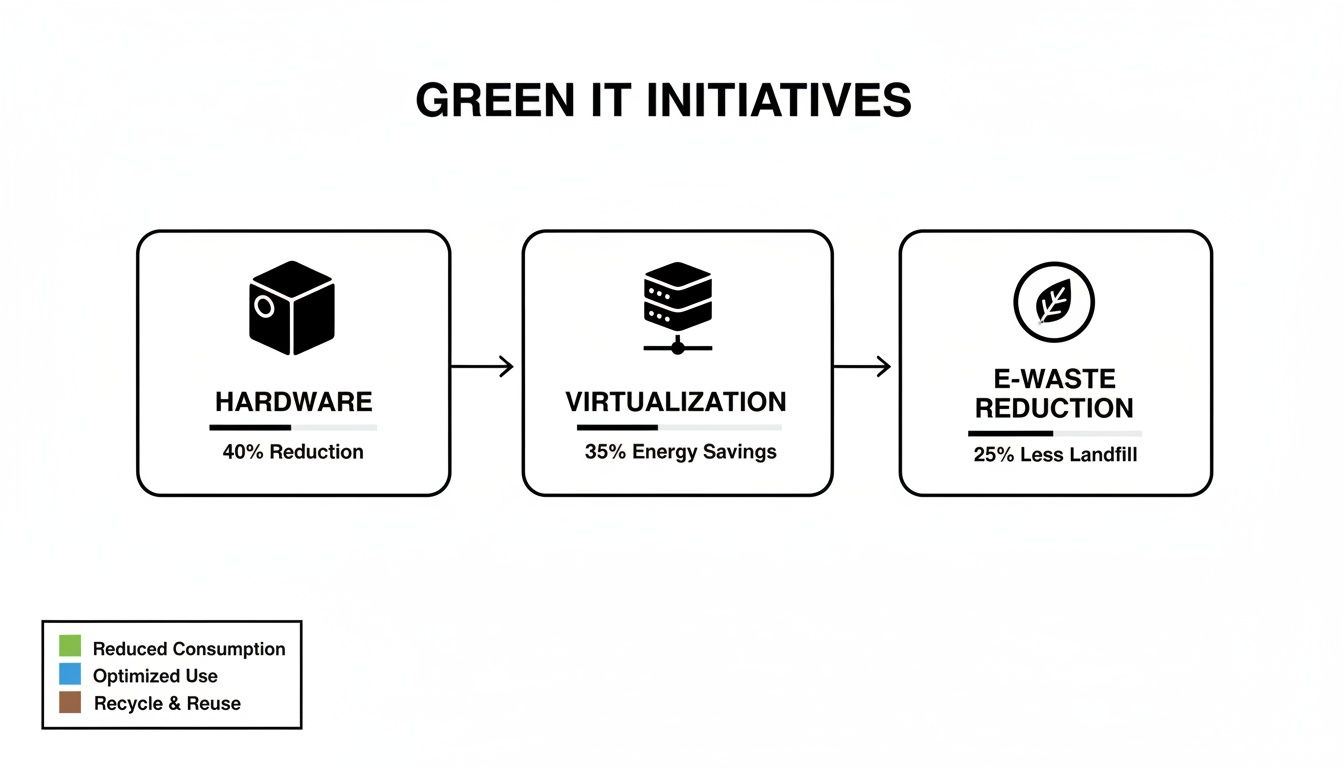
As you can see, optimising one area often has a positive knock-on effect on others. This leads to compounded savings and a much smaller environmental impact over time.
Calculating Your Return on Investment
To get everyone on board, from your finance team to your CEO, you need to show a clear Return on Investment (ROI). Let's walk through a real-world example: a Philippine SMB is deciding between leasing 100 new, energy-efficient laptops or buying 100 older, standard models outright.
A proper ROI calculation goes beyond the initial sticker price. You have to look at the Total Cost of Ownership (TCO) over a specific period, typically three years. To get the data you need for a compelling financial case, using tools for real time monitoring of your IT resources is a game-changer.
A true ROI analysis for green IT must account for hidden costs like energy consumption, maintenance, and the financial flexibility gained by avoiding a large upfront capital expense. This is where the real value becomes clear.
Let's break down the numbers in a simple comparison table. This scenario makes the financial case for green IT leasing practically undeniable.
Here’s a 3-year cost-benefit analysis comparing the two options. It shows how a Philippine SMB can save significantly by choosing to lease green IT equipment instead of making a large, upfront purchase of standard models.
ROI Scenario Leasing 100 Green Laptops vs Buying Standard Models
| Cost Factor | Standard Purchase (PHP) | Green IT Leasing via REDCHIP (PHP) | Savings (PHP) |
|---|---|---|---|
| Upfront Capital Outlay | ₱2,500,000 | ₱0 | ₱2,500,000 |
| Total Lease Payments (36 mos.) | ₱0 | ₱2,160,000 | -₱2,160,000 |
| Estimated Energy Costs | ₱540,000 | ₱270,000 | ₱270,000 |
| Estimated Maintenance & Repairs | ₱200,000 | ₱0 (Included in lease) | ₱200,000 |
| Total 3-Year Cost | ₱3,240,000 | ₱2,430,000 | ₱810,000 |
The table tells a powerful story. Even with the monthly lease payments, the total cost over three years is substantially lower.
The business not only saves ₱810,000 but also frees up a massive ₱2.5 million in initial capital—cash that can be reinvested into growing the business. This kind of clear, data-driven proof shows that green IT isn't just an expense; it's one of the smartest, most profitable investments you can make.
Overcoming Common Hurdles to Green IT Adoption
It’s easy to see the appeal of green information technology, but for many businesses here in the Philippines, the first step feels like the hardest. The path to a more sustainable and wallet-friendly IT operation often seems blocked by a few common, very real challenges. The trick is to face these hurdles head-on with practical solutions that unlock serious savings and make your operations run smoother.
The biggest showstopper? That perceived high upfront cost. When a business owner sees the price of a new energy-efficient server or a fleet of modern laptops, the gut reaction is often, "We just can't afford that right now." For an SMB or a startup carefully watching its cash flow, that initial capital hit can feel impossible.
Another major roadblock is the lack of specialised knowledge in-house. Sure, ideas like server virtualisation or optimising a network sound fantastic in theory. But actually pulling them off requires a specific skillset that many small and medium-sized businesses just don’t have on the payroll. And hiring a full-time expert is often completely out of the question.
Breaking Down the Cost Barrier
The notion that going green requires a massive upfront investment is one of the biggest myths out there, especially with today's flexible ways of getting new gear. You don't have to buy everything outright anymore.
The smartest way to get past the initial cost is to change how you think about IT—shift from ownership to access. Leasing and rent-to-own plans put modern, energy-efficient technology in your hands immediately, without draining your bank account.
Instead of a ₱2.5 million capital expense that hits your books hard, you can have a predictable, manageable monthly operational cost. A practical example is a new logistics company that leases its entire IT setup—from laptops to servers. This allows them to launch with cutting-edge, efficient technology while preserving their capital for hiring drivers and purchasing vehicles.
Getting the Expertise You Need Without the Overhead
You don't have to build an expensive internal team of specialists to put powerful green IT strategies into play. The answer for most businesses is to partner with a managed IT services provider. This gives you on-demand access to the exact expertise you need, right when you need it.
This partnership model is a true game-changer for SMBs. You get all the technical muscle for complex projects like server consolidation or network fine-tuning, but without the long-term salary and benefits commitment of a full-time hire. For instance, a dental clinic can hire a managed service provider to virtualize their old patient record server, a one-time project that cuts their IT energy costs in half without needing to hire an IT manager. You can learn more about how managed services and consulting can affordably fill that expertise gap.
Building a Green-Minded Culture
Sometimes the biggest obstacle isn't about money or technology—it's about people. If your team resists change, even the best-laid plans will stall. Getting everyone on board, from the top down, is absolutely critical for any real, long-term success.
To get the ball rolling, you need clear communication that focuses on real-world benefits.
- Show Them the Money: Use hard numbers, like the ROI table we looked at earlier, to show leadership the undeniable financial upside.
- Educate Your Team: Explain how simple habits, like shutting down workstations at the end of the day, directly contribute to company savings and help the environment.
- Lead by Example: When the bosses actively support and take part in green initiatives, employees are much more likely to get on board. A simple practical example is the CEO making it a point to use a laptop in meetings instead of printing out agendas for everyone.
This cultural shift is becoming more important as the Philippines pushes towards its renewable energy targets. The national goal of reaching 35% renewable energy by 2030 will directly influence the ICT sector, especially with AI and cloud services demanding more and more sustainable power. Big "hyperscale" data centre operators are already investing heavily in efficient cooling and renewable energy, because they know it's key to avoiding massive operational costs down the line. To learn more, check out these insights on the convergence of renewable energy and tech growth in the Philippines on philippinehubpartners.com. By tackling these common barriers now, your business can get ahead of this national trend, making Green IT not just an achievable goal, but a profitable one.
Frequently Asked Questions About Green IT
Thinking about Green IT often brings up some very practical questions for business owners. Let's tackle some of the most common ones with straightforward answers to help you see how it can work for your company.
Is Green IT Only for Large Corporations?
Not at all. While the big players often get the headlines for their sustainability projects, Green IT principles are just as powerful—if not more so—for small and medium-sized businesses (SMBs). The reality is, an SMB can make changes much faster and see the benefits almost immediately.
Think about it: a massive corporation might spend years planning a rollout to replace thousands of desktops. A smaller business with 20 people can swap out old desktops for energy-efficient mini PCs over a single weekend. That move alone can slash workstation energy costs by up to 80%, and you'll see the difference on your very next Meralco bill.
What Is the Easiest First Step Our Business Can Take?
The simplest, highest-impact change you can make is to rethink how you get your hardware in the first place. Before you buy anything, seriously consider leasing energy-efficient laptops or mini PCs. This one decision solves several Green IT challenges at once.
Leasing modern, efficient hardware is the perfect entry point into Green IT. It bypasses the large upfront cost, instantly reduces your daily energy consumption, and outsources the headache of responsible e-waste disposal.
You get immediate access to new tech that uses far less electricity, which directly lowers your operating costs. Better yet, when the lease is up, the provider handles the responsible refurbishing or recycling of the old equipment, so you know it's not just ending up in a landfill.
How Does Virtualization Actually Save Money?
Virtualization is one of the most effective money-saving tools in the Green IT playbook. The concept is simple. Imagine a physical server is like a big, empty warehouse. Instead of using that entire space to store one small box (a single application), virtualization installs shelving and partitions, allowing you to safely store hundreds of different boxes (multiple applications) in the same building.
You’re getting so much more out of the one piece of hardware you already have. This leads to real savings:
- Less Hardware: You don't need to buy, power, and maintain a whole fleet of physical servers. A practical example: A retail chain with 10 stores might have 10 separate servers for inventory. Virtualization could consolidate all 10 onto a single, powerful server at their headquarters.
- Lower Energy Bills: Fewer machines running means a smaller electricity bill.
- Reduced Cooling Costs: A smaller server room generates less heat, which can dramatically cut your air conditioning expenses—a major cost in the Philippines.
Can Green IT Improve Our Cybersecurity?
Yes, and the connection is stronger than you might think. Green IT and solid cybersecurity go hand-in-hand because they both rely on modern, properly managed technology. Old, power-hungry hardware isn't just inefficient; it's a huge security liability. Manufacturers eventually stop releasing security patches for older devices, leaving them wide open to attack.
By adopting a Green IT strategy that includes leasing and regularly refreshing your hardware, you ensure your team is always working on current, fully-patched, and secure equipment. For example, a financial services company that refreshes its employee laptops every three years not only gets more energy-efficient models but also ensures that all devices are running the latest operating systems with up-to-date security features, drastically reducing their vulnerability to cyberattacks.
Ready to make your IT operations more efficient, secure, and cost-effective? REDCHIP IT SOLUTIONS INC. provides business-ready IT leasing, deployment, and managed support to help Philippine businesses scale smarter. Explore our flexible IT solutions at https://redchipcomputers.com.



