Let's get right to it. What exactly is IT asset management (ITAM)? In simple terms, it's the process of making sure every single piece of technology in your business is accounted for, managed effectively, and works for you from the day you buy it until the day it’s retired. It’s much more than just keeping a list of laptops.
Think of it as the central nervous system for your company's tech.
What Is IT Asset Management and Why It Matters
Let’s use an analogy. Imagine running a professional kitchen for a high-end restaurant. A top chef doesn't just "own" equipment; they know everything about it. They know which oven cooks most evenly, when the knives were last sharpened, and precisely what’s in the pantry to avoid spoilage. This level of detail stops a critical oven from failing during the dinner rush and prevents money from being thrown away on expired ingredients.
That’s exactly what IT asset management does for your technology. It’s a complete system for overseeing every piece of hardware and software your business depends on to operate. We're talking about the physical gear you can touch and the digital tools your team uses every single day.
A well-oiled ITAM strategy provides a clear, 360-degree view of your entire tech environment, from the server room to your remote employee's laptop. It brings clarity to what can often be a chaotic mix of equipment and software.
To get a clearer picture, let's break down the main components of ITAM and what they mean for your business.
Core Components of IT Asset Management
| Asset Type | What It Includes | Practical Example & Problem Solved |
|---|---|---|
| Hardware | Desktops, laptops, servers, printers, routers, smartphones, and any other physical tech device. | A sales agent leaves the company but doesn't return their company-issued tablet. Without ITAM, it might go unnoticed. With ITAM, the device is tracked to the employee, ensuring it's recovered and preventing a ₱25,000 loss. |
| Software | All applications, operating systems, and subscriptions (e.g., Microsoft 356, Adobe Creative Cloud). | Your company buys a 50-user licence for a project management tool. ITAM software reveals only 30 employees have logged in over the past 90 days. You can downgrade your plan and save thousands monthly. |
| Cloud | Virtual machines, cloud storage accounts, and Software-as-a-Service (SaaS) platforms. | A developer spins up a powerful cloud server for a test and forgets to shut it down. ITAM tools can flag this idle resource, preventing hundreds of dollars in unnecessary cloud spending. |
| Data | Your company’s information itself—customer records, financial data, internal documents. | ITAM helps track where your client database is stored and shows that an unauthorised junior employee has access. You can revoke their permissions immediately, closing a major security gap. |
This table shows that ITAM isn't just an administrative chore; it's a fundamental business discipline that directly strengthens your operations and finances.
Without it, you’re flying blind. For example, a BPO in Manila might be paying for 500 licences for a particular software but only have 420 active employees using it. That's a huge budget leak happening every single month, completely unnoticed.
IT asset management gives you the visibility needed to make smarter financial, operational, and security decisions. It transforms your technology from a simple expense into a strategic, well-managed business enabler.
By taking a structured approach to it asset management, you can finally get rid of "ghost assets"—those devices that are lost, stolen, or broken but still recorded as active on your books. You can also stop paying for software you don't use. This is the kind of proactive control that makes ITAM a non-negotiable for any scaling business in the Philippines today.
Understanding the IT Asset Lifecycle
Every piece of technology in your business, from a server humming away in the data centre to the laptop you give a new hire, has a story. This story is its lifecycle—a predictable journey from the moment you realise you need it to its final retirement. Real IT asset management isn't just a snapshot in time; it's about steering that entire journey to get the most value out of every device while keeping risks low.
The trick is to see this lifecycle as a continuous loop, not a series of separate events. What you do in one stage has a direct impact on the next, and a small oversight early on can snowball into a major headache down the road.
Let's make this real. Imagine a BPO in Cebu that's just hired a new customer service agent. They need a laptop, and its story is about to begin.
Stage 1: Procurement
This is where it all starts. Procurement is much more than just clicking "buy now." It's the strategic part—figuring out the need, weighing your options, talking to vendors, and finally, making the purchase. So many businesses make the mistake of only looking at the price tag.
For our new BPO agent, the IT manager isn't just grabbing the cheapest laptop available. They're thinking ahead. They consider the specific software the agent needs, the security protocols they have to meet, and how long they expect the device to last. They might opt for a model with slightly better specs, knowing it will keep the agent working efficiently for three solid years. This smart thinking avoids wasting money on overpowered machines or, worse, buying cheap devices that need to be replaced way too soon.
Stage 2: Deployment
Once the laptop arrives, it’s time for deployment. This is all about getting the device set up and into the hands of the new agent, ready to go from day one. Get this part right, and your new hire is productive immediately.
Here's what happens to the BPO agent's new laptop:
- Asset Tagging: First, it gets a unique ID tag. The serial number, model, and assigned user are all logged in the central ITAM system so it never gets lost in the shuffle.
- Software Installation: Next, the IT team loads it up with the company's standard operating system, security software, communication tools, and the all-important CRM platform.
- Configuration: Finally, they configure network access, set up security policies, and apply user permissions based on the agent's role.
A smooth deployment means the device is secure, follows company rules, and is genuinely useful from the moment it's switched on. A rushed job can lead to security holes or hours of wasted time while the employee waits for IT to fix things.
Stage 3: Management and Maintenance
This is the longest part of the asset's life. Now that the laptop is in use, the focus shifts to keeping it running smoothly, securely, and efficiently. This is the active phase of monitoring, maintaining, and updating the device.
For the BPO agent's laptop, this ongoing care looks like:
- Regular Updates: Pushing out critical security patches and software updates to fend off the latest threats.
- Performance Monitoring: Keeping an eye on things like CPU and RAM usage to catch slowdowns before they become a problem.
- Proactive Maintenance: Scheduling routine check-ups to make sure the hardware is in good shape, which is key to preventing unexpected downtime.
Without this proactive approach, the laptop's performance could dip, hurting the agent's productivity. Even worse, it could become an easy target for a security breach.
By actively managing an asset, you extend its useful life and ensure it consistently delivers value to the business. It’s the difference between a reliable tool and a recurring problem.
Stage 4: Disposal
Nothing lasts forever. Eventually, every asset reaches the end of the road. The disposal stage is the final chapter, and it’s all about retiring the asset securely and responsibly. This part needs to be handled with extreme care to protect sensitive company data and meet environmental rules.
After three years of hard work, the BPO agent's laptop is ready for retirement. The process isn't as simple as tossing it in a bin:
- Data Wiping: The first and most critical step is to securely and permanently erase all company and customer data from the hard drive.
- Component Salvaging: Usable parts, like RAM or the power adapter, might be harvested to be used as spares for other devices.
- Responsible Recycling: The rest of the hardware is handed over to a certified e-waste handler. This ensures it’s disposed of properly and doesn’t just end up poisoning a landfill.
Proper disposal protects your business from devastating data leaks and shows you're a responsible corporate citizen. You can learn more about how to handle this correctly in our guide on professional https://redchipcomputers.com/e-waste-management/.
To delve deeper into the various stages of IT asset management, consider exploring a comprehensive guide on Asset Lifecycle Management (ALM).
The Business Benefits of Strategic ITAM
Knowing the lifecycle of your technology is one thing, but turning that knowledge into a real business advantage is where the magic happens. Strategic IT asset management isn't just about ticking boxes or keeping lists; it's a powerful way to cut costs, tighten up security, and make your operations run smoother than ever.
And the best part? The benefits aren't generic. They directly solve the real-world pressures different industries face every day. For a growing business in the Philippines, every peso saved and every minute of downtime avoided goes straight to the bottom line. ITAM gives you the framework to make smart tech decisions that fuel that growth, not hinder it.
Let's dive into how a proper ITAM strategy delivers tangible results for key sectors right here at home.
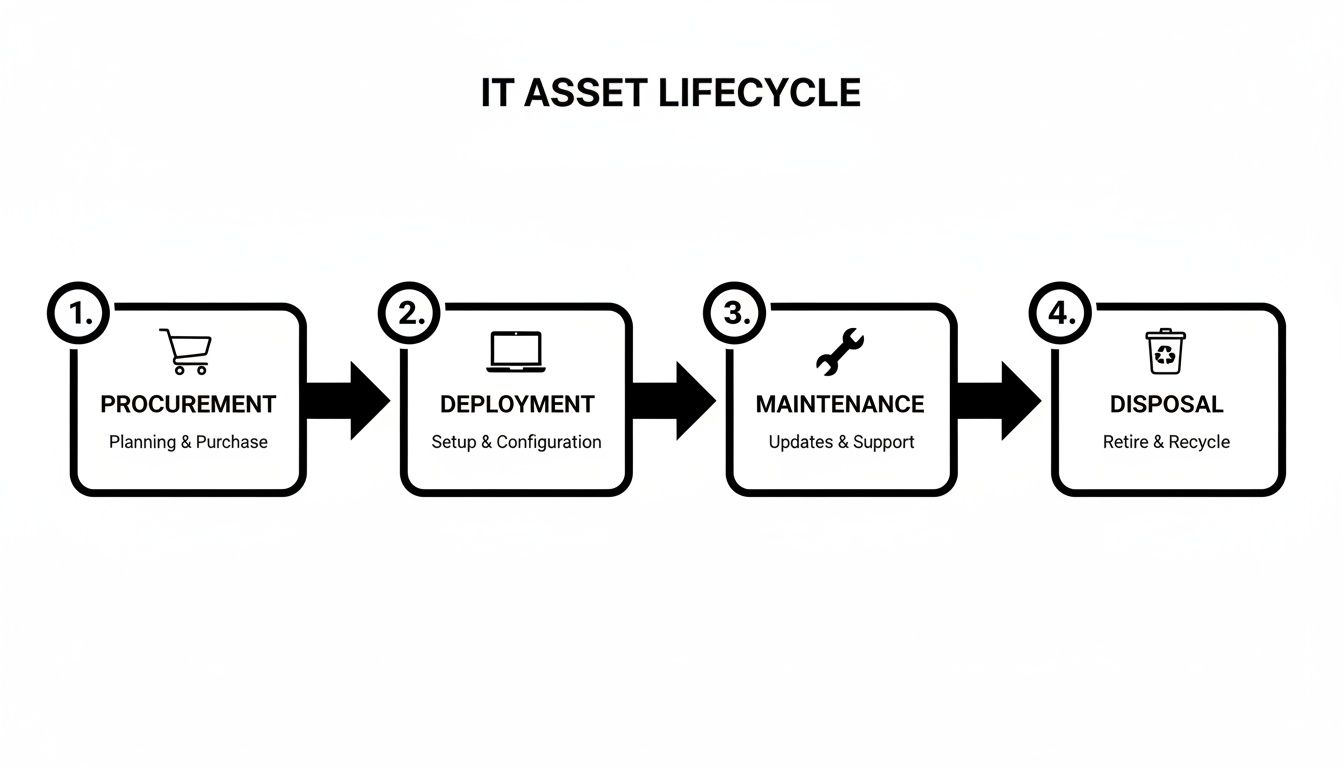
Visualising this journey—from buying a device to retiring it—is crucial. It helps you spot opportunities to get the most value out of your tech and cut risks at every single step.
Cost Control for Small and Medium Enterprises
For any SME, cash flow is everything. Unexpected IT bills can wreck a budget and put the brakes on expansion. This is where strategic IT asset management steps in, bringing much-needed financial clarity and turning chaotic, reactive spending into a predictable, manageable cost.
A classic dilemma for SMEs is whether to buy or lease their equipment. ITAM gives you the hard data to make that call confidently. By tracking how your assets are performing, what they cost to maintain, and how they lose value over time, you can get a crystal-clear picture of the Total Cost of Ownership (TCO).
Practical Example: A Local Design Agency
Picture a small graphic design agency in Makati that needs to upgrade five high-performance workstations. Buying them outright is a massive capital hit—we're talking over ₱750,000. But by looking at their ITAM data, they realise their project-based work means demand for that much power isn't constant.
Instead of buying, they choose to lease the workstations. This simple move transforms a huge one-time expense into a predictable monthly operational cost. Their ITAM system keeps track of the leased gear, making sure it’s returned on time to avoid penalties and making the next upgrade cycle a breeze. That’s smart financing that frees up cash to hire another designer.
Compliance and Uptime for BPOs
The Business Process Outsourcing (BPO) industry is a titan of the Philippine economy, and it's built on two things: reliability and trust. For a BPO, managing thousands of computers isn't just an IT chore—it's fundamental to client confidence and staying on the right side of the law.
BPOs are guardians of sensitive client information, which means sticking to global standards like PCI DSS or HIPAA is non-negotiable. A solid ITAM programme gives them a detailed, real-time inventory of all their hardware and software. This makes audits less painful and proves to clients they have a firm grip on security. It also guarantees every single workstation has the right software—fully licensed and patched—closing off security holes.
And then there's downtime. In a BPO, downtime is a disaster. Every minute an agent’s computer is offline is a minute of lost revenue and a potential breach of their service level agreements (SLAs). ITAM helps them get ahead of problems by tracking the age and performance of devices, flagging those at high risk of failure before they actually break down.
For a BPO, IT asset management is the backbone of operational integrity. It ensures that the thousands of endpoints touching customer data are secure, compliant, and consistently online.
This operational rigour is absolutely critical as the industry continues to boom. The Philippine IT-BPM sector, which depends heavily on robust IT asset management for its huge operations, closed 2025 with nearly 1.9 million employees and export revenues hitting almost US$40 billion. Projections show this climbing to US$42 billion by 2026, which underscores the need for the kind of efficient technology management that REDCHIP IT SOLUTIONS INC. provides. You can read more about the Philippines' IT-BPM industry growth to see the full picture.
Seamless Guest Experiences for Hospitality
In the hotel business, technology is a huge part of what makes or breaks the guest experience. Think about it: from flawless Wi-Fi to a POS system that never glitches, every piece of tech matters. For hotel chains trying to manage multiple properties, keeping that tech consistent and secure is a serious challenge.
ITAM brings order to that chaos. It allows a hotel group to standardise all its equipment—routers, POS terminals, in-room smart devices, you name it—across every single location. This makes maintenance simpler, cuts down on staff training time, and delivers a dependably great experience for guests, whether they’re checking in in Cebu or Manila.
Practical Example: A Hotel Chain
Imagine a boutique hotel chain with three properties. They want their guest Wi-Fi to be fast and secure everywhere, no exceptions. Using an ITAM system, the IT manager quickly spots that one location is running on older, underperforming network hardware.
This data is all the justification they need for a targeted upgrade. The ITAM platform then tracks the new routers all the way from purchase to installation, making sure they are configured with the exact same security settings as the other properties. The result? A consistent, reliable, and secure Wi-Fi experience for every guest, which protects both their data and the hotel's good name.
How to Implement Your IT Asset Management Strategy
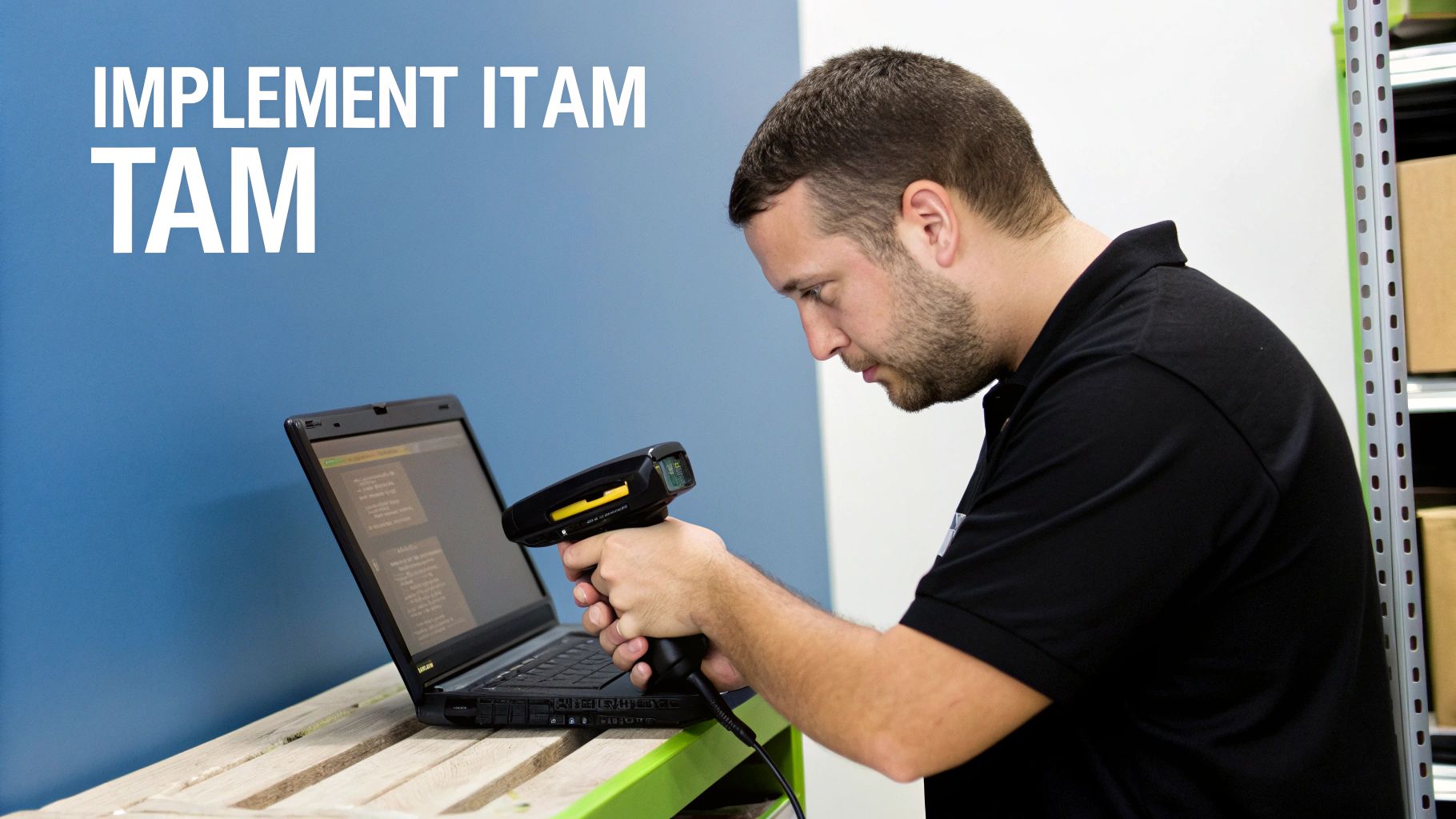
Moving from theory to practice is where an IT asset management programme truly proves its worth. Kicking off a strategy doesn't need to be some monumental undertaking; it's really about a series of clear, logical steps. This roadmap will walk you through building a solid ITAM foundation that can genuinely change how you handle technology in your business.
Think of it like setting up a professional library. You wouldn't just toss books onto shelves at random. First, you'd catalogue every single book, create a system for checking them in and out, and put a librarian in charge. That's the exact same organised approach we’re talking about here.
Start with a Complete Asset Inventory
You can't manage what you don't know you have. That’s why the first, most critical step is to conduct a top-to-bottom inventory of every single IT asset your company owns. This means all your hardware, software licences, cloud subscriptions, and mobile devices.
This initial audit creates your baseline—the single source of truth for everything else you do. It's often an eye-opening exercise that uncovers "ghost assets" (devices that are lost but still on the books) or forgotten software subscriptions quietly draining your budget.
For each asset, be sure to capture key details:
- Asset Type and Model: e.g., Dell Latitude 5420 Laptop.
- Serial Number and Asset Tag: A unique ID for easy tracking.
- Assigned User and Department: Who has it and where it is.
- Purchase Date and Warranty Status: Essential for planning its lifecycle.
An accurate inventory instantly gives you the power to make smarter decisions. As part of this, learning how to do an HP serial number warranty check can be a useful skill.
Define Clear Policies and Roles
Once your inventory is locked down, it's time to set the rules of the game. You need straightforward policies covering how assets are requested, deployed, managed, and eventually brought back. These policies cut through confusion and keep everyone on the same page.
Your policies should answer practical questions, such as:
- Who has the authority to approve a new laptop request?
- What’s the standard set of software for a new employee?
- What happens to a person’s tech when they leave the company?
Alongside solid policies, you must assign clear responsibilities. Who is your "IT librarian"? Even in a small business, one person should be accountable for keeping the asset register accurate and making sure the policies are followed. This creates ownership and stops the system from falling apart.
A well-defined policy is the playbook for your ITAM strategy. It ensures that every team member, from HR to IT to Finance, understands their role in protecting and managing company assets.
This kind of structure is crucial for businesses navigating the fast-paced Philippine market. With the national ICT sector projected to grow at a CAGR of 8% through 2034, digital adoption is booming. This growth means more devices, more software, and more complexity—making a formal ITAM process essential for any business looking to scale.
Choose Your Tools: Lease vs. Buy
So, how are you going to track all this? The tool you choose really depends on your company's size and complexity. For a startup with 10 people, a well-organised spreadsheet might do the job. But for a BPO with 200 agents, you’ll definitely need dedicated ITAM software to automate tracking, monitor usage, and manage licences properly.
At this point, you also hit a major financial crossroads: should you buy your assets outright or lease them?
| Decision Factor | Buying (CAPEX) | Leasing (OPEX) |
|---|---|---|
| Upfront Cost | High initial investment | Low, predictable monthly payments |
| Ownership | You own the asset permanently | You return the asset at end of term |
| Technology Refresh | You are responsible for disposal | Easy to upgrade to newer models |
| Maintenance | Your responsibility | Often included in the lease agreement |
For many SMEs, leasing is an incredibly smart move. It transforms a large capital expenditure (CAPEX) into a manageable operating expense (OPEX). This frees up cash for core business activities like marketing or hiring new talent.
Consider a Managed Service Provider
Finally, remember you don't have to go it alone. Teaming up with a Managed Service Provider (MSP) like REDCHIP can put your ITAM implementation on the fast track. An MSP brings deep expertise and specialised tools to the table, handling the day-to-day grind so you can stay focused on your business.
This is a game-changer for companies without a dedicated in-house IT team. An MSP can manage the entire asset lifecycle for you—from procurement and deployment to ongoing maintenance and secure disposal. It’s a sure-fire way to know your ITAM strategy is being executed professionally from day one.
Measuring the Success of Your ITAM Programme
So, how do you prove your IT asset management strategy is actually working and not just some box-ticking exercise? The proof is in the numbers—specifically, the right Key Performance Indicators (KPIs). These aren't just technical stats for the IT department; they're clear, business-focused metrics that show the real-world value you're creating.
Tracking the right KPIs is what transforms your ITAM efforts from a cost centre into a genuine value driver. It’s how you demonstrate a clear return on investment (ROI) and make smarter, data-backed decisions for every tech purchase down the road.
Financial and Cost-Related KPIs
The most straightforward way to show ITAM’s impact is to follow the money. These metrics help you pin down exact cost savings and show just how much more financially efficient your operations have become.
- Total Cost of Ownership (TCO): This is the big one. TCO isn't just the purchase price; it’s the entire cost of an asset from cradle to grave. We're talking purchase, maintenance, support, and even disposal costs. If the TCO across your asset pool is trending downwards, your ITAM strategy is definitely paying off.
- Software Licence Compliance: This KPI tracks the percentage of your software that is properly licensed. Your goal here should be 100% compliance, no exceptions. Falling short can lead to surprise software audits and eye-watering fines that can easily run into millions of pesos.
Practical Example: Picture a BPO centre in Manila. They run a software audit through their ITAM system and discover they're paying for 100 premium software licences, but only 75 are actually assigned to active employees. By simply cancelling those 25 unused licences, they immediately cut costs by over ₱50,000 every single month.
Operational Efficiency KPIs
Beyond just saving cash, a solid ITAM programme makes your entire business run smoother. These KPIs measure just how much more efficient your day-to-day operations and assets have become.
An effective ITAM strategy reduces waste and ensures your technology is always ready to support your business goals. It’s about getting the maximum value out of every single asset you own.
One of the most telling operational metrics is the Asset Utilisation Rate. This KPI reveals how much an asset is actually being used. For hardware, this might be the CPU usage on a server. For software, it's the number of active users versus the number of licences you've paid for. Low utilisation is a massive red flag pointing straight to wasted money.
Another critical metric is Mean Time to Repair (MTTR). This measures the average time it takes to get a failed asset back up and running, from the moment it breaks down to when it's fully operational again. A consistently decreasing MTTR is a clear sign that your maintenance processes, tracked within your ITAM system, are getting better and more efficient.
If you're looking to bring that number down, a structured approach is essential. You can learn more about building an effective system in our article on preventive and corrective maintenance.
Security and Risk Management KPIs
Finally, effective it asset management is a critical part of any good security strategy. Tracking security-related KPIs is how you demonstrate that ITAM is actively protecting the business from threats.
A key indicator to watch is the Percentage of Assets with Up-to-Date Patches. This shows how quickly your team is rolling out critical security updates to all your devices. A high percentage—ideally above 95%—means you're closing security holes before attackers have a chance to find them.
By keeping an eye on these KPIs, you can confidently show stakeholders that your ITAM programme isn't just saving money; it's making the entire organisation much, much safer.
Common ITAM Mistakes and How to Sidestep Them
Putting a solid IT asset management plan in place can be a game-changer, but the road is often littered with common tripwires that can undo all your hard work. Knowing what to look out for is the best way to navigate around these issues and make sure your ITAM programme pays off from the get-go.
So many businesses fall at the first hurdle: a patchy or just plain wrong asset inventory. Think of it like trying to manage a stockroom when your records don't even show half the shelves. You're going to lose things, waste money, and create massive security blind spots.
Another classic mistake is treating ITAM like a one-off project. It’s not something you can "set and forget." Assets are always on the move—being deployed, updated, or retired—and your system needs to keep up with that constant churn.
Forgetting About Your People
Perhaps the biggest blunder is failing to get your entire team on board. ITAM isn't just a job for the IT department. It touches Finance, HR, and literally every employee who uses a company laptop or phone. If people don't get why you're doing it, they simply won't follow the rules.
Here’s a real-world example: The "Shadow IT" Headache
Picture this: someone in your marketing team signs up for a fancy new design tool with a company credit card, but they never loop in IT. Just like that, you have a "shadow IT" asset. It's unmanaged, potentially insecure, and a complete unknown when it comes to licence compliance. This one small action can open up security holes and lead to you paying for software you already have.
The only way to avoid this is to communicate the benefits clearly to everyone:
- For Staff: It means getting faster help when their laptop acts up.
- For Finance: It means predictable budgets with no nasty surprises.
- For Management: It translates to lower security risks and a smoother-running operation.
A successful ITAM programme is built on a culture of shared responsibility. When everyone understands their role in protecting and tracking company assets, the entire system just works.
Picking Software That's Too Complicated
It's tempting to go for the ITAM software with all the bells and whistles, but choosing a tool that's way too complex for your actual needs is a recipe for disaster. If the system is a pain to use, your team will find every excuse not to, and that expensive software you bought will end up as digital shelfware. The trick is to find a tool that fits you now but has room to grow with you.
This challenge gets even trickier when you factor in cloud and data centre assets. The Philippines data center market, which is crucial for managing this infrastructure, was valued at USD 1,043.5 million in 2025 and is expected to rocket to USD 2,226.9 million by 2034. This explosive growth, fuelled by massive data generation and ever-present security threats, shows why modern ITAM has to look beyond the physical devices on your desk. You can discover more about the Philippine data center market surge to see the bigger picture.
Your ITAM Questions, Answered
Thinking about IT Asset Management often brings up a few common questions. Let's tackle some of the ones we hear most from business owners here in the Philippines.
Is ITAM Just a Fancy Term for an Inventory List?
Not at all. Think of an inventory list as a simple snapshot—it tells you what you have. ITAM is the full movie. It's a living, breathing strategy that tracks an asset's entire journey with your company.
An inventory list might show you have 50 laptops. ITAM, on the other hand, gives you the critical business intelligence behind that number. It’ll tell you that 10 of those laptops need their warranties renewed next month, 5 are performing sluggishly and impacting productivity, and 3 are missing critical security patches, putting your data at risk. It’s the difference between just counting your tools and actually managing them for peak performance and security.
When is the "Right" Time for a Small Business to Start ITAM?
Honestly, the best time was yesterday. The second-best time is right now. It’s a common misconception that you need to be a certain size to start. The real trigger is when technology becomes essential for your business to function.
Ask yourself this: if a key employee’s laptop suddenly died, would it stop a critical part of your business? If the answer is yes, you're ready for ITAM. You don't need a complex system from day one. Even a well-organised spreadsheet is a fantastic starting point that will save you from massive headaches as your company grows.
Does Leasing Equipment Actually Save You Money?
For many businesses, especially those conscious of cash flow, the answer is a resounding yes. Leasing transforms a huge, one-time capital expense (CAPEX) into a predictable, manageable monthly operating expense (OPEX).
Instead of sinking a large chunk of cash into hardware that starts losing value the moment you unbox it, you can invest that capital into what really grows your business—like marketing or hiring top talent. Plus, leasing takes the pain out of technology upgrades, ensuring your team always has up-to-date tools without you having to figure out what to do with the old ones.
What's the Single Most Critical First Step?
Get a complete and accurate count of everything you have. You simply can't manage what you don't know exists. This initial physical audit is the bedrock of your entire ITAM programme.
This foundational step does more than just create a list. It uncovers "ghost assets" you're still paying for, shines a light on potential security vulnerabilities, and gives you the solid data you need to make every future decision with confidence.
Ready to build a robust IT asset management strategy without the guesswork? REDCHIP IT SOLUTIONS INC. delivers the expertise and tools you need, from hardware leasing to managed IT support. Visit us at redchipcomputers.com to see how we can help you scale smarter.



