Think of your business's IT like the plumbing and electricity in your office. You could hire a full-time plumber and electrician to sit around just in case something goes wrong, but that's incredibly expensive and inefficient.
Instead, you’d likely have a reliable facilities company on call. That's exactly what managed services consulting is for your technology. It's a strategic partnership where an external IT provider takes full responsibility for your entire tech environment for a predictable fee. For example, instead of paying a high one-time fee to fix a server that crashes, you pay a flat monthly rate to ensure the server never crashes in the first place. This approach turns your IT from a fluctuating capital expense into a stable, manageable operational cost.
What Is Managed Services Consulting

At its core, managed services consulting is about handing over the keys to your IT kingdom to a team of experts. This team, known as a Managed Services Provider (MSP), doesn't just fix things when they break; they work tirelessly in the background to stop problems before they even start.
This proactive approach means your MSP is constantly monitoring your network, patching your systems, and securing your data. You’re not just getting a helpdesk. You're getting a whole department of specialists—network engineers, cybersecurity analysts, and support technicians—for what is often less than the cost of hiring a single senior IT manager. A practical example is an MSP automatically applying a critical security patch to all company computers overnight to protect against a new virus, something an in-house person might take days to complete.
The Impact for Philippine Businesses
This model is a game-changer for growing businesses here in the Philippines, particularly for Small and Medium Enterprises (SMEs) and Business Process Outsourcing (BPO) firms. It levels the playing field, giving them access to the kind of robust technology and 24/7 support that was once only affordable for large corporations.
A managed services partnership frees you to concentrate on what you do best—serving clients, innovating products, and growing your business—instead of constantly being pulled into frustrating IT fires. It transforms technology from a reactive headache into a strategic asset that fuels your growth.
You can see this shift in the numbers. The Philippine IT-BPM industry, a sector that leans heavily on MSPs for everything from IT support to network management, recently generated an impressive $38 billion in revenue. That’s a 7% jump from the previous year, underscoring how local companies are turning to managed services to scale their operations without the burden of huge in-house investments. You can dive deeper into the trends shaping the Philippine MSP industry and its impact on business growth.
From Theory to Practical Application
So, how does this actually work day-to-day? Let's look at a couple of real-world scenarios.
- For a BPO: Instead of buying and maintaining hundreds of computers, an MSP can handle the leasing, deployment, and ongoing support for every agent’s workstation, ensuring maximum uptime. For instance, if an agent's computer fails mid-shift, the MSP can have a pre-configured replacement delivered and set up within hours, not days, minimising lost productivity.
- For an SME: Rather than losing productivity to a slow or unreliable internet connection, a managed partner proactively monitors network health and security. A practical example would be the MSP detecting unusual network traffic, identifying it as a potential cyber threat, and blocking it before it can compromise the company's data.
This is precisely the kind of value that providers like REDCHIP IT SOLUTIONS INC. bring to the table. Through expert consulting IT services, they help organisations get a firm grip on their technology, enabling them to expand with confidence and efficiency.
What Does a Managed Services Partnership Actually Look Like?

When you partner with a managed services consultant, you're not just buying a block of tech support hours. You’re bringing in a dedicated team with a whole suite of services designed to keep your business running smoothly, securely, and efficiently.
But what does that mean in practical terms? Let’s pull back the curtain and look at the core services that form the backbone of a strong managed services partnership, especially for businesses here in the Philippines.
The most visible and immediate benefit is the 24/7 Helpdesk & IT Support. This is your team's lifeline, the go-to resource that stops small tech hiccups from snowballing into major productivity killers.
Think about a BPO agent on a night shift at 3 AM. They suddenly get locked out of a vital client system, putting their service level targets on the line. Instead of waiting hours for an in-house IT person to clock in, they can contact the MSP helpdesk. A technician can then remote in and solve the problem in minutes, keeping the workflow—and the client—happy. That’s the real-world impact of around-the-clock support.
Keeping Your Business Connected and Secure
Beyond fixing day-to-day user issues, a great managed services provider focuses on the foundational tech that your entire operation depends on. This starts with Network & Wi-Fi Management, the invisible plumbing that keeps data flowing between your team and your customers.
Picture a multi-storey hotel in a tourist hotspot like Cebu or Boracay. Providing fast, reliable, and secure Wi-Fi to hundreds of guests across countless rooms and public areas is a huge technical challenge. An MSP doesn't just install routers; they design, deploy, and constantly monitor the entire network to ensure every guest has a great connection. This directly translates into better reviews and repeat business.
Of course, connectivity and security go hand-in-hand. This is where Cybersecurity Services come in. In a world where a single data breach can devastate a business's reputation, having a proactive defence is no longer a luxury—it's a necessity. Your MSP acts as your digital security detail.
For a law firm handling highly confidential client records, an MSP does more than just install a firewall. They actively manage threat detection systems, run vulnerability scans, and hunt for potential attacks before they can breach the network. A practical example is detecting and blocking a phishing email that impersonates a senior partner, preventing an employee from accidentally revealing their login credentials. It’s this proactive stance that protects the firm and its clients from disaster.
Managed IT services are not just about fixing things when they break. They're about building a resilient and secure technology foundation that lets you focus on what you do best: running your business.
From Reactive Fixes to Proactive Strategy
A major shift that comes with managed services is moving away from the old "break-fix" cycle. This is where Server and PC Maintenance plays a huge role. By constantly monitoring server health, applying critical security patches, and optimising performance, an MSP prevents costly downtime before it ever happens. This is the core difference between preventive and corrective maintenance—one saves you money and headaches, the other just cleans up the mess.
Another game-changer is Hardware Leasing & Deployment. This service completely transforms how you manage your physical IT assets, turning a massive capital outlay into a predictable monthly operating expense.
Imagine a startup that just landed funding and needs to hire 50 new people right away. Instead of burning through their capital to buy 50 high-end laptops, they can work with an MSP. The provider can deliver all the required devices—fully configured with the right software—practically overnight. The startup gets the tools it needs to scale quickly while keeping its cash free for growth.
These are just a few of the core components. To truly understand the possibilities, it’s worth exploring the full range of Managed IT services to see how they can be bundled to fit your company's specific needs. Whether it's laying the foundational network cabling for a new BPO floor or managing a complex server migration, the goal is always the same: providing reliable, secure, and cost-effective technology that helps you win.
Managed Services vs In-House IT for Philippine SMEs
For many Small and Medium-sized Enterprises (SMEs) and BPOs, the big question is whether to build an internal IT department or partner with a managed services provider. The table below breaks down the key differences to help you decide.
| Factor | Managed Services Consulting | Traditional In–House IT |
|---|---|---|
| Cost Structure | Predictable monthly fee (OpEx). | High upfront and ongoing costs (CapEx & salaries). |
| Expertise | Access to a diverse team of specialists (security, network, cloud). | Limited to the knowledge of the individuals you hire. |
| Availability | 24/7/365 support guaranteed by SLA. | Typically limited to standard business hours. |
| Scalability | Easily scale services up or down as business needs change. | Scaling is slow and expensive (hiring/firing). |
| Proactive Focus | Focused on preventing problems before they occur. | Often reactive, firefighting issues as they arise. |
| Tools & Tech | Access to enterprise-grade monitoring and security tools. | Cost of acquiring and maintaining advanced tools is high. |
Ultimately, while an in-house team offers dedicated, on-site presence, a managed services partner provides a breadth of expertise, predictable costs, and scalability that is often a better fit for the dynamic needs of a growing Philippine business.
Finding the Right Engagement Model for Your Business
So, you get what managed services are, but the next big question is how it all works. How do you pay for this, and more importantly, how do you make sure the provider actually delivers what they promise? The answers are found in the engagement model and the contract that holds it all together.
Think of it like a mobile phone plan. There isn't just one option because everyone has different needs. Some people want a predictable, unlimited plan so they never have to worry about overages. Others prefer to pay only for what they actually use. Managed services work the same way, offering different structures to fit how your business operates and budgets.
Exploring Common Pricing Models
The most common models out there offer a trade-off between predictability and flexibility. For any growing business, especially in the Philippines, getting this right is crucial. You want your IT spending to make sense for your financial strategy, not fight against it.
Here are the main models you'll come across:
-
All-You-Can-Eat (Per-Seat/Per-Device): This is by far the most popular and straightforward approach. You pay a flat, predictable monthly fee for each user or device you want covered. That fee includes everything—all the support, maintenance, and monitoring. For a BPO with a headcount that changes month to month, this model is a lifesaver. Hire 20 new agents? Your IT costs scale perfectly with them, making your budget simple and crystal clear.
-
Tiered Pricing: Here, providers offer different packages—think Bronze, Silver, Gold—at various price points. A "Bronze" plan might just cover basic monitoring and helpdesk support during business hours. The "Gold" tier, on the other hand, could include 24/7 support, advanced cybersecurity services, and even on-site visits. This is great for a startup that wants to start with the essentials and then upgrade as it grows and its needs get more complex. For example, a new retail store might start with a basic plan for its point-of-sale system, then upgrade to a higher tier with network management as it expands to multiple locations.
A well-structured engagement model aligns your MSP’s success with your own. When they are paid to prevent problems, their primary goal becomes ensuring your systems run flawlessly, which is exactly what your business needs to thrive.
The Importance of the Service Level Agreement
No matter which pricing model you choose, the entire relationship rests on one key document: the Service Level Agreement (SLA). An SLA is much more than just a contract; it's a performance guarantee. It’s the formal document that spells out exactly what services you're getting and the measurable standards the provider has to meet.
An SLA isn't just corporate jargon; it's your proof of accountability. It takes vague promises and turns them into solid commitments by answering critical questions with hard numbers.
For instance, a good SLA will clearly define things like:
- Response Time: How fast the MSP has to acknowledge your support request (e.g., within 15 minutes for a critical issue).
- Resolution Time: The maximum time they have to actually fix a problem (e.g., a server crash must be resolved within 4 hours).
- Uptime Guarantee: A promise that your core systems, like your network or cloud servers, will be up and running 99.9% of the time.
Just imagine your e-commerce site goes down during a big sale. A solid SLA means your provider is contractually obligated to start fixing that problem in minutes, not hours. It turns a verbal promise of "good service" into a binding commitment you can rely on, giving you the peace of mind you need to run your business.
Calculating the True Value of Managed Services
It's easy to look at a managed services contract as just another line item on your monthly expenses. But to really understand the financial impact, you have to look past the invoice. The true value isn't just about what you pay; it's about what you gain in efficiency and, more importantly, what you avoid losing.
The best way to see this clearly is to compare the Total Cost of Ownership (TCO) of running an in-house IT team versus partnering with a Managed Services Provider (MSP). You also need to calculate the often-overlooked Return on Investment (ROI) that comes from preventing problems before they start.
An MSP agreement might feel like a new cost, but it's really replacing a tangled web of much larger, less predictable expenses. Getting your head around this difference is the key to making a sound financial decision for your company.
This is where understanding the different engagement models becomes crucial.
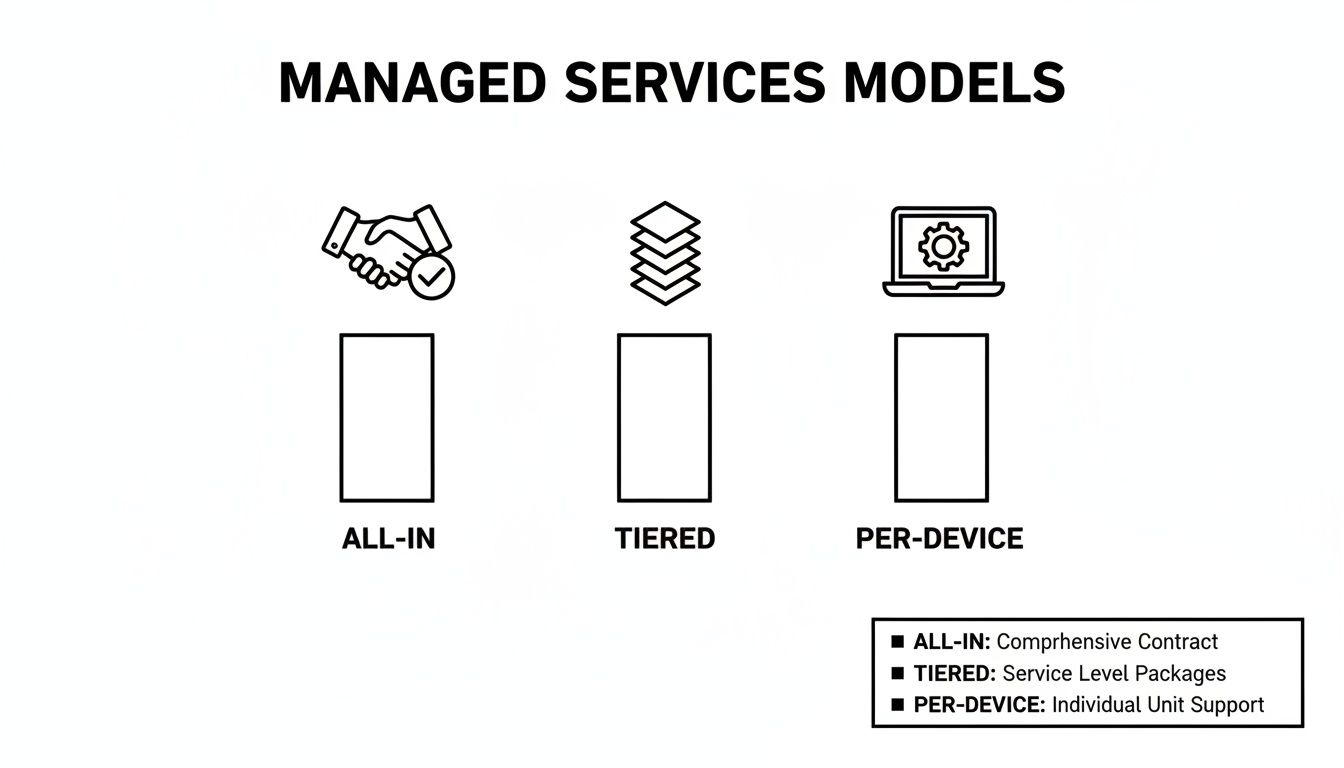
Each of these models—All-In, Tiered, and Per-Device—offers a distinct way to structure your IT investment. It allows you to align your spending directly with your actual operational needs and budget.
Comparing Total Cost of Ownership
Let's run a quick, practical comparison. Imagine you’re a 50-employee company here in the Philippines. The first instinct is to compare an MSP's fee to the salaries of an in-house IT person or two. But that's not the whole story. Not even close.
The true cost of an internal team is buried under a pile of additional expenses that add up fast. To get an honest TCO, you need to account for everything.
In-House IT Team (2 Staff Members):
- Salaries & Benefits: This is the obvious one. But don't forget it includes not just the base pay but also mandatory contributions like SSS, PhilHealth, and Pag-IBIG, plus any bonuses or allowances.
- Recruitment & Training: Finding good IT talent is tough and expensive. Then you have to pay to keep their skills sharp with continuous training on new technologies and threats. For example, sending a staff member to a cybersecurity conference can cost thousands of dollars in fees and travel.
- Software & Tools: Your team can't work without the right gear. Professional tools for network monitoring, cybersecurity, and helpdesk ticketing come with hefty annual license fees. A single enterprise-grade security monitoring license can cost over $10,000 per year.
- Management Overhead: How much time does your senior leadership or HR team spend managing the IT department? That's a real, albeit hidden, cost that pulls them away from their core jobs.
Managed Services Provider Contract:
- Fixed Monthly Fee: This is the beauty of the model. You get a predictable, fixed cost that covers a whole team of specialists and their enterprise-grade toolset. It turns a volatile capital expense into a stable, manageable operational one.
When you lay it all out, the fully-loaded cost of even a small internal team can easily surpass the fee for a comprehensive managed services agreement—an agreement that gives you access to a much deeper and wider pool of expertise.
Uncovering the Hidden Return on Investment
Here’s where the real magic happens. The most powerful financial argument for an MSP lies in the ROI from preventing disasters and boosting productivity. These are the gains that don't show up on a simple budget sheet, but they have a massive impact on your bottom line. To find them, you have to ask: what is the cost of not having an MSP?
The most significant ROI from managed services doesn't come from cutting direct costs. It comes from eliminating the immense hidden costs of downtime, inefficiency, and lost opportunities. It's an investment in business continuity and growth.
Think about it in real terms. What is the actual cost of downtime? If your sales platform goes offline during business hours, how much revenue do you lose for every single hour? Studies have shown that just one hour of downtime can cost a small business thousands of dollars in lost sales, wasted salaries, and damage to your reputation. An MSP’s proactive monitoring is designed specifically to prevent these kinds of outages.
Let's paint a picture. A logistics company in Manila depends on its central server for dispatching and tracking every delivery. An MSP, through routine proactive maintenance, detects a failing hard drive before it crashes. They schedule a replacement overnight, and by morning, it’s business as usual with zero interruption.
Now, imagine that without the MSP. The server would have inevitably failed, probably right in the middle of the morning rush. The result? Hours of chaos, delayed deliveries, frustrated clients, and huge overtime bills to get the system back online. The cost of that single incident would likely be more than several months of the MSP's fees.
That right there is the tangible ROI of managed services—preventing the catastrophe and keeping your business running smoothly.
How To Choose The Right Managed Services Partner
Picking a managed services provider is one of the biggest technology decisions your business will ever make. This isn’t just about hiring someone to fix computers; you’re choosing a long-term strategic partner who will be woven into the fabric of your daily operations. A great partnership can fuel your growth, but the wrong one can become a source of constant frustration and risk.
Making the right choice demands a thoughtful, organised approach. You have to look past the slick sales pitch and really dig into a provider's capabilities, their track record, and how well their team will mesh with yours. For businesses here in the Philippines, that also means asking specific questions that get to the heart of our unique market challenges.
Verifying Technical Chops And Industry Experience
First things first: you need to confirm that any potential partner has the actual technical skills to support your specific setup. IT is a massive field, and no single provider is an expert in everything. You have to be direct and ask for proof.
For instance, if you're planning a big move to the cloud, don't just ask if they do cloud migrations. Ask, "Can you walk me through a recent cloud migration you handled for a company our size?" This pushes them beyond a generic "yes" and forces them to share real, concrete experience.
Just as important is their background in your industry. A provider that mainly serves manufacturing clients might not grasp the high-stakes, 24/7 uptime demands of a BPO. For example, a financial services firm needs an MSP that deeply understands data privacy regulations, while a retail chain needs one with expertise in point-of-sale systems and inventory management networks.
When you're vetting a provider, ask pointed questions about their experience with businesses just like yours. A partner who already speaks your industry's language will get up to speed faster and offer solutions that actually make sense for you from day one.
The Vendor Selection Checklist
To keep your evaluation structured, it helps to use a checklist. This ensures you're comparing every potential partner on the same terms. For Philippine businesses, this means asking about everything from their technical skills to their on-the-ground support capabilities.
Here’s a table you can use to guide your conversations and make sure you cover all the critical bases.
Vendor Selection Checklist
| Evaluation Criteria | Questions to Ask | Why It Matters |
|---|---|---|
| Industry Experience | Can you share case studies or client references from the BPO (or your) industry? | Proof they understand your specific operational pressures, compliance needs, and common challenges. |
| Technical Expertise | How do you certify your engineers? Can we see your team's certifications for [Microsoft Azure, Cisco, etc.]? | Verifies that their team has the formal training and knowledge to manage your specific technologies. |
| Service Level Agreement (SLA) | What are your guaranteed response and resolution times for critical, high, and low-priority issues? What are the penalties if you miss them? | Defines their commitment to service quality and gives you recourse if they don't meet expectations. |
| On-Site Support | What is your on-site response protocol and guaranteed time for businesses located outside of Metro Manila? | Crucial for businesses with physical locations, especially outside major urban centres. Tests their logistical capabilities. |
| Cybersecurity Posture | How do you stay current with the latest threats? What specific tools and protocols do you use to protect client data? | Shows whether they are proactive or reactive about security. Their answer reveals their commitment to protecting your most valuable asset. |
| Team Structure & Escalation | Who will be our primary point of contact? What is the escalation path for critical issues after hours? | You need to know there's a clear, reliable process for getting help when you need it most, not just a generic support email. |
| Scalability Plan | As we plan to double our headcount, how will your services and pricing scale with us? | A good partner should have a clear, predictable plan for growing with you without sudden, massive cost increases. |
| Cultural Fit | Can you describe your communication style? How do you handle disagreements or project delays? | You'll be working with these people daily. A partnership based on transparency and mutual respect is essential for long-term success. |
This checklist is where the real value of managed services consulting comes to life. It’s not just about what they can do, but how they do it. The quality of their answers will tell you a lot about their operational maturity and whether they're truly partner material.
Assessing Scalability And Cultural Fit
Your business isn’t standing still, and your IT partner shouldn’t be either. One of the most critical things to assess is their ability to grow with you. A provider that’s perfect for your 50-person team today must also have the resources and processes to support you when you hit 150.
Ask them straight up: "We plan to double our team in the next two years. How would your support model and services scale with that growth?" A confident partner will have a clear, well-documented process for bringing new users on board and expanding your infrastructure without hiccups. A dependable information technology company is built to grow right alongside its clients.
Finally, never underestimate the importance of a good cultural fit. You’re going to be talking to this team a lot. Do they listen? Do they explain technical things patiently and clearly? A partnership founded on mutual respect and open communication is far more likely to go the distance.
The need for these kinds of partnerships is skyrocketing. The Philippines Managed Services Market was valued at USD 10.11 billion in 2022 and is on track to hit USD 12.45 billion by 2030, largely because businesses need better cybersecurity and more efficient operations. This explosive growth shows just how vital it is to find partners who truly understand the local landscape.
Navigating the Road Ahead: Avoiding Pitfalls and Taking Your First Steps
Jumping into a managed services partnership can be a game-changer for your business, but it's not a magic bullet. Success hinges on sidestepping a few common traps that can sour the relationship before it even gets off the ground. Knowing what these look like is half the battle won.
One of the biggest mistakes we see is companies getting seduced by the lowest price tag. Of course, budget is always a factor, but the cheapest bid can often hide a world of pain—think sluggish support, missed service level agreements, and gaping security holes. Real value in an IT partner comes from reliability and deep expertise, not just a rock-bottom monthly bill.
Another classic pitfall is starting the conversation with fuzzy goals. Simply saying you want "better IT" is like telling a builder you want a "nicer house"—it's a recipe for mismatched expectations and disappointment. If you don't set specific, concrete objectives, how can you ever know if your provider is actually delivering what your business needs?
How to Get It Right from the Start
To dodge these bullets, you need to be deliberate and strategic right from the get-go. It's less about bargain hunting and more about finding a true partner who gets your business.
- Look for Value, Not Just a Low Price: Think beyond the quote. Create a simple scorecard that ranks potential providers on things like their experience in your industry, what their current clients are saying, and the actual skills of their technical team. A slightly more expensive partner with a proven track record is almost always the smarter, safer bet.
- Set Crystal-Clear, Measurable Goals: Before you even pick up the phone, sit down with your team and pinpoint your top three IT headaches. Are you constantly fighting downtime? Worried about your cybersecurity posture? Trying to empower a growing remote team? Put a number on it. Aim for things like "99.9% network uptime" or "cut down IT support tickets by 25% in the first six months."
- Make Communication a Non-Negotiable: Onboarding can be a bumpy process if communication isn't a priority. Insist on a clear communication plan from day one. This should outline regular check-in meetings, spell out who to call when things go wrong, and include transparent reports that show you exactly how they're performing. For instance, ask for a monthly report that shows network uptime percentages, the number of tickets resolved, and any security threats that were blocked.
A great managed services relationship isn't just a transaction; it's a strategic partnership. Treat the selection process like you're hiring a key team member who will be crucial to your company's growth and stability.
Your Action Plan for Moving Forward
Alright, now that you know what to watch out for, it's time to take some real action. The next phase is all about gathering the right intel to make a smart, informed choice.
1. Draft a Simple Request for Proposal (RFP): Don't overcomplicate this. A straightforward, two-page RFP is often all you need. Briefly introduce your company, outline your main IT challenges, and state your goals. Then, ask providers to describe their solution, team, pricing, and a sample Service Level Agreement (SLA).
2. Get Ready for the Discovery Call: This first chat is your chance to dig deep. Don't just let them give you a sales pitch. Come prepared with questions that get to the heart of how they operate.
- What are the top three IT problems you see crippling teams like ours?
- Talk me through how you handle a major security breach that happens at 2 AM on a Sunday.
- What does your onboarding process look like for a company our size?
3. Ask for a Sample Implementation Timeline: Seeing a timeline helps make the whole process tangible. It shows you what to expect and what will be required from your own team. A typical rollout often looks something like this:
- Week 1: Discovery & On-site Systems Audit
- Weeks 2-3: Solution Design & Finalising the Onboarding Plan
- Week 4: Deploying Agents & Taking Over System Monitoring
- Ongoing: Proactive Maintenance, Monthly Reporting & Quarterly Strategy Reviews
By following these practical steps, you'll be in a much stronger position to not just choose a provider, but to build a partnership that truly works.
Frequently Asked Questions
Even with all this information, you're bound to have a few more questions. It's completely normal. Let's tackle some of the most common ones we hear from businesses here in the Philippines.
What's the Smallest Company You Can Help?
Honestly, there’s no magic number. A solid managed services provider can bring value to a five-person startup just as much as they can to a 500-seat BPO. It all comes down to finding a partner with flexible service models.
A smaller business, for example, might just need a basic monitoring and helpdesk plan to get started. A larger company, on the other hand, will probably find an all-inclusive, per-device model a much better fit, covering everything from cybersecurity to hardware leasing. The right partner grows with you.
What Does the Onboarding Process Look Like?
A well-planned onboarding is key to a painless switch. It always starts with a deep dive into your current IT setup. This is where the MSP gets to know your systems, finds the weak spots, and identifies any security gaps.
After that, they'll carefully deploy their monitoring tools and agents onto your network and computers, planning it all out to make sure your day-to-day work isn't interrupted. The final step is introducing your team to the helpdesk and showing them how to get support. You can usually expect this whole process to take between two to four weeks.
A common worry is that bringing in an MSP means losing control of your IT. The reality is the exact opposite. It gives you more control by offering a clear window into your system's health, security, and performance through detailed reports and expert advice.
Can You Work with Our In-house IT Team?
Absolutely. In fact, it’s one of our favourite ways to work. This setup is often called a "co-managed IT" model, and it's all about partnership. The MSP becomes a force multiplier for your internal team, not a replacement.
Think of it this way: the MSP can handle the routine, time-sucking tasks like server patching or 24/7 network monitoring. For example, the MSP can manage the daily backup checks and security patch updates, which might take an in-house person several hours a week. This frees up your own people to focus on the big-picture, strategic projects that actually grow the business, like developing a new internal software application. It's a win-win.
Ready to build a resilient and scalable IT foundation for your business? The team at REDCHIP IT SOLUTIONS INC. specialises in creating managed services solutions that fit the unique needs of Philippine businesses. Explore our IT services today and discover how we can help you scale smarter.


