Technology in the Philippines presents a fascinating paradox. While its people are some of the most digitally savvy consumers in the world, many local businesses are still running on surprisingly outdated infrastructure. This mismatch creates a huge gap between what customers expect and what companies can actually deliver, spelling out both a major challenge and an incredible opportunity for growth.
Understanding the Philippine Digital Landscape
Picture this: a crowded mall where every shopper is tapping their phone to pay using GCash, but most of the shops are still scribbling sales in a paper logbook and fumbling for change. That’s a pretty good snapshot of the tech scene here. There's a real imbalance between the high-speed digital lives of consumers and the often slow, analogue processes of businesses. It's creating an urgent need for companies to catch up, and fast.
This consumer-first digital wave means people now expect everything to be seamless. They want frictionless e-commerce checkouts on Shopee, instant chat support via Facebook Messenger, and quick service. When a company's internal tech—like a clunky point-of-sale system that freezes or spotty office Wi-Fi that drops video calls—can't keep pace, it doesn't just cause a minor headache. It directly hurts the customer experience and hands an advantage to the competition. This is precisely why having a strategic IT partner is no longer a luxury; it's essential for survival.
A Consumer-Powered Digital Economy
The numbers really drive this point home. To get a real feel for what’s happening on the ground, you have to look at the common digital transformation challenges that businesses are grappling with every day.
The Philippine digital economy is on track to hit a staggering $36 billion in Gross Merchandise Value (GMV) by 2025, and e-commerce is the main engine, driving over 60% of that total. At the same time, digital payments have exploded, projected to reach $150 billion in Gross Transaction Value (GTV) as digital wallets become the go-to payment method.
Think about that for a second. With 57% of all monthly retail spending now happening digitally, it’s clear this isn't just a trend. It's a fundamental shift away from cash, and it puts immense pressure on businesses to have robust, secure, and reliable IT infrastructure.
The table below breaks down these key figures and what they mean for businesses trying to compete.
Philippine Digital Economy At A Glance
| Metric | Statistic | Business Implication |
|---|---|---|
| Gross Merchandise Value (GMV) | $36 Billion by 2025 | Requires scalable e-commerce platforms and reliable back-end systems to handle high transaction volumes. |
| Gross Transaction Value (GTV) | $150 Billion | Demands secure payment gateways, robust network security, and compliance with data privacy regulations. |
| Digital Retail Penetration | 57% of monthly retail volume | Businesses without a strong online presence and digital payment options are missing out on the majority of the market. |
| Primary Growth Driver | E-commerce (>60% of GMV) | Success hinges on excellent user experience, stable website/app performance, and efficient inventory management systems. |
These statistics aren't just abstract numbers; they represent millions of Filipinos choosing to shop, pay, and live online. The message for businesses is loud and clear: adapt or get left behind.
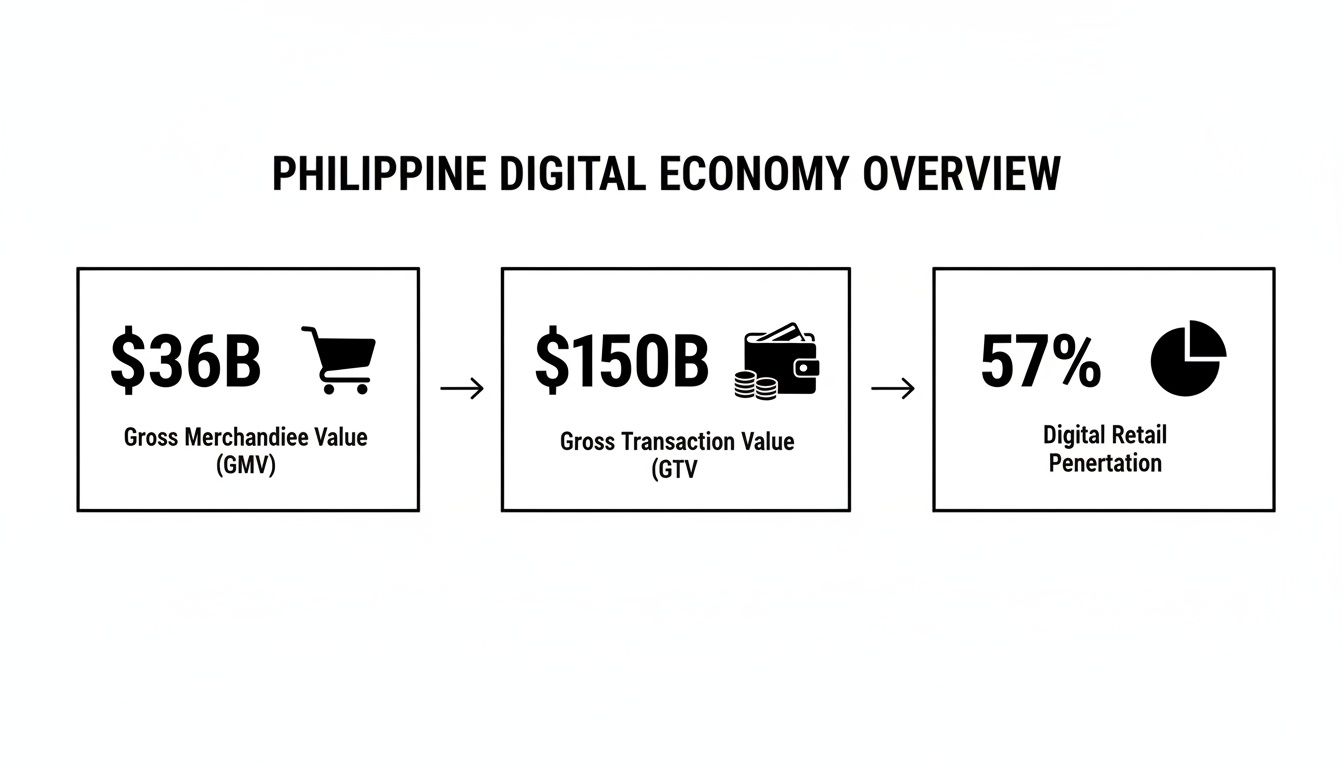
The data confirms it: your customers are already living in the future. The real question is whether your business has the technology to meet them there.
For any organisation looking to scale without sinking huge amounts of cash into hardware, this new reality creates an immediate need for flexible IT solutions. Things like managed services and expert consultancy become critical to ensure your infrastructure can handle the load and keep customer data safe.
Bridging the Business Technology Adoption Gap
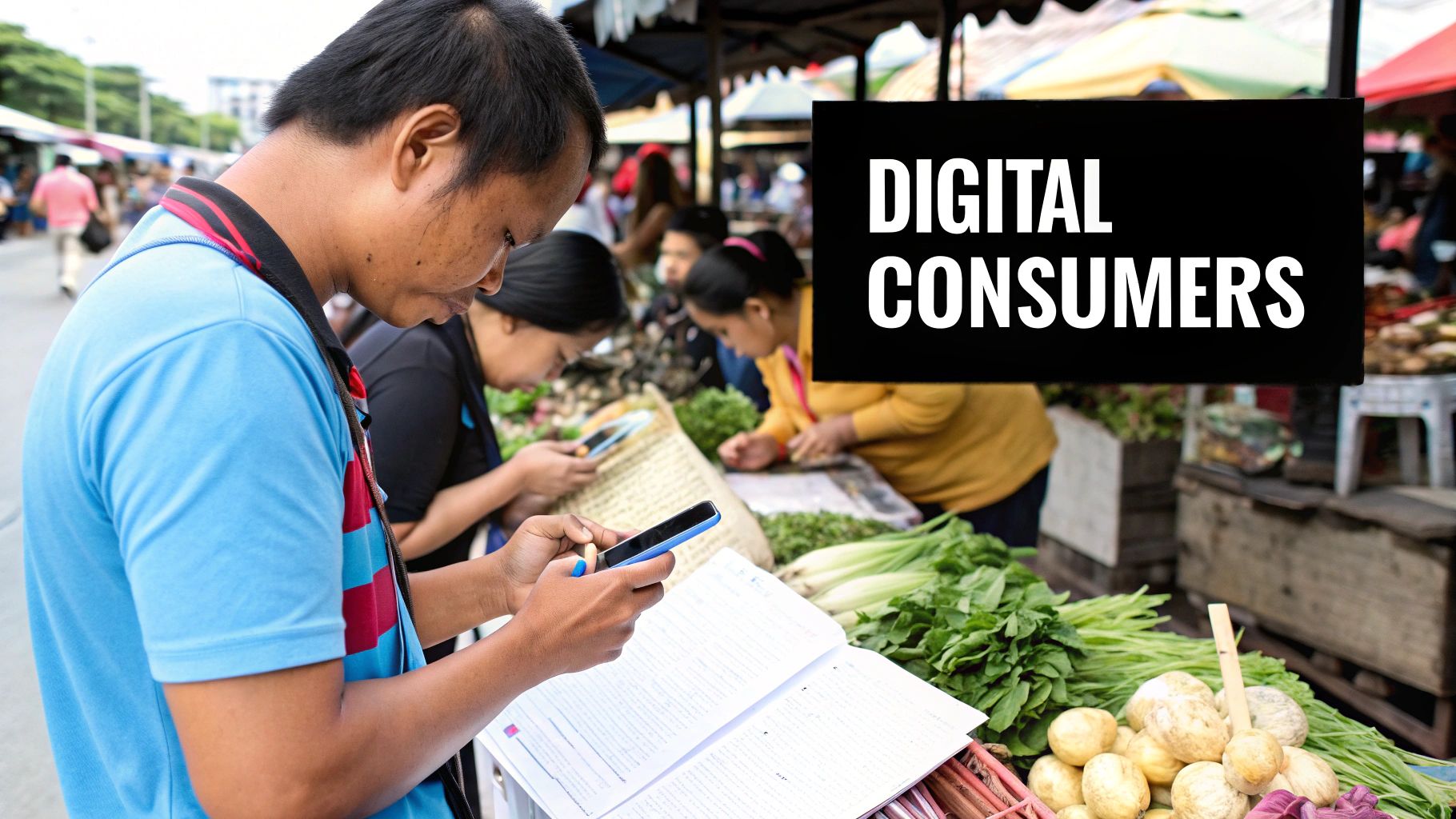
While Filipino consumers are living in the digital fast lane, many local businesses are still trying to figure out how to start the engine. There's a noticeable disconnect between how people use technology in their daily lives and how many companies are running their operations. This isn't just a minor issue; it's a gap that separates what customers expect from what businesses can actually deliver.
Think about a popular local food delivery app. The GrabFood riders zip around the city on their motorcycles, smartphones guiding them to the customer's doorstep. It all looks incredibly modern. But back at the restaurant's kitchen, the staff might be struggling with an old tablet that keeps disconnecting from the Wi-Fi, causing missed orders and delays. The part the customer sees looks great, but the internal engine is sputtering.
This scenario perfectly illustrates the reality of technology in the Philippines for a lot of companies. They see the demand from their tech-savvy customers but are stuck with internal systems that can't keep up.
Why Are Businesses Lagging Behind?
The reasons for this gap aren't some big secret. They’re the real-world, everyday problems that business owners across the country know all too well. The hurdles are usually financial and operational, making the jump to modern tech feel like an impossible leap.
Here are the most common roadblocks:
- High Upfront Costs: Buying new servers, a fleet of enterprise-grade laptops, and the right networking hardware requires a huge cash outlay. For a small cafe, buying a modern Point-of-Sale system for ₱50,000 can feel like a massive, unaffordable expense.
- Shortage of Skilled IT Staff: Good IT talent is hard to find and even harder to afford. A medium-sized retail business might know they need a network administrator, but can't justify the ₱60,000+ monthly salary.
- Persistent Cybersecurity Worries: As you go digital, the risk of data breaches, ransomware, and other cyberattacks skyrockets. Without a dedicated security team, many owners feel dangerously exposed after hearing stories of local businesses being locked out of their data by hackers demanding payment.
These challenges create a vicious cycle. Business owners know they need to upgrade their tech, but the costs and complexity are paralysing. So, they wait, falling further behind what their customers demand.
This isn't just an interesting observation—it's a critical business risk. When your internal technology can't match the speed and efficiency your customers now expect as standard, you are losing ground to competitors who have already made the investment.
The Rise of IT-as-a-Service Solutions
Fortunately, there’s a new way forward that’s helping businesses close this gap. IT-as-a-Service (ITaaS) completely changes the conversation by shifting the model from owning technology to simply using it. It’s a practical approach that directly solves the problems holding businesses back.
For instance, instead of buying expensive servers, hardware leasing lets a company get the equipment it needs for a predictable monthly fee. The massive upfront cost disappears, and you're no longer stuck with outdated hardware in a few years.
Likewise, managed IT support gives you an entire team of experts for less than the cost of one in-house hire. This service handles everything from network monitoring to cybersecurity, letting business owners focus on their actual business. It's telling that despite high consumer tech use, less than 15% of Philippine businesses use advanced tools like AI, largely because of these cost and expertise barriers. You can read more about the state of AI in the Philippines and the factors limiting its adoption.
By turning technology into a flexible operational expense instead of a rigid capital one, ITaaS gives businesses the bridge they need to finally catch up to their customers.
Building Your Essential IT Infrastructure

Okay, so we've identified the challenges. Now, how do we actually start building a solution? A strong IT setup isn't about having the flashiest gadgets; it's about laying a dependable foundation that actually helps you hit your business goals. For any company in the Philippines wanting to stay competitive, this foundation rests on three crucial pillars: reliable connectivity, capable hardware, and solid security.
Think of it like building a house. You wouldn't dream of putting up walls before pouring a solid concrete foundation. In the business world, you can't run things efficiently if your team is constantly fighting slow internet, crashing computers, or fending off security threats.
Getting these fundamentals right is the first real step toward closing the technology gap and giving your customers the experience they expect. Let's break down each pillar with some real-world examples that highlight the difference between just getting by and truly thriving.
The Lifeline of Connectivity
Let's be honest, poor connectivity is one of the most common and damaging issues for businesses here. It’s the digital equivalent of having a faulty phone line—infuriating for employees and a total deal-breaker for customers. That cheap, consumer-grade Wi-Fi router might seem okay for a tiny team, but as you grow, the cracks will start to show.
Imagine a 10-person design agency sharing a basic home internet plan. During a critical video presentation to a client, the connection drops. Large design files take an eternity to download. Uploading the final project to the client's server grinds to a halt. Now, contrast that with a 100-seat call centre that invested in professionally designed and structured network cabling.
This professional setup guarantees every agent has a stable, high-speed connection for crystal-clear VoIP calls and instant access to customer data. The difference isn't just about speed; it's about operational continuity and professionalism.
Hardware That Empowers Your Team
The second pillar is the actual gear your team uses day in and day out. Outdated hardware is a silent productivity killer. A computer that takes five minutes just to boot up or constantly freezes doesn't just waste time—it drains morale and creates a massive bottleneck in your workflow.
Consider a startup trying to cut corners by buying second-hand, mismatched laptops from Gilmore. What they get is a support nightmare. Their IT person (if they're lucky enough to have one) spends all day troubleshooting different models, dealing with dead batteries, and trying to secure devices that the manufacturer no longer even supports.
Now, picture that same startup using a hardware leasing service. For a predictable monthly fee, every team member gets a new, standardised, business-grade laptop. The benefits are immediate:
- Productivity Soars: Faster processors and more RAM mean less waiting and more doing.
- Support is Simplified: With uniform models, troubleshooting and updates become a breeze.
- Cash Flow is Protected: There's no massive upfront investment, which frees up precious capital for growth.
This approach flips the script, turning hardware from a costly headache into a flexible tool that directly boosts your team's output.
Security as a Non-Negotiable Foundation
Finally, strong security is the pillar that protects everything else you've built. In a world where your data is as good as currency, overlooking security is like leaving the front door of your office wide open overnight. So many small businesses make the mistake of thinking, "We're too small to be a target." That's a dangerous assumption.
A simple password like "Admin123" on your main office server is practically a welcome mat for cybercriminals. In contrast, a professionally configured business-grade firewall, combined with multi-factor authentication, acts as a vigilant security guard, actively monitoring and blocking suspicious traffic before it can do any harm.
Proper security isn't just about preventing theft; it's about building trust with your customers and ensuring your business isn't crippled by an attack. This is where managed IT services become invaluable, providing the deep expertise needed to properly secure your network. It's also a field with expanding career paths; you can get a better sense of this by looking into available information technology help desk jobs.
Smart Tech Solutions for Key Philippine Industries
A cookie-cutter approach to IT just doesn't work. Every industry operates under unique pressures, and the tech that keeps a creative agency humming would quickly buckle under the weight of a high-volume call centre. Knowing these specific needs is the real secret to building smart, effective technology solutions that fix problems instead of causing new ones.
This is especially true for technology in the Philippines, where businesses across the board are all trying to modernise at the same time. From the breakneck pace of the BPO world to the guest-first focus of the hospitality sector, each has its own set of IT headaches that demand a specialised strategy. The right partner won't just sell you a box; they'll get to know your workflow and build a solution that fits.
Let's dive into a few real-world scenarios to see exactly how this plays out. Think of these as mini-case studies, showing how the right IT services solve very specific, very real industry pain points.
BPOs and Call Centres: The Need for Speed and Scale
Business Process Outsourcing is a titan of the Philippine economy, and its success is built on agility. Picture this: a BPO in Cebu IT Park lands a huge new client. The great news is they need to hire 200 agents. The challenge? They need to be up and running in two weeks.
That’s a massive logistical nightmare. Buying, setting up, and deploying 200 workstations is a huge cash drain and an impossibly tight timeline for most in-house teams. This is where a combination of hardware leasing and rapid deployment services changes the game completely. Instead of buying, the BPO simply leases the exact number of business-grade desktops or laptops it needs.
An expert IT team can then get all 200 units deployed, loaded with the right software, and secured well within that two-week deadline. This strategy turns a crippling capital expense into a predictable operational cost, giving the BPO the power to scale up or down as contracts change, without getting stuck with a warehouse full of dusty, unused PCs.
Hotels and Hospitality: Seamless Guest Connectivity
In the hotel business, the guest experience is king. Imagine a 500-room hotel in Boracay. Its single biggest IT challenge is delivering flawless, high-speed Wi-Fi to every guest, everywhere on the property—from the lobby bar to the rooftop pool to their room on the top floor. One bad review on TripAdvisor about a spotty connection can do serious damage to their reputation.
The fix here isn't as simple as buying a few more routers off the shelf. It requires professional network design and Wi-Fi optimisation. A proper IT partner starts with a site survey, mapping out signal dead zones, figuring out the best placement for every access point, and configuring the network to handle hundreds of people logging on at once without grinding to a halt.
This strategic approach ensures that every guest—whether it's a business traveller on a critical video call or a family streaming cartoons—gets a rock-solid connection. It turns Wi-Fi from a potential source of frustration into a seamless, invisible part of a premium guest experience.
Startups and SMEs: Enterprise Power on a Budget
Startups run lean but dream big. A new software development startup in BGC needs to equip its team of ten programmers with high-performance laptops, but dropping ₱500,000 on hardware upfront is completely out of the question. They need enterprise-grade power to even compete, but their cash flow can't handle that kind of hit.
This is the perfect use case for a flexible rent-to-own or leasing programme. The startup can get its entire team the powerful machines they need for a manageable monthly payment, freeing up precious capital for essentials like marketing and hiring more talent.
When you bundle this with managed IT support, the startup gets expert help on demand without the high cost of an in-house IT department. This savvy financial move gives them access to the same calibre of technology as a huge corporation, effectively levelling the playing field so they can focus on what they do best: innovate.
Remote and Hybrid Teams: Secure Support, Anywhere
The massive shift to remote work has introduced a whole new set of IT headaches. A company with 50 employees working from their homes across Luzon, Visayas, and Mindanao has a big problem: how do you keep everyone secure and productive? What happens when a laptop dies and the employee lives in a remote province?
The answer lies in a comprehensive remote support solution. This isn't just one thing, but a system that includes:
- Work-From-Home PC Deployment: Shipping pre-configured, security-hardened laptops directly to employees' doorsteps.
- Remote Helpdesk Support: Having on-call tech experts ready to troubleshoot issues, no matter where an employee is.
- Hardware Retrieval: A clear, organised process for getting company assets back when an employee moves on.
This kind of organised system ensures that remote work doesn't mean disconnected or insecure work. It's proof that a distributed workforce can be just as efficient as an in-office one, as long as the right IT backbone is in place.
Matching IT Services to Business Needs
To make things even clearer, let's break down how specific IT solutions directly address the common frustrations felt by different business sectors in the Philippines.
| Business Sector | Common IT Challenge | Recommended IT Solution |
|---|---|---|
| BPOs & Call Centres | Rapidly scaling workforce up or down for new client projects. | Hardware Leasing & Rapid Deployment |
| Hotels & Hospitality | Poor Wi-Fi coverage leading to negative guest reviews. | Professional Network Design & Wi-Fi Optimisation |
| Startups & SMEs | Needing powerful computers without the large upfront capital. | Hardware Leasing or Rent-to-Own Programmes |
| Remote/Hybrid Teams | Providing secure IT support to a geographically scattered team. | Managed IT Services & Remote Support Helpdesk |
| Retail & E-commerce | Protecting sensitive customer data from cyber threats. | Security Hardening & Managed Security Services |
Ultimately, the goal is to stop thinking of IT as just a cost and start seeing it as a strategic tool that directly enables growth, efficiency, and security for your specific business.
Preparing for the Next Wave of Technology
When you hear terms like Artificial Intelligence (AI) and automation, what comes to mind? For many business owners in the Philippines, it sounds like something reserved for massive global corporations—expensive, complicated, and a bit like science fiction. But that perception is quickly becoming outdated.
The reality is that these powerful tools are now more accessible and practical than ever. We need to cut through the hype and look at what they actually do. This isn't about building armies of robots to take over your company. It's about using smart software to work more efficiently, understand your customers on a deeper level, and make better, data-backed decisions.
Making AI and Automation Work for You
So, what does this actually look like on the ground? Let's forget the abstract buzzwords and look at a couple of real-world scenarios that are already helping businesses across the country.
For a Retail Business: Picture a local clothing shop in Greenhills trying to decide what to stock for the next season. Instead of just going with gut instinct, they could use a simple AI tool to scan their past sales data. The system could instantly pinpoint that blue shirts sold best on weekends in December, and even predict that demand for formal wear will spike before graduation season. That’s not magic—it's just smart business, helping them reduce unsold inventory and increase profit.
For a Logistics Company: A delivery service navigating the chaos of Metro Manila traffic has a daily battle against the clock. An automation system can plan the most efficient delivery routes in real-time, instantly adjusting for a sudden traffic jam on EDSA, road closures for a fiesta, and specific delivery time windows. The result? More packages delivered in less time, lower fuel costs, and happier customers.
These examples prove that AI and automation are really about solving very specific, practical problems. They're tools designed to help you get more value out of the people and resources you already have.
The Foundation Must Come First
Here’s the single most important thing to remember: you can't leap into advanced technology without a solid IT foundation. Trying to run a sophisticated data analysis tool on an unreliable network is like trying to build a skyscraper on sand. It's doomed from the start.
Before you even think about implementing AI, you have to get the basics right. Your core infrastructure must be stable, secure, and dependable. This is the non-negotiable first step that makes everything else possible.
Before your business can handle the demands of these next-generation tools, you need to have your fundamentals locked down. That means having:
- A Stable Network: Your connection needs to handle a lot more data without slowing to a crawl or constantly dropping out.
- Reliable Hardware: Your computers and servers must be up to the task of running modern software without freezing up every other hour.
- Secure Data: Advanced tools run on your business data. That information is gold, and it needs to be protected with rock-solid security, like properly configured firewalls and strict access controls.
Without these essentials in place, any money you spend on AI or automation is simply money wasted. A good IT partner doesn't just sell you the latest gadgets; they build this critical groundwork first, ensuring that when you're ready to innovate, you're building on solid rock.
How to Choose the Right IT Partner in the Philippines
Knowing what your business needs is one thing, but finding the right technology partner is what actually brings that vision to life. In a market as dynamic as the Philippines, your IT provider isn't just another vendor. They're your guide, your support system, and a critical piece of your company's growth. The real goal is to find a partner who solves your problems, not just sells you products.
Don't rush this decision. Picking the wrong provider can saddle you with expensive downtime, glaring security holes, and technology that frustrates your team instead of helping them. The right partner, on the other hand, feels like an extension of your own team—proactively managing your systems and offering advice that actually helps you hit your business goals.
Key Factors to Evaluate in an IT Provider
When you're looking at potential partners, you have to look past the price tag and see what they can really do. A cheap solution that keeps breaking down is far more expensive in the long run. Use these points as a real-world checklist to make sure you're making a smart choice for your company's future.
Your evaluation should really zero in on their ability to deliver real results and support the way you actually operate.
- Proven Local Experience: Have they actually worked with businesses like yours—your size, your industry—right here in the Philippines? Ask for case studies or client names you can talk to. A provider who knows the local scene will already understand common headaches like unpredictable internet from PLDT or Globe and logistical snags in provincial areas.
- On-Site and Remote Support: A helpdesk on the other end of a phone line isn't enough. Your partner must be able to provide on-site technical support when a server dies in your Makati office or a network goes down and you need someone physically there to fix it. This is non-negotiable if you want to keep disruptions to a minimum.
- Flexible Financial Models: Look for partners that offer more than just a "buy it now" option. Things like hardware leasing or rent-to-own programmes are absolute lifesavers for managing cash flow, especially for startups and small businesses. This kind of flexibility gives you access to top-tier technology without a massive upfront cost.
Asking the Right Questions Before You Commit
Once you have a shortlist, the questions you ask will tell you everything you need to know about their service. You need to dig deeper than their slick marketing brochures and find out how they handle things when they go wrong. This is how you separate a true partner from a simple box-pusher.
For businesses that rely on distributed teams, working with reputable virtual assistant companies in the Philippines can be a game-changer, and your IT partner needs to have the chops to support that kind of setup securely.
A truly valuable IT partner doesn't just respond to trouble tickets; they work to prevent problems from happening in the first place. Their value is measured in uptime and efficiency, not just how quickly they can fix something that’s already broken.
Try asking them these direct questions:
- What is your standard procedure for a major network outage?
- How do you secure and manage devices for a remote workforce?
- Can you provide a detailed plan for scaling our infrastructure as we grow?
Their answers will give you a crystal-clear picture of their expertise and commitment, helping you choose a partner that will genuinely help your business succeed.
Have Questions? We Have Answers.
Thinking about upgrading your business tech in the Philippines can feel overwhelming. Let’s cut through the noise and tackle some of the most common questions business owners like you are asking. Here are some straightforward answers to help you map out your next move.
Why Should I Lease Equipment Instead of Buying It?
Leasing is often a much smarter play than buying, especially for businesses that need to stay nimble. Buying a whole new set of computers is like paying for a fleet of company cars upfront—it’s a massive cash drain for an asset that starts losing value the second you use it.
Leasing, on the other hand, works like a subscription. You get all the high-performance gear you need for a predictable monthly fee.
- Protect Your Cash Flow: Instead of a huge capital expense, you get a manageable operational cost. That frees up money you can put into what really grows your business, like marketing or hiring top talent.
- Stay Ahead of the Curve: Tech moves fast. A laptop that's top-of-the-line today might be sluggish in two years. Leasing lets you upgrade to the latest models on a regular cycle, so your team is never held back by outdated tools.
- No More Maintenance Headaches: Good leasing agreements usually include support and maintenance. When something goes wrong, you just make a call. You're not stuck trying to find a reliable repair shop or dealing with warranty claims.
Imagine a BPO startup that needs 20 powerful laptops for its new team. Buying them could easily cost over ₱1,000,000. By leasing, they can get the same equipment for a fixed monthly payment of around ₱50,000, keeping their precious capital in the bank.
What Does a Managed IT Service Actually Do?
Think of a managed IT service as your on-demand, expert technology department. Instead of the cost and complexity of hiring an in-house IT team, you partner with a company that handles everything for you. Their entire job is to keep your systems running smoothly so you can focus on your business.
A great managed IT provider is proactive, not reactive. They aren't just waiting for a help ticket. They're constantly monitoring your network, patching vulnerabilities, and making sure everything is optimised. The goal is for your tech to work so well, you barely notice it’s there.
For a small hotel in Palawan, for example, a managed service provider would do it all: keep the guest Wi-Fi blazing fast, secure the online booking system from hackers, and make sure the front desk PCs are always working. If a computer dies at 2 AM during check-in, the hotel manager has a 24/7 helpdesk to call—not an employee they have to wake up.
How Can I Make Sure My Business Data Is Secure?
Good data security isn't about buying one piece of software; it's about building layers of defence. The first and most critical step is to accept that every business, no matter its size, is a target. From there, you can take practical steps to protect yourself.
Here are three things you can do right away:
- Get a Business-Grade Firewall: This is the digital bouncer for your network. It stands at the door, inspecting traffic and blocking anything—or anyone—that looks suspicious.
- Use Multi-Factor Authentication (MFA): Passwords get stolen. It happens all the time. MFA adds a simple but powerful second step, like a one-time code sent to your phone via SMS, making it incredibly difficult for criminals to access your accounts even if they have your password.
- Train Your People: The biggest security risk is often human error. Teaching your team how to spot a phishing email (like a fake BDO alert asking for their password) or avoid clicking on a suspicious link is one of the most effective security investments you can make.
Ready to build a resilient and efficient IT foundation for your business? The experts at REDCHIP IT SOLUTIONS INC. specialise in providing practical, business-ready technology services across the Philippines, from flexible hardware leasing to comprehensive managed IT support. Learn more on the REDCHIP website.
Article created using Outrank


